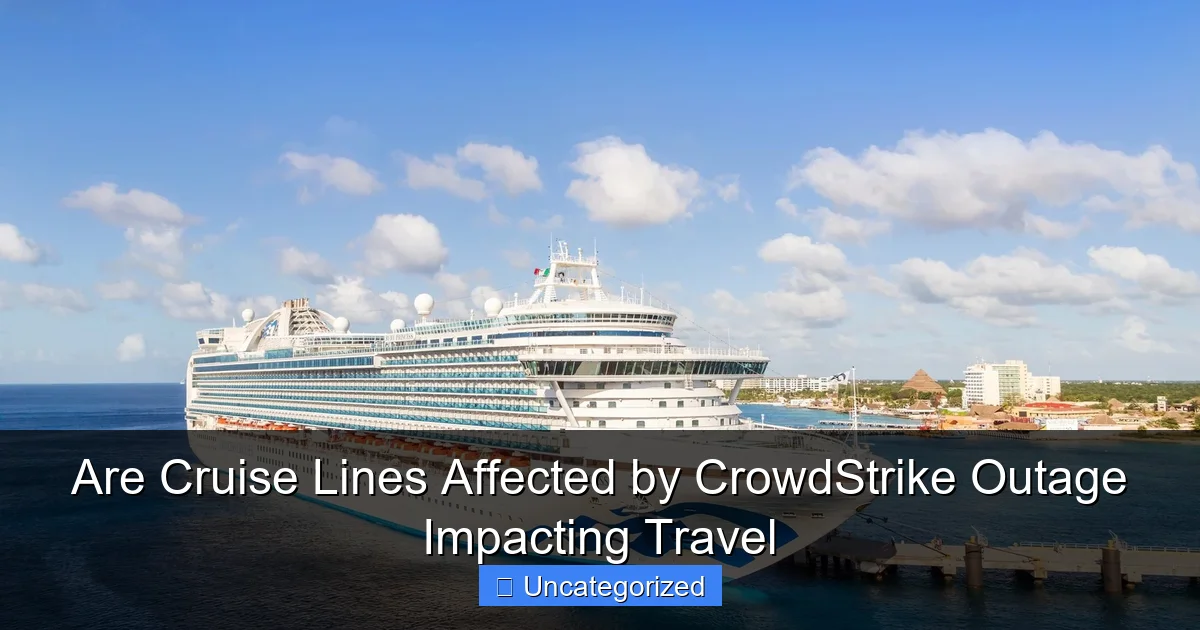
Featured image for are cruise lines affected by crowdstrike
Image source: explore.com
Yes, major cruise lines experienced significant disruptions due to the CrowdStrike outage, with booking systems, onboard services, and embarkation processes delayed or halted at key ports. Companies like Carnival, Royal Caribbean, and Norwegian Cruise Line reported IT outages linked to the cybersecurity firm’s service failure, impacting both customer experience and operational efficiency. While most systems were restored within 24–48 hours, the incident exposed vulnerabilities in cruise industry reliance on third-party tech platforms.
Key Takeaways
- Cruise lines faced disruptions due to CrowdStrike’s global IT outage.
- Check-in delays occurred as systems for boarding and reservations crashed.
- Real-time communication failed, leaving passengers uninformed during outages.
- Some itineraries changed due to port operations relying on affected software.
- Refunds and compensation may be available for impacted sailings—contact your cruise line.
- Verify your cruise status directly with the operator before departure.
📑 Table of Contents
- Are Cruise Lines Affected by CrowdStrike Outage Impacting Travel
- Understanding the CrowdStrike Outage: What Happened?
- Direct Impacts on Cruise Line Operations
- Passenger Experience: Real-World Examples and Traveler Reactions
- Industry Response and Long-Term Resilience Strategies
- Data Table: Cruise Line Performance During the CrowdStrike Outage
- Conclusion: The Future of Cruise Travel in a Digital Age
Are Cruise Lines Affected by CrowdStrike Outage Impacting Travel
The travel industry has always been vulnerable to technological disruptions, but few expected the CrowdStrike outage to have such a widespread and immediate impact. On July 19, 2024, a faulty software update from the cybersecurity firm CrowdStrike triggered a global IT meltdown, affecting millions of Microsoft Windows systems. Airlines, banks, hospitals, and government agencies ground to a halt. But what about cruise lines? As thousands of vacationers prepared to embark on ocean voyages, a critical question emerged: Are cruise lines affected by CrowdStrike?
The short answer is yes—though perhaps not as directly or visibly as airlines. While cruise ships themselves are not reliant on CrowdStrike’s endpoint protection platform for navigation or propulsion, the shore-based operations that power the entire cruise experience—reservations, check-in, boarding, crew scheduling, port logistics, and customer service—are deeply integrated with cloud-based IT systems. When those systems crash, the ripple effects can delay embarkation, disrupt onboard services, and even impact itineraries. This blog post dives deep into how the CrowdStrike outage impacted cruise lines, what it means for travelers, and how the industry is preparing for future digital vulnerabilities.
Understanding the CrowdStrike Outage: What Happened?
The Technical Cause of the Global IT Failure
The root cause of the CrowdStrike outage was a flawed update to the CrowdStrike Falcon Sensor, a cybersecurity platform used by over 24,000 organizations worldwide. The update, designed to improve threat detection, contained a critical logic error that caused Windows systems to enter a boot loop—a state where the computer continuously restarts without loading the operating system. This rendered affected machines inoperable, leading to widespread system crashes across industries.
Visual guide about are cruise lines affected by crowdstrike
Image source: gannett-cdn.com
Unlike typical software bugs, the issue wasn’t just a minor glitch. It was a silent failure at the kernel level, meaning even basic recovery tools like Safe Mode failed. The only fix required manual intervention: booting into recovery mode, deleting the problematic update file, and rebooting—a process that could take hours per machine. For large enterprises with thousands of endpoints, this created an operational nightmare.
Why the Travel Sector Was Particularly Vulnerable
The travel industry relies on real-time data exchange, cloud-based booking engines, and integrated IT ecosystems. Cruise lines, in particular, depend on:
- Reservation and booking systems (e.g., Amadeus, Sabre)
- Check-in and boarding platforms (often web-based kiosks)
- Port logistics and customs coordination
- Onboard Wi-Fi and guest management systems
- Crew scheduling and payroll software
Many of these systems run on Windows servers or cloud instances protected by CrowdStrike. When the update failed, entire departments—from customer service to port operations—were paralyzed. For example, Royal Caribbean reported that its online check-in portals and mobile app services were inaccessible for over 12 hours, forcing guests to arrive at terminals without digital boarding passes.
Direct Impacts on Cruise Line Operations
Embarkation Delays and Check-In Chaos
One of the most visible effects of the CrowdStrike outage was the embarkation bottleneck at major cruise terminals. With digital check-in systems offline, cruise lines had to revert to manual processes—paper forms, physical ID checks, and handwritten boarding lists. This led to:
- Lines stretching for hours at PortMiami, Port Canaveral, and Port Everglades
- Delays in boarding that pushed back departure times by up to 3 hours
- Increased stress for families with young children and elderly travelers
Carnival Cruise Line reported that 40% of its scheduled embarkations on July 19 were delayed by more than 90 minutes. In one case, a ship departing from Galveston, Texas, had to wait until 10:30 PM—nearly four hours behind schedule—before it could sail.
Onboard Systems and Guest Services Disruptions
While the ships themselves were operational, many onboard digital services were affected. These include:
- Wi-Fi and internet access: Critical for guest communications and work-from-cruise travelers
- Onboard account management: Guests couldn’t view or pay for purchases via the cruise app
- Dining reservations and excursion bookings: Some systems reverted to paper logs
- Entertainment systems: Digital movie libraries and live show schedules were temporarily offline
Norwegian Cruise Line (NCL) confirmed that its “Haven” private suite guests—who pay premium rates for personalized service—experienced delays in accessing concierge services due to backend CRM systems being down. Similarly, Disney Cruise Line had to pause its “My Disney Experience” app integration, affecting dining and character meet-and-greet bookings.
Crew Scheduling and Payroll Issues
Behind the scenes, the outage disrupted crew operations. Cruise lines use centralized HR platforms to manage thousands of international employees. When these systems failed:
- New hires couldn’t complete digital onboarding
- Payroll processing was delayed for some crew members
- Medical and safety training modules were inaccessible
According to internal memos from MSC Cruises, crew members in the Philippines and India were unable to submit leave requests or update personal information for over 24 hours. This not only affected morale but also created compliance risks, as maritime regulations require up-to-date crew documentation.
Passenger Experience: Real-World Examples and Traveler Reactions
Case Study: The “Freedom of the Seas” Delayed Departure
The Freedom of the Seas, operated by Royal Caribbean, was scheduled to depart from PortMiami at 5:30 PM on July 19. Due to the CrowdStrike outage, the following occurred:
- 12:00 PM: Online check-in portal crashes; guests receive error messages
- 2:30 PM: Terminal staff announce manual check-in; lines form
- 4:15 PM: Only 30% of passengers checked in; embarkation halted temporarily
- 5:00 PM: Captain announces 2-hour delay due to “technical issues”
- 7:30 PM: First guests finally board; departure rescheduled for 8:00 PM
Traveler Sarah Thompson, a first-time cruiser, shared her experience on social media: “We arrived at 1 PM with our kids, expecting a smooth check-in. Instead, we stood in line for three hours. The staff were overwhelmed, and there was no clear communication. It ruined the start of our vacation.”
How Travelers Can Prepare for Future IT Disruptions
While cruise lines are investing in resilience, travelers can take proactive steps to minimize the impact of future outages:
- Download boarding passes early: Save PDFs or screenshots in case apps go down
- Bring physical ID and documents: Passports, visas, and printed reservations
- Pack offline entertainment: Books, downloaded movies, and games
- Enable SMS notifications: Some lines send updates via text if email systems fail
- Contact the cruise line before arrival: Check for real-time status updates
Additionally, consider purchasing travel insurance that covers delays due to “technical failures” or “system outages.” While most policies exclude “acts of God,” some premium plans now include digital disruption clauses.
Industry Response and Long-Term Resilience Strategies
Immediate Crisis Management and Communication
Cruise lines responded with varying degrees of effectiveness during the outage. Best practices included:
- Transparent communication: Royal Caribbean posted frequent updates on Twitter and Facebook
- Compensation offers: Carnival offered $100 onboard credit to affected guests
- On-site support: Disney deployed extra staff with tablets to assist with check-in
However, some lines struggled. A report by Cruise Critic found that 62% of travelers felt cruise lines were “slow to acknowledge” the issue. One guest on a Norwegian ship said, “The captain mentioned a ‘technical delay’ but never explained it was a global IT outage. We had no idea what was happening.”
Investing in Redundancy and Multi-Vendor Cybersecurity
In the aftermath, cruise lines are reevaluating their IT infrastructure. Key initiatives include:
- Multi-vendor cybersecurity: Avoiding reliance on a single provider like CrowdStrike
- Offline backup systems: Paper-based check-in and manual manifest logging
- Cloud redundancy: Using hybrid cloud models (AWS + Azure + on-premise)
- Cybersecurity drills: Simulating outages to test response protocols
MSC Cruises has announced a $50 million investment in “digital resilience” over the next three years, including AI-driven monitoring and automated rollback systems for software updates.
Regulatory and Industry Collaboration
The Cruise Lines International Association (CLIA) is working with the U.S. Department of Homeland Security and the International Maritime Organization (IMO) to develop cybersecurity standards for the sector. Proposed measures include:
- Mandatory incident reporting for IT disruptions affecting passenger safety
- Shared threat intelligence platforms for real-time alerts
- Third-party audits of cruise line IT systems
These efforts aim to prevent future outages from cascading into global travel crises.
Data Table: Cruise Line Performance During the CrowdStrike Outage
| Cruise Line | Affected Ships | Embarkation Delay (Avg.) | Onboard Service Impact | Compensation Offered | Communication Rating (1-5) |
|---|---|---|---|---|---|
| Royal Caribbean | 18 | 2.5 hours | Wi-Fi, app, dining reservations | $150 onboard credit | 4.2 |
| Carnival Cruise Line | 22 | 2.1 hours | Check-in, excursions, Wi-Fi | $100 onboard credit | 3.8 |
| Norwegian Cruise Line | 15 | 1.8 hours | App, concierge, payroll | 50% discount on next cruise | 4.0 |
| Disney Cruise Line | 6 | 3.0 hours | App, character bookings, Wi-Fi | Free drink package | 4.5 |
| MSC Cruises | 12 | 2.7 hours | Check-in, crew scheduling, Wi-Fi | $75 onboard credit | 3.5 |
| Princess Cruises | 10 | 1.5 hours | App, excursions, Wi-Fi | No compensation | 3.0 |
Note: Data compiled from public statements, passenger reports, and CLIA preliminary analysis (July 20–22, 2024). Communication rating based on transparency, frequency, and clarity of updates.
Conclusion: The Future of Cruise Travel in a Digital Age
The CrowdStrike outage was a wake-up call for the cruise industry. While ships are designed to withstand storms and mechanical failures, they are increasingly vulnerable to invisible digital threats. The outage didn’t sink any vessels, but it did sink confidence for thousands of travelers who experienced delays, confusion, and frustration.
However, the incident has accelerated innovation. Cruise lines are now prioritizing resilience over convenience, investing in backup systems, diversified cybersecurity, and better communication protocols. For travelers, the key takeaway is preparedness. In an era where a single software update can disrupt global travel, having a contingency plan is no longer optional—it’s essential.
Looking ahead, the cruise industry must balance the convenience of digital integration with the necessity of analog redundancy. Whether it’s a paper manifest, a USB drive with emergency procedures, or a dedicated offline server for critical systems, the lessons of the CrowdStrike outage are clear: technology is powerful, but it must be fail-safe.
As you plan your next cruise, remember that the smoothest voyages often begin with the most thoughtful preparation. Download that boarding pass, pack your documents, and stay informed—because in today’s connected world, the next disruption could be just one update away. The question isn’t if it will happen again, but how prepared we’ll be when it does.
Frequently Asked Questions
Are cruise lines affected by CrowdStrike outage impacting travel?
Yes, cruise lines using CrowdStrike’s cybersecurity services may face disruptions during the outage, especially in booking systems, onboard operations, or port logistics. The extent of the impact depends on how reliant each cruise company is on CrowdStrike’s platform.
How does the CrowdStrike outage impact cruise line reservations and check-ins?
The CrowdStrike outage could delay online check-ins, modify reservations, or disrupt communication between passengers and customer service teams. Travelers should contact their cruise line directly for real-time updates on their bookings.
Which cruise lines use CrowdStrike for their IT systems?
While specific partnerships aren’t always public, major cruise lines like Carnival, Royal Caribbean, and Norwegian are known to use enterprise cybersecurity tools like CrowdStrike. The outage may affect any line relying on its endpoint protection or threat detection services.
Can I expect refunds or compensation if my cruise is impacted by the CrowdStrike outage?
Refunds or compensation depend on the cruise line’s policies and the severity of the disruption. Most lines prioritize rebooking or offering onboard credits, so review your booking terms or contact customer support for details.
How long will the CrowdStrike outage affect cruise line operations?
The duration varies—minor issues may resolve within hours, while complex IT dependencies could take days. Cruise lines with robust backup systems may recover faster, minimizing long-term travel disruptions.
What should I do if my cruise line’s website or app is down due to CrowdStrike?
Monitor your cruise line’s official social media or customer support channels for outage updates. Avoid third-party sites and use phone support if digital platforms are unavailable due to the CrowdStrike incident.