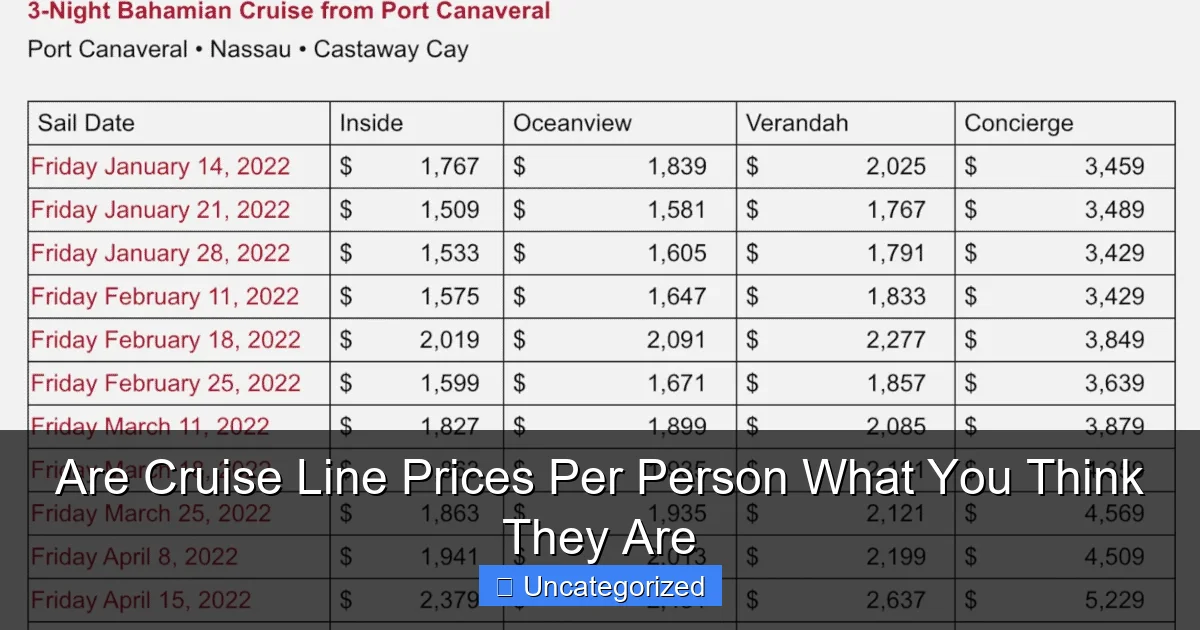
Featured image for are cruise line prices per person
Image source: insidethemagic.net
Cruise line prices listed as “per person” can be misleading—they often exclude hidden fees like port charges, taxes, and gratuities, which can inflate your final cost by 20% or more. Always read the fine print to uncover the true total price and avoid budget surprises before booking your voyage.
Key Takeaways
- Cruise prices are per person but double-check for solo traveler fees.
- Double occupancy rates mean two people share a cabin; adjust budgets accordingly.
- Always read the fine print for hidden costs like port fees and taxes.
- Book early for discounts but compare last-minute deals for better savings.
- All-inclusive options vary—confirm what’s covered in your fare before booking.
- Group bookings save money with perks like free cabins or onboard credit.
📑 Table of Contents
- Are Cruise Line Prices Per Person What You Think They Are?
- Understanding the “Per Person” Pricing Model
- Hidden Fees and Add-Ons That Inflate the Total Cost
- How Cabin Type and Occupancy Affect Pricing
- Seasonal and Promotional Pricing Strategies
- How to Decode Cruise Pricing and Avoid Surprises
- Conclusion
Are Cruise Line Prices Per Person What You Think They Are?
Imagine this: you’re browsing cruise deals, excited about a tropical getaway, and stumble upon a price that seems too good to be true—just $399 per person for a seven-night Caribbean cruise. You click through, dreaming of white-sand beaches, all-inclusive buffets, and poolside cocktails. But when you reach checkout, the total is suddenly double what you expected. Sound familiar? If you’ve ever felt blindsided by cruise pricing, you’re not alone. The question “are cruise line prices per person” isn’t as straightforward as it seems, and understanding the nuances can save you hundreds—or even thousands—of dollars on your next vacation.
Cruise pricing is a complex ecosystem of base rates, hidden fees, add-ons, and marketing strategies designed to attract your attention. The industry standard of advertising prices per person is meant to make cruises appear affordable, but it often masks the true cost of a trip. What starts as a seemingly low rate can balloon due to taxes, port fees, gratuities, and optional extras. In this guide, we’ll peel back the layers of cruise pricing, decode the fine print, and arm you with the knowledge to book smarter. Whether you’re a first-time cruiser or a seasoned sailor, understanding how cruise line pricing works is the key to getting the best value for your money.
Understanding the “Per Person” Pricing Model
How Base Cruise Fares Are Structured
When you see a cruise advertised at “$499 per person,” this refers to the base fare—the cost of your stateroom divided by the number of occupants. Most cruise lines use a double occupancy model, meaning the advertised price assumes two people sharing a cabin. For example, a $499 per person rate for a balcony room totals $998 for the cabin. This model allows cruise lines to market lower prices, making trips seem more accessible. However, it creates confusion when solo travelers or groups of three or more book, as pricing adjustments apply.

Visual guide about are cruise line prices per person
Image source: cruise-panorama.com
Let’s break it down: a 7-night Alaska cruise might be advertised at $699 per person. For a couple, the total cabin cost is $1,398. But if you’re traveling alone, many lines charge a single supplement, often 100–150% of the per-person fare. In this case, a solo traveler could pay $1,398–$2,097 for the same room. Similarly, a family of three might pay $699 (first guest) + $699 (second) + $500 (third, often at a discount), totaling $1,898—not the $2,097 you’d assume from the per-person rate.
Why Cruise Lines Use Per-Person Pricing
Per-person pricing is a marketing tool. It’s psychologically appealing: “$399” sounds far more attractive than “$798 for two.” This strategy also lets cruise lines compete on perceived value. A $2,000 cruise (for two) looks cheaper than a $1,000 land-based hotel stay when split between two people. Additionally, per-person rates simplify comparisons across cabin types (interior, oceanview, balcony) and itineraries. However, this model obscures the fact that the base fare is just the tip of the iceberg.
Pro Tip: Always multiply the per-person rate by the number of travelers to estimate the total cabin cost before factoring in fees. For example, a $599/person Mediterranean cruise for four guests = $2,396 for the room alone.
Common Misconceptions About Per-Person Rates
- Misconception: “Per-person” includes all expenses. Reality: It rarely covers taxes, port fees, or gratuities.
- Misconception: Solo travelers pay the same per-person rate. Reality: Single supplements often apply.
- Misconception: Group bookings get automatic discounts. Reality: Third/fourth guests may pay reduced rates, but not always.
For instance, Royal Caribbean’s “Kids Sail Free” promotions apply only to third/fourth guests in a cabin, not the first two. A family of four on a $1,000/person cruise might pay $2,000 (first two) + $0 (third/fourth) = $2,000 total—but this isn’t reflected in the base per-person rate.
Hidden Fees and Add-Ons That Inflate the Total Cost
Taxes, Fees, and Port Charges
While the base fare is per person, government taxes, port fees, and fuel surcharges are often additional. These can add 10–20% to your total. For example:
- Caribbean Cruise: $599/person base fare + $250/person taxes/fees = $849/person total.
- European Cruise: $899/person base + $400/person fees (due to higher European port costs).
These fees aren’t always itemized in initial quotes. Carnival, for instance, lists them as “port charges and government taxes” in checkout. Always check the final invoice for a breakdown.
Mandatory Gratuities
Most cruise lines auto-charge daily gratuities ($14–$20 per person, per day). For a 7-night cruise, this adds $98–$140 per person. While optional in theory, removing these charges requires a formal request (often at guest services). Example:
- Norwegian Cruise Line: $16.99/person/day for standard staterooms.
- Princess Cruises: $15.50/person/day, with 18% added for specialty dining.
Pro Tip: Pre-pay gratuities during booking for potential discounts (e.g., Celebrity Cruises offers 10% off pre-paid tips).
Optional Add-Ons and “Upselling”
Once onboard, cruise lines aggressively promote extras:
- Drink Packages: $50–$100/day per person (e.g., Royal Caribbean’s Deluxe Beverage Package).
- Specialty Dining: $25–$75 per person, per meal (e.g., steakhouse on Carnival).
- Excursions: $50–$200/person for port activities.
- Spa Services: $100+ per treatment.
A couple on a 7-night cruise might spend $700+ on these extras—more than the base fare! For example, a $1,000/person cruise with $150/person/day drink packages = $1,000 + $1,050 = $2,050/person.
How Cabin Type and Occupancy Affect Pricing
Single vs. Double Occupancy
As mentioned, single supplements are common. Here’s how major lines handle them:
| Cruise Line | Single Supplement Policy | Example (7-Night Cruise) |
|---|---|---|
| Royal Caribbean | 100–150% of per-person fare | $699/person base → $1,398–$1,748 solo |
| Norwegian | 100% (no supplement) for solo cabins | $899/person for solo studio stateroom |
| Holland America | 150% for most cabins | $1,099/person base → $2,748 solo |
Norwegian’s “Studio Staterooms” are a rare exception, designed specifically for solo travelers. Other lines may offer occasional single supplement waivers, but these are time-limited promotions.
Family and Group Pricing
Cruise lines use occupancy tiers to price cabins:
- First Guest: Full per-person fare.
- Second Guest: Full fare (double occupancy).
- Third/Fourth Guests: 25–75% off (e.g., Carnival’s “Kids Sail Free” or “Third Guest at 50% Off”).
Example: A family of four on a $1,200/person Alaska cruise:
- First guest: $1,200
- Second guest: $1,200
- Third guest (age 12): $600 (50% off)
- Fourth guest (age 5): $0 (“Kids Sail Free”)
- Total: $3,000 (not $4,800)
Pro Tip: Book early for third/fourth guest discounts—they’re often capacity-controlled.
Upgrades and Cabin Categories
Upgrading from interior to balcony can double the per-person rate. For example:
- Interior Cabin: $499/person
- Balcony Cabin: $999/person
- Suite: $1,999/person
But balcony rooms often come with perks: priority boarding, concierge service, or free drink packages. Always compare the value of upgrades, not just the price.
Seasonal and Promotional Pricing Strategies
When to Book for the Best Rates
Cruise pricing is dynamic, with rates fluctuating based on demand. Key trends:
- Early Booking (6–12 months out): Best for families (third/fourth guest discounts).
- Last-Minute (30–60 days out): Deep discounts (20–50% off) for flexible travelers.
- Wave Season (January–March): Industry-wide promotions (free upgrades, onboard credit).
Example: A 7-night Caribbean cruise in December (peak season) might cost $1,500/person, while the same itinerary in October (shoulder season) is $899/person.
Promotions and “Free” Perks
Cruise lines use promotions to attract bookings:
- Onboard Credit: $100–$500 per stateroom (e.g., “Book by March 31 for $200 OBC”).
- Free Upgrades: “Book balcony, pay interior price.”
- Drink Package Deals: “Buy one, get one 50% off.”
Pro Tip: Compare promotions across lines. A $200 onboard credit is less valuable than a free balcony upgrade on a $400/person cruise.
Repositioning and Transatlantic Cruises
Repositioning cruises (e.g., moving ships from Alaska to Asia) are often 30–50% cheaper due to longer durations and lower demand. A 21-night transatlantic cruise might cost $999/person, while a 7-night Caribbean cruise is $1,200/person. However, repositioning trips have fewer ports and more sea days.
How to Decode Cruise Pricing and Avoid Surprises
Reading the Fine Print
Always scrutinize the Terms & Conditions for:
- Price Guarantees: Can the line raise your fare? (Most allow increases up to final payment.)
- Refund Policies: What’s the penalty for cancellation?
- Fee Inclusions: Does the price list taxes, port charges, and gratuities?
Example: A “from $299” cruise might have a disclaimer: “Taxes, fees, and port charges additional. Gratuities not included.”
Using Comparison Tools
Use third-party sites like:
- Cruise Critic: Price comparisons and user reviews.
- VacationsToGo: “90-Day Ticker” for last-minute deals.
- CruiseSheet: Price tracking and alerts.
These tools show historical pricing, helping you identify fair rates. For instance, if a cruise has averaged $600/person, a “$399” deal might indicate a repositioning cruise or last-minute availability.
Booking Through Travel Advisors
Reputable travel agents (e.g., AAA, Expedia Cruises) often have access to exclusive promotions, onboard credit, or group rates. They can also negotiate upgrades or waive single supplements. Example: A travel agent might secure a $300 onboard credit on a $1,000/person cruise—effectively reducing the cost to $700/person.
Pro Tip: Ask about “price protection.” Some agencies will refund the difference if the fare drops after booking.
Conclusion
So, are cruise line prices per person what you think they are? The answer is a resounding no. The per-person rate is a starting point—a marketing tactic designed to make cruises seem affordable. The true cost includes taxes, fees, gratuities, and optional add-ons that can double the advertised price. By understanding how pricing works—from single supplements to third-guest discounts, from seasonal trends to hidden fees—you can avoid sticker shock and book with confidence.
The key is to calculate your total cost early. Multiply the per-person fare by the number of travelers, then add 15–20% for taxes/fees, $100–$150 per person for gratuities, and any extras (drink packages, excursions). Use comparison tools, read the fine print, and consider booking through a travel advisor for added perks. Remember, a “$399” cruise might actually cost $800–$1,000 per person once all expenses are factored in. But with the right strategy, you can find deals that deliver exceptional value—and turn that dream vacation into a reality without breaking the bank.
Next time you browse cruise deals, don’t just focus on the per-person rate. Ask: What’s the total cost? What’s included? What am I missing? Armed with this knowledge, you’ll be ready to sail—smarter, savvier, and stress-free.
Frequently Asked Questions
Are cruise line prices per person or per cabin?
Cruise line prices are typically advertised as “per person,” but this is based on double occupancy (two people sharing a cabin). If you’re traveling solo, you may pay a “single supplement” fee, effectively covering most or all of the second person’s cost.
Do cruise line prices per person include taxes and fees?
No, the listed per-person prices usually exclude port fees, government taxes, and gratuities. These additional costs are added during checkout and can significantly increase the total price of your cruise.
Are cruise line prices per person the same for kids and adults?
Not always. Many cruise lines offer discounted rates for third or fourth guests in a cabin, often children. However, some sailings (like luxury or themed cruises) may charge the same rate regardless of age.
Why do cruise line prices per person fluctuate so much?
Prices change due to demand, seasonality, promotions, and booking timing. Early-bird deals and last-minute offers can make “per person” rates vary widely—even for the same cabin category on the same sailing.
Can I get a cheaper per-person rate if I book a group cruise?
Yes, most cruise lines offer group discounts when booking multiple cabins or a set number of guests. These deals reduce the per-person cost, especially if you pay upfront or book well in advance.
Are cruise line prices per person negotiable?
While base rates aren’t usually negotiable, travel agents or cruise lines may offer onboard credits, upgrades, or discounts during promotions. It’s worth asking about deals to lower your effective per-person cost.