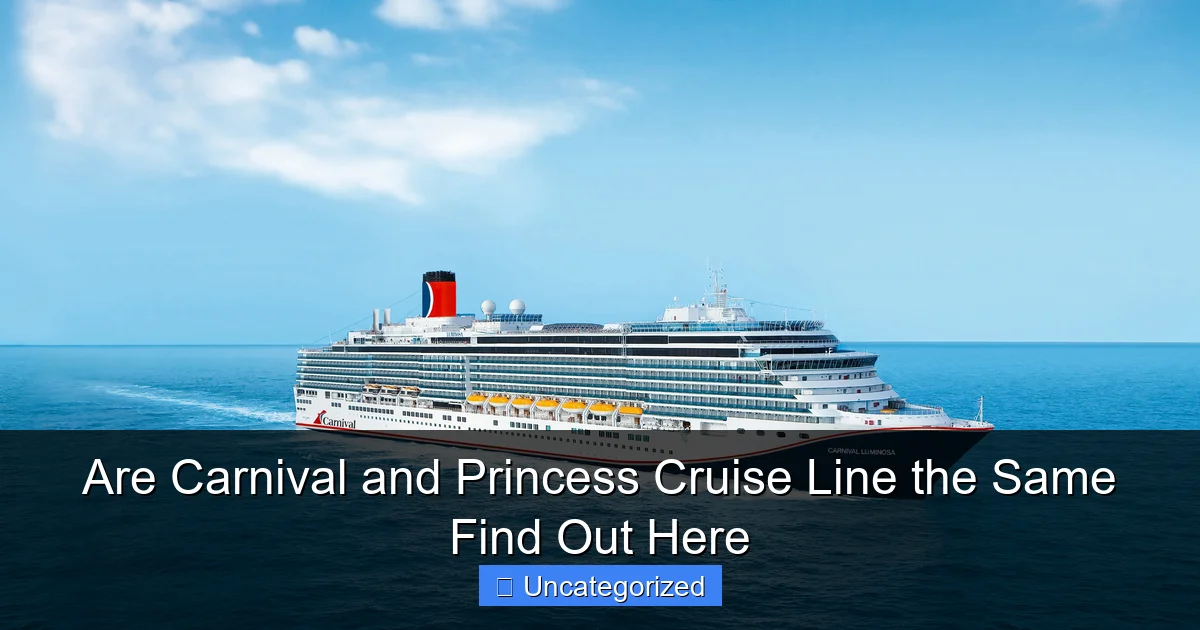
Featured image for are carnival and princess cruise line
Image source: cdn.visioncruise.co.uk
Carnival and Princess Cruise Line are not the same, despite both being major players in the cruise industry and owned by Carnival Corporation. Carnival Cruise Line focuses on fun, vibrant, budget-friendly experiences with a casual atmosphere, while Princess emphasizes refined elegance, destination-rich itineraries, and premium service—making each brand distinct in style, pricing, and target audience.
Key Takeaways
- Different brands: Carnival and Princess are separate lines under Carnival Corporation.
- Target audiences: Carnival focuses on fun; Princess offers refined, scenic cruising.
- Itineraries differ: Princess sails longer routes; Carnival features shorter, vibrant voyages.
- Onboard experience: Carnival is energetic; Princess emphasizes elegance and relaxation.
- Shared ownership: Both belong to Carnival Corp but maintain unique identities.
📑 Table of Contents
Are Carnival and Princess Cruise Line the Same? Find Out Here
When planning a dream cruise vacation, many travelers find themselves weighing the pros and cons of various cruise lines. Among the most popular names in the industry are Carnival Cruise Line and Princess Cruises, both of which offer extensive itineraries, diverse onboard experiences, and global destinations. However, despite their similar reputations and shared parent company, these two brands are far from identical. The question often arises: Are Carnival and Princess Cruise Line the same? The short answer is no—while they share some corporate ties, their target audiences, service styles, and onboard experiences differ significantly. This comprehensive guide will dive deep into the distinctions and similarities between the two, helping you make an informed decision for your next cruise adventure.
Choosing the right cruise line can dramatically impact your vacation experience, from the type of entertainment available to the quality of dining, the size of the ships, and even the demographics of fellow passengers. Whether you’re a budget-conscious family traveler looking for fun and affordability or a luxury-seeking couple desiring refined elegance and personalized service, understanding the nuances between Carnival and Princess is essential. In this article, we’ll explore their corporate ownership, brand positioning, onboard amenities, dining experiences, itineraries, and more. By the end, you’ll have a clear picture of which line—if either—best suits your travel style and expectations.
1. Corporate Ownership and Brand Hierarchy
Shared Parent Company: Carnival Corporation & plc
One of the most important facts to understand when comparing Carnival and Princess is that both are subsidiaries of Carnival Corporation & plc, the world’s largest cruise company. Founded in 1972, Carnival Corporation owns and operates 10 major cruise brands across the globe, including:

Visual guide about are carnival and princess cruise line
Image source: cruisefever.net
- Carnival Cruise Line
- Princess Cruises
- Holland America Line
- Seabourn
- Cunard
- AIDA Cruises
- P&O Cruises (UK and Australia)
- Costa Cruises
- Windstar Cruises
- Fathom (discontinued)
Despite being under the same corporate umbrella, each brand operates independently with its own management, marketing, ship design, and guest experience philosophy. This means that while Carnival Corporation provides financial backing, operational support, and shared technologies (like the OceanMedallion on select ships), the individual brands maintain distinct identities. Think of it like General Motors owning Chevrolet, Cadillac, and Buick—same parent, different brands with different target markets.
Brand Positioning and Market Segmentation
The strategic separation of Carnival and Princess reflects a deliberate effort to serve different segments of the cruise market. Carnival Cruise Line positions itself as a fun, casual, and value-oriented experience, often marketed as “The World’s Most Popular Cruise Line.” It appeals to first-time cruisers, families, and younger travelers seeking high-energy entertainment, affordable pricing, and a relaxed atmosphere.
In contrast, Princess Cruises is marketed as a premium, mid-tier cruise experience with a focus on comfort, service, and destination immersion. It’s often described as “the love of travel, the sea, and discovery,” and caters to older travelers, couples, and repeat cruisers who appreciate a more refined, less chaotic environment. While not as luxurious as Seabourn or Regent Seven Seas, Princess offers a step up from Carnival in terms of service quality, cabin design, and overall ambiance.
Operational Independence and Brand Identity
Each brand maintains its own headquarters: Carnival Cruise Line is based in Miami, Florida, while Princess Cruises operates from Santa Clarita, California. They have separate marketing teams, reservation systems, and customer service departments. Even their loyalty programs—Captain’s Circle for Carnival and Captain’s Circle for Princess—are distinct, though they occasionally offer reciprocal benefits for top-tier members.
This operational independence allows each brand to innovate and evolve without directly competing with the other. For example, Carnival launched the “Fun Ship” concept with vibrant colors, water slides, and comedy clubs, while Princess introduced the OceanMedallion, a wearable device that enables personalized service, keyless stateroom entry, and real-time location tracking. These innovations reflect their respective brand goals: Carnival prioritizes fun and accessibility, while Princess emphasizes convenience and customization.
2. Onboard Experience and Atmosphere
Ship Design and Decor
The physical design of Carnival and Princess ships immediately signals their different personalities. Carnival ships are known for their bright, bold, and playful aesthetics. Expect neon lighting, colorful murals, and whimsical themes—like the “Carnival Horizon” with its “Taste of the World” dining concept or the “Mardi Gras” with its roller coaster, BOLT: Skyride. The decor often features cartoonish characters, tropical motifs, and a party-like atmosphere that encourages social interaction.
Princess ships, on the other hand, feature more subdued, elegant, and modern interiors. Think neutral tones, wood accents, and art pieces inspired by global destinations. The “Discovery at Sea” program, for instance, includes curated art collections and educational exhibits that reflect the regions visited. The overall ambiance is calm, sophisticated, and designed to promote relaxation and exploration.
Entertainment and Activities
Entertainment is where the contrast between the two lines becomes most apparent. Carnival offers a high-octane lineup of activities tailored to a younger, more energetic crowd:
- Comedy clubs with late-night adult shows
- Live music in multiple venues (e.g., “Punchliner Comedy Club,” “Limelight Lounge”)
- WaterWorks water parks with slides and splash zones
- Casino with a wide variety of games
- Dance parties, deck games, and themed nights (e.g., “80s Night,” “Carnival Jamboree”)
Princess Cruises takes a more refined and educational approach to entertainment. While they do offer live music, Broadway-style shows, and dance clubs, the emphasis is on cultural enrichment:
- “Discovery at Sea” lectures by scientists, historians, and travel experts
- “Movies Under the Stars” with large outdoor screens
- “Shore Excursions” with immersive, small-group tours
- “The Piazza” with street performers, wine tastings, and art auctions
- “Enrichment” programs like cooking demos, language lessons, and wellness workshops
For example, a Carnival cruise to the Caribbean might feature a “Pirate Night” with costume contests and a deck party, while a Princess cruise to Alaska could include a lecture on glacier formation followed by a naturalist-led whale-watching excursion.
Passenger Demographics and Social Vibe
The social atmosphere on each line naturally reflects their target demographics. Carnival cruises tend to attract families, younger couples, and first-time cruisers, resulting in a lively, sometimes noisy environment. You’ll often find kids running through the halls, teens in the arcade, and adults dancing late into the night.
Princess Cruises draws a slightly older, more experienced traveler—typically couples aged 50 and up, though families and solo travelers are also common. The vibe is more relaxed, with quieter lounges, fewer children, and a greater emphasis on conversation and personal space. That said, Princess ships aren’t dull—they still offer plenty of social events, but they’re generally more subdued and less crowded.
Tip: If you’re traveling with young children or seeking a party atmosphere, Carnival may be the better fit. If you prefer a peaceful, adult-oriented environment with enriching experiences, Princess is likely the way to go.
3. Dining and Culinary Experience
Main Dining Options and Service Style
Dining is a major differentiator between the two lines. Carnival offers a casual, flexible dining model with options like:
- “Your Time Dining” – Choose your own dining time (no fixed seating)
- “Traditional Dining” – Assigned tables and seating times (early/late)
- “Chef’s Table” – Premium, reservation-only experience with a multi-course meal and wine pairing
The food is generally American-style comfort cuisine—think burgers, pasta, pizza, and fried chicken—with some international options. The quality is good for the price point, but not gourmet.
Princess Cruises, meanwhile, emphasizes refined, globally inspired cuisine with a focus on freshness and presentation. Their main dining rooms often feature:
- “Anytime Dining” – Similar to Carnival’s Your Time Dining
- “Traditional Dining” – With a more formal, European-style service
- “Specialty Dining” – Including Sabatini’s (Italian), Crown Grill (steakhouse), and Bistro Sur La Mer (French)
Princess also partners with Chef Curtis Stone for exclusive menus and hosts wine tastings, sommelier-led dinners, and cooking demonstrations. The food is generally higher quality, with more attention to detail and presentation.
Specialty Dining and Unique Concepts
Both lines offer specialty restaurants (often for an additional fee), but the variety and quality differ:
- Carnival: Guy’s Burger Joint (by Guy Fieri), BlueIguana Cantina, JiJi Asian Kitchen, Fahrenheit 555 Steakhouse
- Princess: Sabatini’s Italian Trattoria, Crown Grill, Bistro Sur La Mer, The Catch by Rudi (seafood), SHARE by Curtis Stone
Princess’s specialty venues are generally more upscale, with white-tablecloth service and curated wine lists. Carnival’s are more casual and fun-focused—perfect for families or those who want a quick, flavorful bite without the formality.
Example: On a Princess cruise, you might enjoy a 7-course Italian dinner at Sabatini’s with handmade pasta and truffle oil, while on Carnival, you might grab a “Guy’s Pig & Anchor” burger with craft beer at a lively outdoor bar.
24/7 Dining and Snack Options
Both lines offer 24/7 dining, but the options vary. Carnival has a 24-hour pizza station, burger bar, and room service (with a limited menu). Princess offers a 24-hour International Café with sandwiches, pastries, and espresso, plus a more extensive room service menu with hot and cold items.
Tip: If you’re a night owl or have picky eaters, Carnival’s late-night options might be more convenient. If you value variety and quality, Princess’s International Café is a standout.
4. Itineraries and Destination Focus
Geographic Coverage and Route Diversity
Both Carnival and Princess offer extensive itineraries, but their destination focus differs slightly:
| Destination | Carnival Cruise Line | Princess Cruises |
|---|---|---|
| Caribbean | Very popular; short 3-7 day cruises; ports like Nassau, Cozumel, Grand Turk | Popular; longer 7-14 day cruises; ports like St. Thomas, Barbados, Antigua |
| Alaska | Offers 7-day cruises; Glacier Bay and Hubbard Glacier | Extensive; 7-14 day cruises; Denali and Kenai Fjords extensions |
| Mediterranean | Limited; shorter 7-day cruises; ports like Barcelona, Rome, Athens | Strong presence; 7-21 day cruises; cultural focus in Italy, Greece, Turkey |
| Asia | Emerging market; 10-14 day cruises; Japan, China, Vietnam | Established; 10-14 day cruises; cultural immersion in Japan, Thailand, Singapore |
| Australia/NZ | Limited; seasonal cruises | Strong; year-round; Great Barrier Reef, Fiordland, Tasmania |
Princess Cruises tends to offer longer, more destination-rich itineraries, especially in regions like Alaska, the Mediterranean, and Asia. They often include overnight stays in key ports (e.g., St. Petersburg, Kyoto) to allow for deeper exploration. Carnival focuses more on short, affordable Caribbean and Mexican Riviera cruises, ideal for weekend getaways or first-time cruisers.
Shore Excursions and Onshore Experiences
Princess excels in curated, high-quality shore excursions with small groups, expert guides, and immersive experiences—like a private cooking class in Tuscany or a glacier hike in Juneau. They also offer “Discovery Tours” in partnership with Discovery Channel, featuring behind-the-scenes access and educational content.
Carnival offers a wider variety of budget-friendly, family-oriented excursions—like snorkeling, zip-lining, and beach days. They’re generally more casual and less structured, making them ideal for travelers who want to relax rather than sightsee intensively.
Tip: If you’re a culture or nature enthusiast, Princess’s excursions are often worth the premium. If you’re looking for fun, active, or low-cost options, Carnival delivers great value.
5. Pricing, Value, and Target Audience
Base Fare and Inclusions
Carnival is widely known for its low base fares, often starting at $300–$500 per person for a 7-day cruise. These prices include:
- Accommodation
- Most meals
- Entertainment
- Use of pools, fitness center, and water parks
However, add-ons like specialty dining, alcohol, shore excursions, and gratuities can significantly increase the total cost.
Princess’s base fares are typically 20–40% higher than Carnival’s for similar itineraries, but they include more perks:
- Higher-quality dining
- More refined entertainment
- Better cabin amenities (e.g., robes, upgraded toiletries)
- OceanMedallion technology on select ships
Gratuities and alcohol are still extra, but the overall value proposition leans toward a more premium experience.
Who Should Choose Which?
- Choose Carnival if you:
- Are on a tight budget
- Traveling with kids or teens
- Want a high-energy, fun-filled vacation
- Prefer casual dining and quick service
- Are a first-time cruiser
- Choose Princess if you:
- Value comfort, service, and elegance
- Are a couple or solo traveler seeking a quieter atmosphere
- Enjoy cultural and educational experiences
- Want longer itineraries with in-depth destinations
- Are willing to pay more for a refined experience
6. Final Verdict: Are They the Same?
After examining corporate ownership, onboard experiences, dining, itineraries, and pricing, the answer is clear: Carnival and Princess Cruise Line are not the same. While they share a parent company and some operational efficiencies, they are strategically positioned to serve different markets with distinct philosophies.
Carnival is the fun, affordable, family-friendly choice—perfect for those who want to let loose, make memories, and enjoy a lively vacation. Princess is the refined, destination-focused, service-oriented option—ideal for travelers who value comfort, culture, and a more relaxed pace.
Ultimately, the “best” cruise line depends on your personal preferences, travel goals, and budget. By understanding these differences, you can choose the line that aligns with your dream vacation—whether that’s dancing under the stars in the Caribbean or sipping wine while watching glaciers calve in Alaska.
So, are Carnival and Princess Cruise Line the same? No—and that’s a good thing. The diversity within Carnival Corporation’s portfolio ensures there’s a perfect cruise experience for every traveler.
Frequently Asked Questions
Are Carnival and Princess Cruise Line the same company?
No, Carnival Cruise Line and Princess Cruises are separate brands under the same parent company, Carnival Corporation & plc. While they share corporate ownership, each operates independently with distinct ships, itineraries, and onboard experiences.
Do Carnival and Princess Cruise Line share loyalty programs?
No, each brand maintains its own loyalty program: Carnival’s VIFP Club and Princess’s Captain’s Circle. However, members can earn status match perks through Carnival Corporation’s reciprocal benefits for elite-tier members.
Which cruise line is better: Carnival or Princess?
It depends on your preferences—Carnival focuses on casual, fun-filled vacations with lively entertainment, while Princess emphasizes refined dining, enrichment programs, and a more relaxed ambiance. Both offer great value but cater to different vacation styles.
Can I book a Carnival Cruise with Princess Cruise Line?
No, you must book directly through each brand’s website or travel agent. Carnival and Princess Cruise Line operate separate booking systems, though some travel agencies may sell both brands in the same platform.
Do Carnival and Princess Cruise Line have similar itineraries?
They often sail overlapping regions (e.g., Caribbean, Alaska), but their itineraries and ports of call differ. Princess tends to offer more extended and destination-focused voyages, while Carnival emphasizes shorter, high-energy trips.
Is the food on Carnival and Princess Cruise Line comparable?
Princess Cruise Line is known for its premium dining experiences, including specialty restaurants and partnerships with celebrity chefs. Carnival offers more casual, diverse options with a focus on fun, like Guy’s Burger Joint and 24-hour pizza.