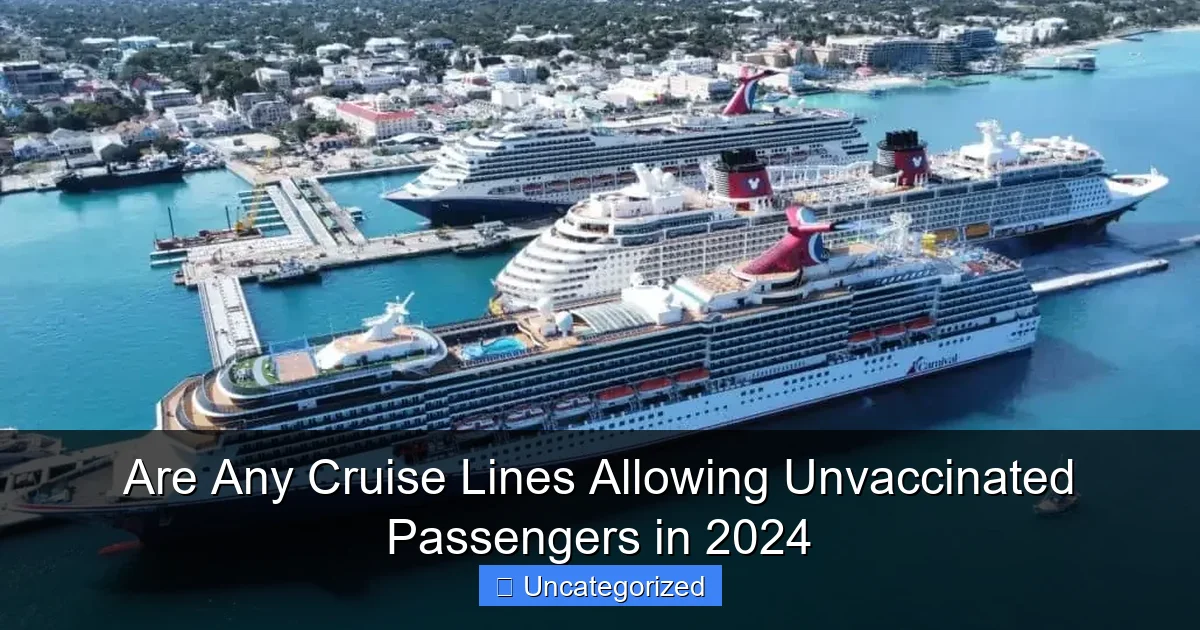
Featured image for are any cruise lines allowing unvaccinated passengers
Image source: cruiseradio.net
Yes, several major cruise lines—including Carnival, Royal Caribbean, and Norwegian—are now allowing unvaccinated passengers to sail in 2024, marking a significant shift from earlier pandemic policies. However, unvaccinated travelers may still face testing requirements, travel insurance mandates, or itinerary restrictions, especially on international voyages or select destinations. Always check the latest rules before booking, as policies vary by cruise line and departure port.
Key Takeaways
- Most major cruise lines now accept unvaccinated passengers with testing.
- Check pre-cruise testing rules—unvaccinated travelers often need negative PCR/antigen results.
- Royal Caribbean allows unvaccinated guests on select sailings with testing.
- Carnival Cruise Line permits unvaccinated passengers but enforces onboard protocols.
- Norwegian Cruise Line has removed vaccine mandates for most voyages.
- Always verify destination rules—ports may impose stricter entry requirements.
- Travel insurance is critical for unvaccinated travelers due to policy changes.
📑 Table of Contents
- The Changing Tides: Are Cruise Lines Welcoming Unvaccinated Travelers in 2024?
- Current Vaccination Policies Across Major Cruise Lines
- Smaller and Luxury Cruise Lines: A Different Approach
- Destination-Specific Regulations: The Key to Unvaccinated Travel
- Practical Tips for Unvaccinated Cruisers in 2024
- Data Table: Cruise Line Policies for Unvaccinated Passengers (2024)
- Conclusion: Navigating the New Normal with Confidence
The Changing Tides: Are Cruise Lines Welcoming Unvaccinated Travelers in 2024?
The cruise industry, once brought to a near standstill by the global pandemic, is now navigating a complex and evolving landscape of health and safety regulations. For many travelers, the return of cruising has been a welcome relief, but for others—particularly unvaccinated individuals—the journey back to the high seas has been fraught with uncertainty. As of 2024, the question on many minds is: are any cruise lines allowing unvaccinated passengers? The answer, while not uniform, reveals a shifting tide. Cruise lines are increasingly adopting more flexible policies, driven by declining global infection rates, updated health advisories, and the desire to attract a broader customer base. Yet, the rules remain nuanced, with distinctions based on destination, itinerary, age, and even the type of vessel.
For unvaccinated travelers, this means the door is no longer entirely closed. Some cruise lines have lifted mandatory vaccination requirements entirely, while others maintain them for specific voyages—especially those visiting countries with strict entry rules. The landscape is dynamic, and what was true six months ago may no longer apply. Whether you’re an immunocompromised individual, someone with religious or medical exemptions, or simply choosing not to be vaccinated, understanding the current policies is essential to planning a successful and stress-free cruise. This guide explores the latest developments across major and niche cruise lines, highlights practical considerations, and offers actionable advice for unvaccinated cruisers in 2024.
Current Vaccination Policies Across Major Cruise Lines
Royal Caribbean International: Flexible but Conditional
Royal Caribbean has adopted a hybrid approach in 2024. As of early this year, the line no longer requires all passengers to be vaccinated on most U.S.- and Caribbean-based sailings. However, unvaccinated guests must meet specific criteria to board. For sailings of five nights or less, unvaccinated passengers aged 12 and older must provide a negative PCR or antigen test taken within 72 hours of embarkation. For longer cruises (six nights or more), unvaccinated guests must undergo a PCR test within three days of departure and an additional antigen test at the terminal.
Visual guide about are any cruise lines allowing unvaccinated passengers
Image source: cruiseradio.net
Notably, Royal Caribbean still enforces vaccination requirements on certain itineraries, particularly those involving Canada, Bermuda, and some European ports. For example, the Harmony of the Seas’s 10-night transatlantic voyage from Miami to Southampton requires full vaccination for all passengers 12 and older. Additionally, unvaccinated travelers are subject to enhanced health screenings and may be restricted from certain onboard activities, such as shore excursions in ports with strict entry rules.
Carnival Cruise Line: Testing Over Vaccination
Carnival has taken a test-first, vaccine-optional stance for most of its fleet in 2024. The line dropped its universal vaccination mandate in late 2023 and now allows unvaccinated passengers on nearly all sailings, provided they submit a negative PCR test taken no more than 72 hours before embarkation. This policy applies to all guests aged 12 and older.
However, Carnival maintains vaccination requirements for cruises to specific destinations. For instance, the Carnival Breeze’s 7-night Alaska itinerary requires full vaccination due to Canadian entry regulations. Unvaccinated guests on these voyages are not permitted to board unless they qualify for a medical or religious exemption—and even then, they must undergo additional testing and quarantine protocols. Carnival also reserves the right to deny boarding if local health authorities impose sudden restrictions at the time of departure.
Norwegian Cruise Line: Gradual Relaxation
Norwegian Cruise Line (NCL) has gradually relaxed its policies since 2022. In 2024, unvaccinated passengers are allowed on most sailings, but with a catch: they must purchase travel insurance that covers medical evacuation and quarantine costs. This requirement is designed to mitigate financial risks for the line and ensure unvaccinated guests can cover potential medical expenses abroad.
Additionally, unvaccinated guests must present a negative PCR test taken within 72 hours of embarkation. For cruises to Europe, the Caribbean, and the South Pacific, NCL follows destination-specific rules. For example, the Norwegian Encore’s 14-night Transatlantic crossing from Miami to Barcelona requires full vaccination due to EU regulations. Unvaccinated travelers on these voyages may be allowed to sail but cannot disembark in certain ports unless they undergo onshore testing and quarantine.
MSC Cruises: Destination-Driven Policies
MSC Cruises operates under a destination-first policy, meaning vaccination requirements are determined by the ports of call rather than the home port. For U.S.-based cruises (e.g., MSC Seashore out of Miami), unvaccinated guests aged 12 and older must provide a negative PCR test within 72 hours of boarding. However, if the itinerary includes a stop in a country with a vaccine mandate—such as Canada, France, or Italy—unvaccinated passengers may not be allowed to disembark.
MSC offers a unique “shore excursion only” option in some cases, where unvaccinated guests can remain on the ship while others go ashore. This is particularly useful for families with mixed vaccination statuses. MSC also provides detailed pre-cruise guidance, including a port-by-port vaccination and testing matrix, accessible through its website.
Smaller and Luxury Cruise Lines: A Different Approach
Virgin Voyages: Vaccine-Required with Exemptions
Virgin Voyages stands out as one of the few major lines still maintaining a vaccination mandate for all passengers 12 and older. As of 2024, the line requires full vaccination (including boosters, if eligible) for all sailings, including its popular 4- and 5-night Caribbean voyages. Unvaccinated guests are not permitted to board unless they qualify for a medical or religious exemption.
For exemption requests, Virgin requires documentation from a licensed healthcare provider or a notarized religious statement. Even with an exemption, unvaccinated passengers must undergo a PCR test 72 hours before embarkation and an antigen test at the terminal. Additionally, they may be restricted from certain high-risk activities, such as group excursions in ports with high transmission rates. Virgin’s strict policy reflects its brand ethos of prioritizing crew and guest safety, especially given its adult-only, high-capacity ships.
Oceania Cruises: Luxury with Flexibility
Oceania Cruises, known for its intimate ships and destination-rich itineraries, has adopted a flexible but cautious approach. In 2024, unvaccinated guests are allowed on most sailings, provided they submit a negative PCR test within 72 hours of departure and agree to additional health screenings onboard. Oceania also requires unvaccinated passengers to carry travel insurance with medical coverage of at least $50,000.
What sets Oceania apart is its port-specific advisory system. Before each voyage, the line sends passengers a detailed email outlining the vaccination and testing requirements for every port of call. For example, on a 12-night Mediterranean cruise that includes stops in Greece, Italy, and Croatia, unvaccinated guests may be allowed to disembark in Greece (which has no vaccine mandate) but required to stay onboard in Italy (which requires EU Digital COVID Certificate). Oceania also offers private shore excursions for unvaccinated travelers to minimize risk.
Windstar Cruises: Boutique and Adaptive
Windstar Cruises, with its small ships and personalized service, allows unvaccinated passengers on most voyages. However, the line emphasizes pre-cruise communication. Unvaccinated guests must complete a health questionnaire and provide a negative PCR test within 72 hours of embarkation. Windstar also recommends—but does not require—travel insurance with pandemic coverage.
Windstar’s small-ship model (typically 148–342 passengers) allows for rapid response to changing regulations. For instance, if a port suddenly imposes a vaccine mandate, Windstar may reroute the ship or offer private tendering services to minimize exposure. The line also provides onboard medical staff trained in pandemic protocols, giving unvaccinated travelers added peace of mind.
Destination-Specific Regulations: The Key to Unvaccinated Travel
U.S. and Caribbean Cruises: Generally Open
For cruises departing from U.S. ports (e.g., Miami, Port Canaveral, Galveston) and visiting the Caribbean, unvaccinated passengers face the fewest restrictions in 2024. Most islands, including the Bahamas, Jamaica, and the Cayman Islands, no longer require vaccination for entry. However, testing requirements still apply. Unvaccinated guests must present a negative PCR or antigen test taken within 72 hours of arrival.
Example: On a 4-night Carnival cruise from Miami to Nassau and Cozumel, unvaccinated passengers need only a pre-departure test. Cozumel, part of Mexico, allows unvaccinated travelers to enter with a negative test and complete a health declaration form online. However, if the cruise includes a stop in a country like Canada (e.g., a repositioning cruise to Vancouver), vaccination becomes mandatory.
European and Transatlantic Voyages: Stricter Rules
European destinations vary widely in their requirements. As of 2024, countries like France, Italy, and Spain no longer require vaccination for entry but may impose testing or quarantine for unvaccinated travelers from high-risk regions. The EU Digital COVID Certificate is no longer mandatory, but some ports may still request proof of vaccination or a negative test.
Transatlantic cruises (e.g., Miami to Barcelona) are particularly complex. While the U.S. does not require vaccination for entry, Spain mandates a negative PCR test for unvaccinated travelers. Some cruise lines, like Norwegian and MSC, require full vaccination for these voyages to avoid complications. Unvaccinated passengers may be allowed to sail but restricted from disembarking in certain ports unless they undergo additional testing.
Alaska and Canada: The Vaccination Mandate Persists
Alaska cruises remain one of the most challenging for unvaccinated travelers. Due to Canadian regulations, all passengers on cruises that include Canadian ports (e.g., Vancouver, Juneau, Skagway) must be fully vaccinated. This applies even if the cruise is marketed as a “U.S.-only” itinerary but transits through Canadian waters.
For example, a 7-night Royal Caribbean cruise from Seattle to Juneau and Ketchikan requires full vaccination. Unvaccinated guests cannot board unless they have a medical exemption and undergo a 14-day quarantine before departure. The Canadian government also requires unvaccinated travelers to complete a mandatory 14-day quarantine upon entry, which is impractical for most cruisers.
Practical Tips for Unvaccinated Cruisers in 2024
1. Verify Policies Early and Often
Always check the cruise line’s official website and review the “Health & Safety” section at least 60 days before departure. Policies can change with little notice, especially if new variants emerge. Sign up for email alerts from the cruise line to receive updates on testing, vaccination, and port requirements.
2. Carry the Right Documentation
Unvaccinated travelers should bring:
- A printed copy of the negative PCR or antigen test (within 72 hours)
- Proof of travel insurance with medical coverage (minimum $50,000 recommended)
- Completed health declaration forms (required by many ports)
- Exemption letters (if applicable)
3. Plan for Shore Excursions
Many ports allow unvaccinated passengers to disembark with a negative test, but some do not. Research each port’s requirements using resources like the International Air Transport Association (IATA) Travel Centre or Sherpa. Consider booking private tours through the cruise line or local operators who accommodate unvaccinated guests.
4. Consider Travel Insurance with Pandemic Coverage
Standard travel insurance rarely covers pandemic-related cancellations or medical costs abroad. Look for policies that include:
- Medical evacuation
- Quarantine expenses
- Trip interruption due to COVID-19
- Coverage for unvaccinated travelers
Companies like Allianz, Travel Guard, and Seven Corners offer specialized pandemic plans.
5. Prepare for Onboard Adjustments
Even on cruise lines that allow unvaccinated guests, you may face:
- Separate dining areas or times
- Restricted access to high-capacity venues (e.g., theaters, gyms)
- Mandatory mask-wearing in crowded areas
Pack masks, hand sanitizer, and a portable air purifier for your cabin.
Data Table: Cruise Line Policies for Unvaccinated Passengers (2024)
| Cruise Line | Vaccine Mandate? | Testing Required? | Travel Insurance Required? | Special Notes |
|---|---|---|---|---|
| Royal Caribbean | No (most sailings) | Yes (PCR within 72h) | No | Vaccine required for Canada/Bermuda |
| Carnival | No (most sailings) | Yes (PCR within 72h) | No | Vaccine required for Alaska/Canada |
| Norwegian | No (most sailings) | Yes (PCR within 72h) | Yes | Insurance must cover quarantine/evacuation |
| MSC Cruises | No (U.S. sailings) | Yes (PCR within 72h) | No | Port-specific rules; may restrict disembarkation |
| Virgin Voyages | Yes | Yes (PCR + antigen) | Yes | Exemptions allowed with documentation |
| Oceania | No | Yes (PCR within 72h) | Yes | Port advisory emails; private excursions |
| Windstar | No | Yes (PCR within 72h) | Recommended | Small ships; flexible routing |
Conclusion: Navigating the New Normal with Confidence
The cruise industry in 2024 is a mosaic of policies, reflecting a world still adapting to the post-pandemic era. While the answer to “are any cruise lines allowing unvaccinated passengers” is a resounding “yes,” the reality is layered with conditions, exceptions, and destination-specific rules. For unvaccinated travelers, the key to a successful cruise lies in proactive planning, meticulous documentation, and flexibility.
Major lines like Royal Caribbean, Carnival, and Norwegian now welcome unvaccinated guests on most voyages, but with testing and insurance requirements. Luxury and boutique lines offer more tailored experiences but may enforce stricter rules for high-risk itineraries. Meanwhile, destinations like Canada and parts of Europe remain off-limits to unvaccinated cruisers unless they meet additional criteria.
Ultimately, the cruise experience for unvaccinated travelers in 2024 is not about finding a line with no rules—it’s about choosing the right line for your needs, understanding the trade-offs, and preparing thoroughly. With the right strategy, unvaccinated passengers can once again enjoy the freedom of the open sea, the beauty of exotic ports, and the joy of shared adventure. The tides are turning, and the horizon is bright.
Frequently Asked Questions
Are any cruise lines allowing unvaccinated passengers in 2024?
Yes, several cruise lines, including Carnival, Royal Caribbean, and Norwegian Cruise Line, now permit unvaccinated passengers on most sailings, though some destinations or ships may still require proof of vaccination. Always check the specific cruise line’s policy before booking.
Do I need a COVID-19 vaccine to go on a cruise?
Not always. While some cruise lines have dropped mandatory vaccination requirements, others may enforce them for certain itineraries or high-risk regions. Unvaccinated passengers should expect pre-travel testing and possible onboard restrictions.
Which major cruise lines accept unvaccinated travelers?
Celebrity Cruises, Princess Cruises, and Holland America Line are among the major brands allowing unvaccinated guests, but policies vary by departure port and destination. Unvaccinated passengers often need to provide negative COVID-19 test results within 72 hours of boarding.
Can unvaccinated kids cruise without restrictions?
Many cruise lines allow unvaccinated children under 12 to sail if they test negative before departure. However, age limits and testing rules differ by company, so verify requirements for family-friendly sailings.
Are there extra rules for unvaccinated passengers on cruises?
Yes, unvaccinated travelers may face mandatory pre-cruise PCR/antigen tests, denied access to certain ports, or restricted participation in shore excursions. Some ships also require masks in crowded areas.
Do any cruise lines still require vaccines for all passengers?
A few luxury or small-ship lines, like Viking Ocean Cruises, may maintain universal vaccination policies for specific sailings. Most mainstream lines, however, now accommodate unvaccinated passengers with testing alternatives.