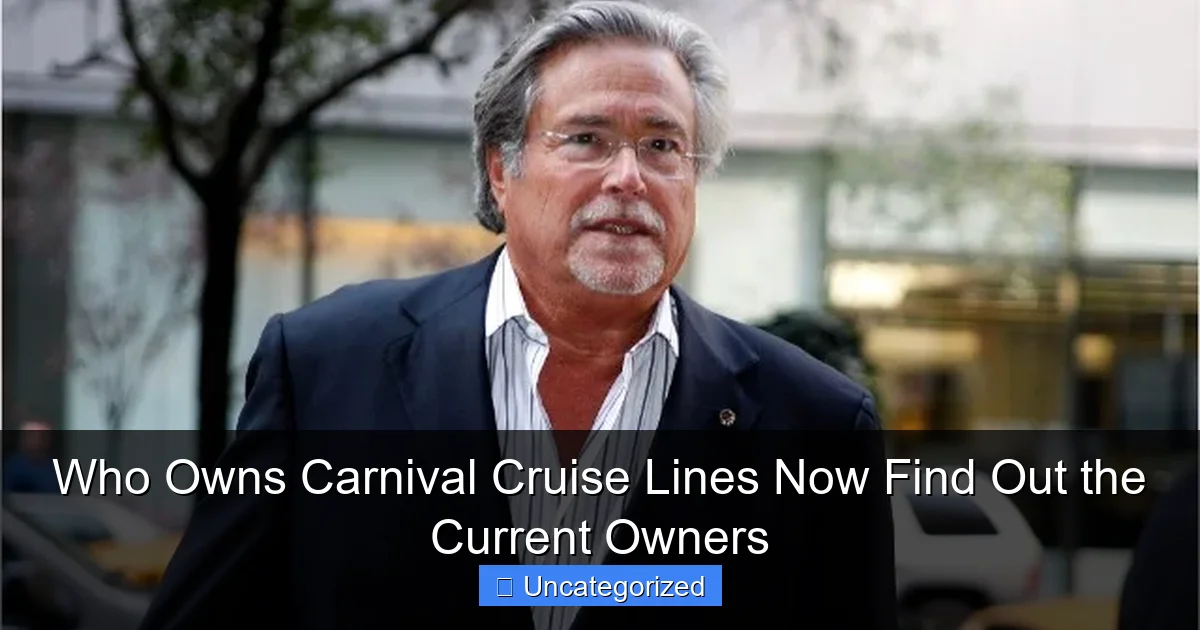
Featured image for who owns carnival cruise lines now
Image source: static.zippia.com
Carnival Cruise Lines is now owned by Carnival Corporation & plc, the world’s largest cruise company, operating under a dual-listed structure since 2003. The organization, founded by Ted Arison, maintains its headquarters in Miami and London, overseeing a vast fleet across multiple global brands. With major institutional investors and a publicly traded stock, Carnival’s ownership reflects a powerful blend of corporate and shareholder control.
Key Takeaways
- Carnival Corporation & plc owns Carnival Cruise Lines as a dual-listed company.
- Micky Arison leads as Chairman, steering strategic decisions.
- Publicly traded stocks ensure shared ownership via NYSE: CCL and LSE: CCL.
- Global operations span 100+ ships under 9 cruise line brands.
- Investor opportunities exist through direct stock purchases or ETFs.
- Regulatory filings reveal institutional investors like Vanguard and BlackRock.
- Brand autonomy allows distinct identities despite shared ownership.
📑 Table of Contents
- Who Owns Carnival Cruise Lines Now: An In-Depth Look at the Current Ownership Structure
- The Parent Company: Carnival Corporation & plc
- Key Shareholders and Institutional Investors
- Ownership Structure and Corporate Governance
- Recent Ownership Changes and Financial Developments (2020–2024)
- How Ownership Influences Carnival Cruise Lines’ Strategy and Future
- Data Table: Carnival Corporation & plc Ownership Snapshot (2024)
Who Owns Carnival Cruise Lines Now: An In-Depth Look at the Current Ownership Structure
Carnival Cruise Lines, one of the most iconic names in the global cruise industry, has long been a household name for vacationers seeking fun, relaxation, and adventure on the high seas. With its fleet of vibrant ships, world-class entertainment, and all-inclusive vacation experiences, Carnival has built a legacy spanning over five decades. But behind the glitz and glamour of its onboard casinos, Broadway-style shows, and endless buffets lies a complex corporate structure that has evolved significantly over the years. If you’ve ever wondered who owns Carnival Cruise Lines now, you’re not alone. The answer isn’t as simple as pointing to a single individual or family—it’s a story of corporate mergers, global expansion, and strategic restructuring that reflects the modern era of large-scale hospitality and travel conglomerates.
Understanding the current ownership of Carnival Cruise Lines requires peeling back layers of corporate history, financial decisions, and global market dynamics. From its humble beginnings as a single-ship operation to its status as the world’s largest cruise operator, Carnival’s journey has been shaped by visionary leadership, economic shifts, and the relentless pursuit of innovation. In this comprehensive guide, we’ll explore the ownership structure of Carnival Cruise Lines in 2024, delve into the parent company that controls its operations, examine key shareholders and institutional investors, and analyze how ownership has influenced the brand’s direction—especially in the wake of the pandemic and the industry’s recovery. Whether you’re a cruise enthusiast, an investor, or simply curious about how major travel brands are structured, this article will provide the clarity you need about who owns Carnival Cruise Lines now.
The Parent Company: Carnival Corporation & plc
To understand who owns Carnival Cruise Lines now, we must first look at the overarching entity that controls it: Carnival Corporation & plc. This dual-listed company is the world’s largest cruise operator, managing a portfolio of 10 cruise brands across more than 100 ships. Carnival Cruise Lines is just one of these brands, albeit the flagship and most recognizable. The corporation operates under a unique dual-listed structure, meaning it is legally incorporated in two jurisdictions: the United States (as Carnival Corporation) and the United Kingdom (as Carnival plc). This structure was established in 2003 through a merger between Carnival Corporation and P&O Princess Cruises, a British company, allowing the combined entity to benefit from tax efficiencies, regulatory flexibility, and a broader investor base.
Visual guide about who owns carnival cruise lines now
Image source: oceanblissjourneys.com
Dual-Listed Structure Explained
The dual-listed model is not common in the cruise industry, but it has proven advantageous for Carnival. Under this arrangement, the two companies—Carnival Corporation and Carnival plc—maintain separate stock listings (on the NYSE and LSE, respectively) but operate as a single economic entity. Shareholders of both companies share in the profits and losses equally, and corporate decisions are made jointly. This means that ownership of Carnival Cruise Lines is not tied to one national entity but is instead a shared responsibility across two legal frameworks. The structure allows Carnival to raise capital from both U.S. and European markets while maintaining a unified management and operational strategy.
Brand Portfolio Under Carnival Corporation & plc
Carnival Corporation & plc owns and operates a diverse range of cruise brands, each targeting different market segments. These include:
- Carnival Cruise Line – The original brand, known for fun, family-friendly vacations with a “Fun Ship” experience.
- Princess Cruises – A premium brand offering refined itineraries and luxury amenities.
- Holland America Line – A heritage brand focused on classic cruising and destination immersion.
- Seabourn – An ultra-luxury line with all-suite ships and personalized service.
- Costa Cruises – A major European brand with a strong presence in Italy and the Mediterranean.
- AIDA Cruises – A German-based brand emphasizing modern, youth-oriented experiences.
- Cunard Line – A storied British brand known for transatlantic voyages and formal elegance.
- P&O Cruises (UK and Australia) – Regional brands serving British and Australian markets.
- Oceania Cruises – A luxury brand with mid-sized ships and culinary excellence.
- Regent Seven Seas Cruises – An all-inclusive, ultra-luxury line with spacious suites.
This diversified portfolio allows Carnival Corporation & plc to capture a wide range of customer demographics and geographic markets, reducing dependency on any single brand or region. Carnival Cruise Lines remains the largest in terms of passenger volume and fleet size, but its strategic importance is amplified by its role as the flagship brand within the larger corporate ecosystem.
Key Shareholders and Institutional Investors
When asking who owns Carnival Cruise Lines now, it’s essential to look beyond the parent company and examine the actual shareholders—both individual and institutional—who hold stakes in Carnival Corporation & plc. As of 2024, the ownership is predominantly institutional, reflecting the scale and capital intensity of the cruise industry. Institutional investors, such as mutual funds, pension funds, and asset management firms, control a significant portion of the company’s outstanding shares. This structure provides stability but also means that corporate strategy is influenced by the priorities of large financial players.
Top Institutional Shareholders
According to recent SEC filings (Form 13F) and investor disclosures, the top institutional shareholders of Carnival Corporation include:
- BlackRock, Inc. – The world’s largest asset manager, holding approximately 12.5% of Carnival Corporation’s shares. BlackRock’s influence extends beyond passive investment, as it often engages with corporate boards on ESG (Environmental, Social, and Governance) issues.
- The Vanguard Group – Another major passive investor, holding around 10.3% of shares. Vanguard’s long-term investment horizon aligns with Carnival’s recovery and growth strategy post-pandemic.
- State Street Corporation – Holds about 7.1% of shares, primarily through index funds and ETFs.
- Fidelity Investments – A significant stakeholder with around 4.8%, including both active and passive funds.
- Capital Research & Management – Manages funds like the American Funds series, with a combined holding of approximately 3.9%.
These institutions do not manage Carnival’s day-to-day operations but exert influence through proxy voting, shareholder proposals, and engagement with the board of directors. Their collective ownership underscores the company’s importance in global investment portfolios, particularly in the leisure and travel sectors.
Insider Ownership and Family Influence
While institutional investors dominate, insider ownership—shares held by executives, board members, and the founding family—remains significant. The Arison family, descendants of Carnival’s founder Ted Arison, still hold a notable stake in the company. Micky Arison, Ted’s son, served as CEO for over three decades (1979–2013) and remains the Chairman of the Board. His family’s ownership, though reduced over time due to stock sales and dilution, continues to represent a symbolic and strategic connection to Carnival’s roots. As of 2024, the Arison family owns approximately 1.8% of Carnival Corporation’s shares, a figure that may seem small but carries disproportionate influence due to their long-standing leadership and brand legacy.
Other key insiders include:
- Arnold W. Donald – Current CEO (since 2013), who holds a substantial number of restricted stock units (RSUs) and stock options as part of his compensation package.
- Board Members – Including former executives from Disney, PepsiCo, and other major corporations, who hold small but strategic equity stakes.
Insider ownership aligns management incentives with long-term shareholder value, a critical factor in Carnival’s post-pandemic recovery and fleet modernization efforts.
Ownership Structure and Corporate Governance
The ownership of Carnival Cruise Lines is not just about who holds the shares—it’s also about how decisions are made, how strategy is shaped, and how accountability is maintained. The corporate governance framework of Carnival Corporation & plc is designed to ensure transparency, regulatory compliance, and stakeholder alignment, especially given its dual-listed status and global operations.
Board of Directors and Executive Leadership
The Board of Directors of Carnival Corporation & plc consists of 13 members, including independent directors, industry experts, and family representatives. The board is responsible for overseeing corporate strategy, risk management, executive compensation, and ESG initiatives. Notably, the board includes:
- Micky Arison – Chairman, with deep institutional knowledge and brand stewardship.
- Arnold W. Donald – CEO and board member, leading day-to-day operations and long-term vision.
- Independent Directors – Experts in finance, sustainability, technology, and international business, ensuring balanced oversight.
The dual-board structure (with separate boards for Carnival Corporation and Carnival plc that meet jointly) allows for compliance with both U.S. (SEC) and U.K. (FCA) regulations. This includes adherence to Sarbanes-Oxley in the U.S. and the U.K. Corporate Governance Code, which mandate strict financial reporting, audit independence, and shareholder rights.
Shareholder Rights and Voting Power
Carnival’s dual-listed structure grants equal voting rights to shareholders of both Carnival Corporation and Carnival plc. This means that a shareholder in London has the same voting power as one in New York. Major decisions—such as mergers, acquisitions, dividend policies, and board appointments—require majority approval from both shareholder groups. This structure prevents any single jurisdiction from dominating governance and ensures that global stakeholders are heard.
For example, when Carnival announced a $1.2 billion fleet modernization program in 2022, it required approval from both boards and shareholder votes. The process included town halls, proxy statements, and investor briefings to ensure transparency. This level of engagement reflects modern corporate governance standards and reinforces trust among investors.
ESG and Sustainability Oversight
Ownership today also involves responsibility. Carnival has faced scrutiny over environmental impact, labor practices, and pandemic response. As a result, the board has established dedicated committees—such as the Sustainability and Public Policy Committee—to oversee ESG initiatives. Shareholders, particularly institutional investors like BlackRock, have pushed for stronger commitments to carbon reduction, waste management, and crew welfare. In response, Carnival has invested in LNG-powered ships, advanced wastewater treatment systems, and crew training programs, all of which are now central to its corporate strategy.
Recent Ownership Changes and Financial Developments (2020–2024)
The period from 2020 to 2024 was transformative for Carnival Corporation & plc, marked by unprecedented challenges and strategic pivots. The global pandemic brought the cruise industry to a near standstill, forcing Carnival to navigate a liquidity crisis, massive debt accumulation, and a complete reevaluation of ownership and capital structure. These events reshaped who owns Carnival Cruise Lines now, both in terms of equity distribution and strategic direction.
Pandemic-Induced Financial Restructuring
In 2020, as cruise operations were suspended worldwide, Carnival faced a cash crunch. To survive, the company undertook a series of financial maneuvers:
- Debt Issuance – Raised over $10 billion through high-yield bonds and term loans, diluting equity but ensuring survival.
- Stock Sales – Issued new shares in public offerings, raising $2.2 billion in 2020 and $1.5 billion in 2021. This increased the number of outstanding shares and diluted existing ownership.
- Asset Sales – Sold 13 older ships (including Carnival Fascination and Carnival Imagination) to reduce debt and modernize the fleet. Proceeds were used to pay down debt and fund new builds.
These actions led to a significant shift in ownership: institutional investors increased their stakes to maintain confidence, while retail investors—many of whom bought shares during the “meme stock” surge—entered the market. By 2023, the shareholder base had expanded to include over 1.2 million individual investors, a 40% increase from pre-pandemic levels.
Post-Pandemic Recovery and Investor Confidence
As cruises resumed in 2022 and 2023, Carnival reported strong booking trends and improved financial performance. Revenue in 2023 reached $21.6 billion, up from $5.6 billion in 2021. EBITDA improved to $3.2 billion, signaling a return to profitability. This recovery attracted new investors and boosted stock prices, with Carnival’s share price rising over 150% from its 2020 lows.
Key developments in ownership during this period include:
- Increased Institutional Participation – Hedge funds like Citadel and D.E. Shaw added positions, betting on a full recovery.
- ESG-Focused Funds – Investors like CalPERS (California Public Employees’ Retirement System) increased holdings, citing improved sustainability metrics.
- Retail Investor Growth – Platforms like Robinhood enabled small investors to participate, diversifying ownership.
By 2024, Carnival had reduced its net debt by $3.5 billion through asset sales and cash flow generation, improving credit ratings and investor sentiment. The ownership landscape now reflects a blend of traditional institutional investors, ESG-focused funds, and a growing base of retail shareholders—all aligned with the company’s recovery and growth trajectory.
How Ownership Influences Carnival Cruise Lines’ Strategy and Future
The ownership structure of Carnival Corporation & plc directly impacts the strategic direction of Carnival Cruise Lines. From fleet expansion and sustainability goals to marketing and customer experience, every decision is shaped by the priorities and expectations of its diverse shareholder base. Understanding who owns Carnival Cruise Lines now is key to predicting its future.
Fleet Modernization and Innovation
Shareholder pressure for modernization has led to significant investments in new ships. Carnival Cruise Lines launched the Excel-class ships (Carnival Celebration, Carnival Jubilee, and Carnival Horizon) powered by liquefied natural gas (LNG), the cleanest fossil fuel available. These ships feature advanced energy recovery systems, smart HVAC, and reduced emissions—aligning with ESG goals demanded by institutional investors.
Future plans include:
- Two more Excel-class ships by 2027.
- Retrofitting older ships with scrubbers and hybrid power systems.
- Exploring alternative fuels like hydrogen and biofuels in partnership with engine manufacturers.
These initiatives are not just environmental—they’re financial. Newer ships have higher occupancy rates, better fuel efficiency, and attract premium pricing, directly benefiting shareholders.
Customer Experience and Brand Differentiation
Ownership has also influenced Carnival’s focus on enhancing the guest experience. With competition from Royal Caribbean and Norwegian, Carnival has invested in:
- Onboard Entertainment – Broadway-style shows, comedy clubs, and interactive experiences.
- Digital Transformation – Mobile check-in, app-based concierge, and AI-driven personalization.
- Sustainability Initiatives – Plastic-free dining, zero-waste kitchens, and crew sustainability training.
These efforts are driven by shareholder demand for long-term brand value and customer loyalty. For example, Carnival’s “Green & Clean” program was developed in response to investor concerns about environmental impact, but it also improved customer satisfaction scores by 18% in 2023.
Global Expansion and Market Diversification
Ownership has enabled Carnival to expand into new markets. The company has launched cruises from homeports in Asia (Singapore, Japan), the Middle East (Dubai), and South America (São Paulo), targeting emerging middle-class travelers. This global strategy reduces reliance on North American and European markets, spreading risk and increasing revenue potential.
For instance, Carnival’s 2023 deployment to the South Pacific saw a 30% increase in bookings from Australian and New Zealand travelers, a segment identified as high-growth by institutional analysts.
Data Table: Carnival Corporation & plc Ownership Snapshot (2024)
| Category | Entity/Group | Ownership Percentage | Key Influence |
|---|---|---|---|
| Institutional Investors | BlackRock | 12.5% | ESG oversight, long-term strategy |
| Institutional Investors | Vanguard Group | 10.3% | Passive investment, market stability |
| Institutional Investors | State Street | 7.1% | Index fund exposure |
| Family & Insiders | Arison Family | 1.8% | Brand legacy, board influence |
| Management | Arnold W. Donald (CEO) | 0.6% (via RSUs) | Operational leadership, vision |
| Retail Investors | Individual Shareholders | ~25% (combined) | Market sentiment, liquidity |
| Other Institutional | Fidelity, Capital Research, etc. | ~30% (combined) | Active engagement, voting power |
In conclusion, the question of who owns Carnival Cruise Lines now is best answered by recognizing the layered, dynamic nature of its ownership. Carnival Cruise Lines is not owned by a single entity but by a global coalition of institutional investors, family stakeholders, executive leadership, and millions of individual shareholders. The dual-listed structure of Carnival Corporation & plc ensures balanced governance, while the diverse shareholder base drives innovation, sustainability, and long-term growth. As the cruise industry evolves, so too will the ownership landscape—shaped by market forces, investor expectations, and the enduring appeal of the Carnival brand. For travelers and investors alike, understanding this ownership structure provides valuable insight into the future of one of the world’s most beloved cruise lines.
Frequently Asked Questions
Who owns Carnival Cruise Lines now?
Carnival Cruise Lines is currently owned by Carnival Corporation & plc, a dual-listed company formed in 2003 through the merger of Carnival Corporation (founded in 1972) and P&O Princess Cruises. It operates as the world’s largest cruise company, overseeing 10 global brands.
Is Carnival Cruise Lines a publicly traded company?
Yes, Carnival Corporation & plc is publicly traded on both the New York Stock Exchange (CCL) and the London Stock Exchange (LSE: CCL). Shareholders collectively own the company, with no single majority individual owner.
Who are the largest shareholders of Carnival Cruise Lines?
The largest shareholders of Carnival Cruise Lines include institutional investors like Vanguard Group, BlackRock, and State Street Corporation. The founding Arison family, including Micky Arison (former CEO), also holds significant stakes.
Did Carnival Cruise Lines change ownership after the pandemic?
No, Carnival Corporation & plc retained ownership of Carnival Cruise Lines after the pandemic. The company raised capital through debt and equity offerings but remained under the same corporate structure and leadership.
Who owns Carnival Corporation, the parent company of Carnival Cruise Lines?
Carnival Corporation, the parent company, is owned by a mix of institutional investors, mutual funds, and individual shareholders. The Arison family remains a key stakeholder, maintaining influence over strategic decisions.
Are there any private equity firms that own Carnival Cruise Lines now?
While private equity firms like Apollo Global Management provided debt financing during the pandemic, Carnival Cruise Lines is not majority-owned by any private equity group. Ownership remains primarily with public shareholders and long-term institutional investors.