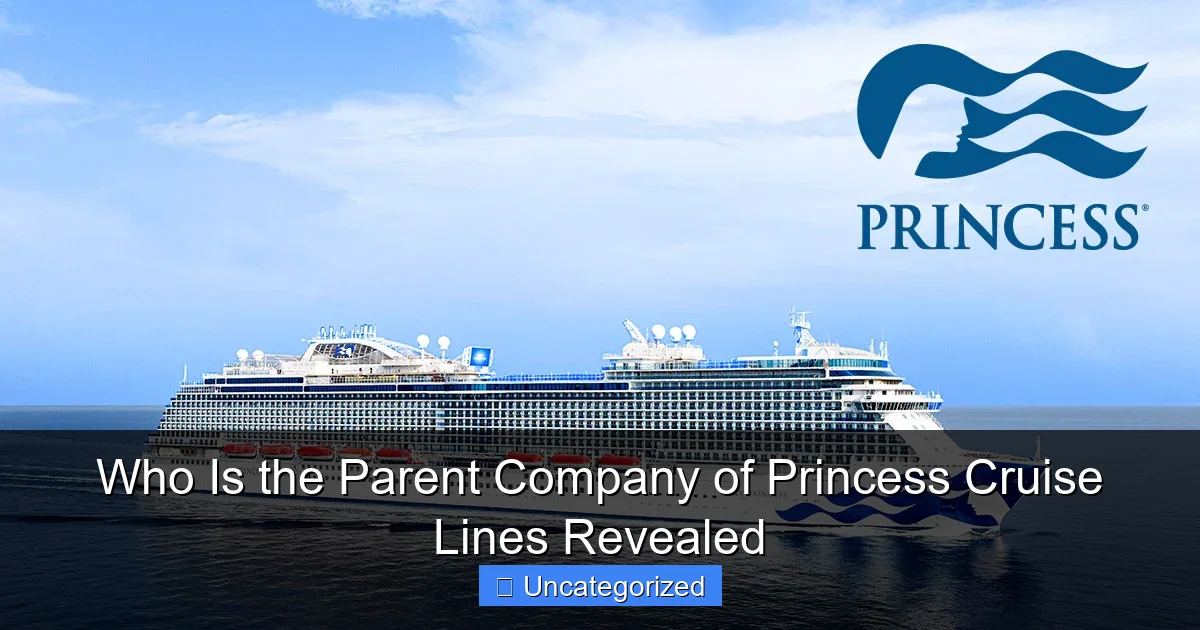
Featured image for who is the parent company of princess cruise lines
Image source: princess.com
Princess Cruise Lines is owned by Carnival Corporation & plc, the world’s largest cruise company, which operates multiple premium brands globally. This powerhouse parent ensures Princess maintains its reputation for luxury, innovation, and unforgettable voyages, backed by decades of maritime expertise.
Key Takeaways
- Carnival Corporation owns Princess Cruise Lines: The parent company is a global cruise leader.
- Diverse brand portfolio: Carnival also operates Holland America, Seabourn, and other major cruise lines.
- Publicly traded entity: Carnival Corporation is listed on NYSE under ticker CCL.
- Global market influence: Combined fleet strength ensures wide itinerary options for travelers.
- Shared resources: Princess benefits from Carnival’s R&D, sustainability, and booking platforms.
📑 Table of Contents
- Who Is the Parent Company of Princess Cruise Lines Revealed
- The Corporate Giant Behind Princess Cruises: Carnival Corporation & plc
- A Portfolio of Cruise Brands Under Carnival’s Umbrella
- How Carnival’s Ownership Shapes Princess Cruises’ Strategy and Innovation
- Financial Performance and Investor Insights
- The Future of Princess Cruises Under Carnival’s Leadership
Who Is the Parent Company of Princess Cruise Lines Revealed
When you think of luxury cruise vacations, Princess Cruises is likely one of the first names that come to mind. Known for its elegant ships, world-class service, and unforgettable itineraries spanning every continent, Princess Cruises has built a reputation as a leader in the global cruise industry. From its iconic “Love Boat” legacy to modern innovations like MedallionClass technology, Princess Cruises has continuously evolved to meet the expectations of today’s travelers. But behind this globally recognized brand lies a much larger corporate structure—one that shapes its operations, strategy, and long-term vision.
Have you ever wondered who owns Princess Cruises? While the brand operates independently with its own identity, it is ultimately part of a multinational corporation with a diverse portfolio of cruise lines, hospitality assets, and maritime investments. Understanding the parent company of Princess Cruise Lines not only reveals the brand’s financial backing and global reach but also provides insight into its future direction, sustainability efforts, and competitive advantages in the cruise market. In this comprehensive guide, we’ll uncover the full story behind the parent company, explore its corporate structure, examine its impact on Princess Cruises, and reveal why this relationship matters to passengers, investors, and industry watchers alike.
The Corporate Giant Behind Princess Cruises: Carnival Corporation & plc
A Dual-Listed Powerhouse
Princess Cruises is owned by Carnival Corporation & plc, one of the largest and most influential cruise companies in the world. What makes Carnival unique is its dual corporate structure: it operates as both Carnival Corporation (incorporated in the United States) and Carnival plc (incorporated in the United Kingdom). Despite this dual listing, the two entities function as a single economic enterprise, sharing a common board of directors, executive leadership, and operational strategy. This structure allows Carnival to leverage financial, legal, and tax advantages across multiple jurisdictions while maintaining a unified global brand presence.
Visual guide about who is the parent company of princess cruise lines
Image source: cruisemapper.com
Carnival Corporation & plc was formed in 2003 through the merger of Carnival Corporation (founded in 1972) and P&O Princess Cruises plc (formerly the British cruise line). The merger created the world’s largest cruise company, with a combined fleet of over 80 ships and a presence in more than 100 countries. Today, Carnival is dual-listed on both the New York Stock Exchange (NYSE: CCL) and the London Stock Exchange (LSE: CCL), giving it access to a broad investor base and significant capital for expansion.
Financial and Market Leadership
Carnival Corporation & plc is the undisputed leader in the global cruise industry. As of 2023, it controls approximately 40% of the worldwide cruise market, with annual revenues exceeding $20 billion. The company’s scale allows it to negotiate favorable contracts with shipyards, fuel suppliers, and port authorities—cost advantages that trickle down to its individual brands, including Princess Cruises.
For example, Carnival’s massive purchasing power enabled Princess Cruises to build the Enchanted Princess (launched in 2020) and the Sun Princess (launched in 2024) at Fincantieri shipyards in Italy, with access to cutting-edge technology and sustainable design features. Without the financial backing of Carnival, such large-scale investments would be far more difficult for a standalone cruise line to achieve.
Global Operations and Infrastructure
Carnival Corporation & plc operates not just cruise ships but an entire ecosystem of maritime infrastructure. The company owns and manages:
- Private islands (e.g., Half Moon Cay, Princess Cays)
- Cruise terminals in major ports (e.g., Miami, Barcelona, Sydney)
- Marine operations, logistics, and supply chain networks
- Digital platforms for booking, guest services, and onboard connectivity
This infrastructure directly benefits Princess Cruises by ensuring seamless guest experiences, efficient port operations, and exclusive access to premium destinations. For instance, Princess Cays in the Bahamas—a private island developed by Carnival—offers Princess passengers a private, all-inclusive beach experience with water sports, dining, and entertainment, all managed under Carnival’s operational umbrella.
A Portfolio of Cruise Brands Under Carnival’s Umbrella
Princess Cruises: The Premium Global Brand
Within Carnival’s diverse portfolio, Princess Cruises holds a unique position as a premium brand focused on global itineraries, cultural enrichment, and destination immersion. Unlike Carnival Cruise Line (which targets a more casual, family-friendly market), Princess emphasizes sophistication, personalized service, and immersive travel experiences. Itineraries often include longer voyages to remote destinations like Antarctica, the South Pacific, and the Arctic, appealing to seasoned travelers and retirees.
Princess Cruises is also known for its “MedallionClass” experience, powered by the OceanMedallion—a wearable device that enables keyless stateroom entry, contactless payments, personalized recommendations, and even crew recognition of guest preferences. This innovation, developed under Carnival’s R&D arm, exemplifies how the parent company’s resources and technology investments directly enhance the Princess brand.
Other Major Brands in Carnival’s Portfolio
Carnival Corporation & plc operates nine distinct cruise brands, each targeting a different market segment. This multi-brand strategy allows Carnival to capture a wide range of travelers without diluting brand identity. Key brands include:
- Carnival Cruise Line – Fun, affordable, family-oriented cruises with a focus on the Caribbean and short getaways.
- Holland America Line – Classic, traditional cruising with a focus on elegance and longer itineraries.
- Seabourn – Ultra-luxury, all-suite ships with personalized service and expedition-style voyages.
- Costa Cruises – Europe-focused brand with Italian flair, popular in Mediterranean and Asian markets.
- AIDA Cruises – Germany’s leading cruise brand, known for vibrant, youth-oriented experiences.
- P&O Cruises (UK) – British heritage brand with traditional British cuisine and entertainment.
- P&O Cruises (Australia) – Tailored to the Australian market with local cuisine and regional itineraries.
- Cunard Line – Iconic transatlantic luxury, home of the Queen Mary 2 and White Star Service.
- Princess Cruises – Premium global brand with destination-focused voyages and innovative tech.
This portfolio diversity allows Carnival to cross-promote brands, share best practices, and optimize fleet deployment. For example, during the pandemic, Carnival temporarily reflagged some Princess ships to operate under Holland America Line to serve different markets—a flexibility only possible with centralized ownership and management.
Brand Autonomy vs. Corporate Oversight
While Carnival provides financial and operational support, each brand maintains significant autonomy in marketing, guest experience, and itinerary planning. Princess Cruises, for instance, has its own President (currently John Padgett), marketing team, and guest experience designers. However, major decisions—such as new ship construction, fleet expansion, sustainability initiatives, and crisis management—are coordinated at the Carnival corporate level.
This balance of autonomy and oversight ensures that Princess Cruises can preserve its brand identity while benefiting from Carnival’s scale, expertise, and risk management. For passengers, this means consistent quality across the fleet, even as individual ships and routes vary.
How Carnival’s Ownership Shapes Princess Cruises’ Strategy and Innovation
Technology and Digital Transformation
One of the most visible impacts of Carnival’s ownership is its investment in digital innovation. The MedallionClass experience, launched in 2017, was developed by Carnival’s Global Experience and Innovation team, a centralized R&D division. The OceanMedallion uses Bluetooth, RFID, and AI to track guest preferences, optimize dining reservations, and even guide passengers to their staterooms using real-time location data.
For example, when a Princess guest walks past the spa, the system might send a personalized notification offering a discounted massage based on past bookings. Or, if a guest frequently orders a certain cocktail, the bar staff can have it ready upon arrival. These features were not developed in isolation by Princess but were rolled out across multiple Carnival brands, demonstrating the power of shared innovation.
Sustainability and Environmental Leadership
Carnival Corporation & plc has committed to net-zero carbon operations by 2050, a goal that directly influences Princess Cruises’ ship design and operations. Carnival has invested over $1 billion in LNG (liquefied natural gas) technology, exhaust gas cleaning systems (scrubbers), and shore power connectivity—all of which are being implemented on Princess ships.
The Sun Princess, launched in 2024, is the first LNG-powered ship in the Princess fleet, reducing sulfur oxide emissions by 90% and particulate matter by 85% compared to traditional marine fuel. Carnival’s corporate-level partnerships with engine manufacturers, fuel suppliers, and environmental organizations enable such advancements at scale.
Market Expansion and Global Reach
Under Carnival’s ownership, Princess Cruises has expanded into new markets, including:
- Asia-Pacific – With homeports in Singapore, Japan, and Australia, targeting growing middle-class demand.
- Alaska – Princess dominates the Alaska cruise market with exclusive access to Glacier Bay National Park.
- Expedition Cruising – Princess launched Princess Expeditions in 2022, operating smaller ships to Antarctica and the Arctic, leveraging Carnival’s expedition expertise from Seabourn and Holland America.
Carnival’s global sales and marketing network—with offices in 30+ countries—helps Princess attract international passengers and tailor itineraries to regional preferences. For instance, Princess ships in Asia often feature Chinese-speaking staff, local cuisine, and cultural entertainment, all coordinated through Carnival’s regional hubs.
Crisis Management and Operational Resilience
The 2020 pandemic tested the resilience of the cruise industry. Carnival’s centralized crisis management team coordinated a fleet-wide suspension, repatriation of crew, and financial restructuring. Princess Cruises, like other brands, benefited from Carnival’s:
- Access to emergency funding and government support
- Shared medical protocols and health safety standards
- Unified communication strategy with passengers and regulators
When Princess resumed operations in 2021, it did so under Carnival’s “Enhanced Health & Safety Protocols”, which included pre-cruise testing, onboard medical facilities, and contact tracing—all developed at the corporate level.
Financial Performance and Investor Insights
Revenue Contribution of Princess Cruises
While Carnival does not break out revenue by brand in its annual reports, analysts estimate that Princess Cruises contributes approximately 15–20% of Carnival’s total cruise revenue. In 2023, Carnival reported $20.3 billion in total revenue, with Princess likely generating $3–4 billion. The brand’s focus on premium pricing, longer itineraries, and destination experiences allows it to command higher average ticket prices than mass-market brands like Carnival Cruise Line.
Fleet and Capacity Data
As of 2024, Princess Cruises operates 15 ships with a total capacity of over 45,000 berths. The fleet includes:
- Royal-class ships (e.g., Royal Princess, Regal Princess) – 3,600+ passengers, built between 2013–2017
- Sky-class ships (e.g., Sky Princess, Enchanted Princess) – 3,660 passengers, launched 2019–2020
- Sun-class ships (e.g., Sun Princess) – 4,300 passengers, LNG-powered, launched 2024
- Expedition ships (e.g., Coral Princess, Island Princess) – 1,970–2,200 passengers, converted for expedition voyages
Data Table: Princess Cruises Fleet Overview (2024)
| Ship Name | Class | Passenger Capacity | Year Built | Key Features |
|---|---|---|---|---|
| Sun Princess | Sun | 4,300 | 2024 | LNG-powered, largest Princess ship, family suites |
| Enchanted Princess | Sky | 3,660 | 2020 | MedallionClass, 3-deck atrium, specialty dining |
| Regal Princess | Royal | 3,560 | 2014 | SeaWalk, Crown Grill, Piazza atrium |
| Island Princess | Sun (Expedition) | 2,200 | 2003 (refurbished 2022) | Expedition voyages, enhanced medical facilities |
| Crown Princess | Grand | 3,080 | 2006 | Alaska-focused, Glacier Bay access |
Investor Considerations
For investors, Carnival’s ownership of Princess Cruises offers:
- Diversification – Exposure to multiple cruise segments via one stock
- Stability – Backed by Carnival’s balance sheet and credit rating
- Innovation pipeline – Shared R&D reduces risk and accelerates rollout
- Global reach – Less reliant on any single market
However, risks include regulatory scrutiny (due to Carnival’s market dominance) and brand dilution if corporate priorities shift. Still, Princess Cruises remains a key growth driver for Carnival, especially in the premium and expedition segments.
The Future of Princess Cruises Under Carnival’s Leadership
Upcoming Fleet Expansion
Carnival has committed to building three new LNG-powered Princess ships between 2025 and 2027, each with a capacity of 4,000+ passengers. These vessels will feature:
- Enhanced MedallionClass technology
- Expanded wellness and fitness centers
- Zero-emission shore power connectivity
- Family-friendly suite accommodations
The investment reflects Carnival’s long-term confidence in the premium cruise market and Princess’s ability to attract high-value customers.
Sustainability and ESG Goals
Under Carnival’s ESG (Environmental, Social, Governance) framework, Princess Cruises is piloting new initiatives such as:
- Zero-waste-to-landfill programs
- Partnerships with local conservation groups
- Carbon offset programs for passengers
- Gender and diversity training for crew
These efforts not only align with global sustainability trends but also enhance Princess’s brand reputation among eco-conscious travelers.
Enhanced Guest Experience
Future Princess ships will integrate AI-driven personalization, virtual reality shore excursions, and expanded digital concierge services—all developed through Carnival’s innovation labs. The goal is to create a seamless, anticipatory experience that sets Princess apart from competitors.
In conclusion, the parent company of Princess Cruise Lines—Carnival Corporation & plc—is far more than a financial backer. It is a strategic partner that shapes every aspect of the brand, from ship design and technology to sustainability and global expansion. For passengers, this means access to world-class infrastructure, cutting-edge innovations, and a financially stable operator. For the cruise industry, it underscores the power of corporate ownership in driving scale, resilience, and long-term vision. As Princess Cruises continues to sail into new horizons, its journey is guided not just by its own legacy, but by the strength and strategy of the corporate giant behind the helm.
Frequently Asked Questions
Who is the parent company of Princess Cruise Lines?
Princess Cruise Lines is owned by Carnival Corporation & plc, the world’s largest cruise company. The parent company operates multiple cruise brands globally, including Princess, under its portfolio.
Is Carnival Corporation the parent company of Princess Cruise Lines?
Yes, Carnival Corporation is the parent company of Princess Cruise Lines, having acquired it in 2003. Princess operates as a subsidiary while maintaining its distinct brand identity and customer experience.
What major cruise brands does Carnival Corporation own?
Carnival Corporation owns several leading cruise brands, including Princess Cruise Lines, Carnival Cruise Line, Holland America Line, and Costa Cruises. This diverse portfolio allows the parent company to cater to different travel markets.
How does Princess Cruise Lines benefit from its parent company?
As part of Carnival Corporation, Princess Cruise Lines leverages shared resources, technology, and global marketing power. This backing helps maintain its reputation for premium cruise vacations while expanding its fleet and destinations.
When did Carnival Corporation become the parent company of Princess Cruise Lines?
Carnival Corporation became the parent company of Princess Cruise Lines after acquiring a majority stake in 2003. The acquisition solidified its position as the dominant player in the cruise industry.
Does the parent company influence Princess Cruise Lines’ onboard experience?
While Carnival Corporation provides strategic and financial support, Princess Cruise Lines retains creative control over its onboard experience. Guests still enjoy Princess’s signature service, dining, and entertainment under the parent company’s umbrella.