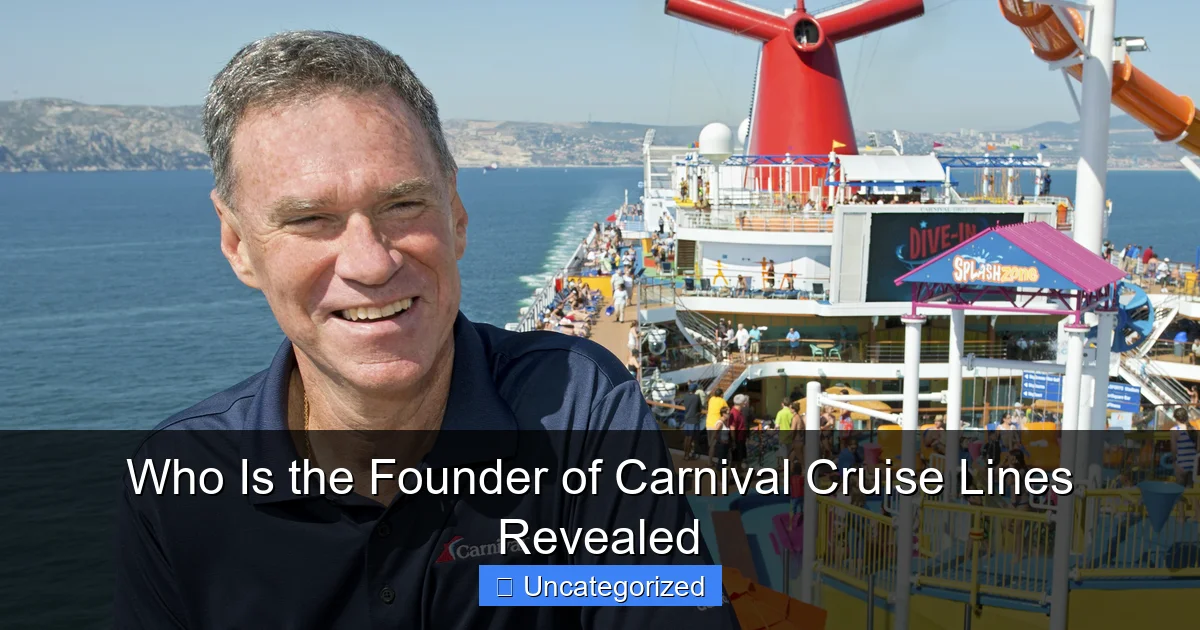
Featured image for who is the founder of carnival cruise lines
Image source: carnival-news.com
Ted Arison, an Israeli-American entrepreneur, is the visionary founder of Carnival Cruise Lines, launching the company in 1972 with a single ship and a bold dream to make cruising accessible to the masses. His innovative approach transformed Carnival into the “Fun Ships” brand, revolutionizing the cruise industry and paving the way for its global dominance today.
Key Takeaways
- Ted Arison founded Carnival Cruise Lines in 1972, revolutionizing affordable leisure cruising.
- Visionary leadership transformed Carnival from a single ship to a global cruise empire.
- Fun Ship concept pioneered casual, entertainment-focused vacations, redefining cruise experiences.
- Arison’s immigrant background fueled his entrepreneurial drive and innovative business strategies.
- Carnival’s growth under Arison set industry standards for mass-market cruise tourism.
- Legacy endures through Carnival Corporation, now the world’s largest cruise company.
📑 Table of Contents
- The Birth of a Cruise Empire: Who Is the Founder of Carnival Cruise Lines?
- Ted Arison: The Man Behind the Vision
- The Launch of Carnival Cruise Lines: A Risky Gamble
- Business Philosophy: The “Fun Ship” Revolution
- Ted Arison’s Legacy and Leadership Style
- The Lasting Impact of Ted Arison on the Cruise Industry
The Birth of a Cruise Empire: Who Is the Founder of Carnival Cruise Lines?
Imagine a world where vacationing at sea wasn’t reserved for the elite, but instead accessible to everyday families, couples, and adventurers seeking sun, fun, and relaxation. This vision didn’t materialize overnight—it was the brainchild of one man whose name would become synonymous with affordable, fun-filled ocean travel: Ted Arison. The story of Carnival Cruise Lines is not just a tale of a successful business, but a transformative moment in the history of tourism. In the late 1960s, when cruising was still a luxury for the wealthy, Arison dared to dream differently. He saw the potential to democratize sea travel, turning cruise vacations into an accessible, mass-market experience. Today, Carnival Cruise Lines is one of the most recognizable names in the global cruise industry, but few know the man behind the magic—how he started, what drove him, and how his legacy continues to shape the way millions travel.
Understanding who founded Carnival Cruise Lines isn’t just about uncovering a name—it’s about exploring a revolution in travel. From a single secondhand ship purchased in 1972 to a fleet that now spans over 20 vessels and carries more than 6 million passengers annually, Carnival’s journey is a masterclass in innovation, resilience, and entrepreneurial spirit. This blog post dives deep into the life of Ted Arison, the visionary founder of Carnival Cruise Lines, examining his background, business philosophy, early struggles, and the cultural shift he helped create. Whether you’re a cruise enthusiast, a business student, or simply curious about the man who made “Fun Ships” a household name, this comprehensive exploration reveals the full story behind one of the most impactful figures in modern leisure travel.
Ted Arison: The Man Behind the Vision
Early Life and Background
Ted Arison was born on February 24, 1924, in Tel Aviv, then part of British Mandate Palestine (now Israel). Raised in a family with strong business roots, Arison’s father, Leon Arison, was a successful entrepreneur who ran a shipping company and a travel agency. This early exposure to international trade, logistics, and customer service planted the seeds for Ted’s future career in the travel and shipping industries. As a young man, Arison served in the Israeli Air Force during the 1948 Arab-Israeli War, an experience that honed his discipline, leadership, and strategic thinking—qualities that would later define his business acumen.
Visual guide about who is the founder of carnival cruise lines
Image source: cruisefever.net
After the war, Arison moved to the United States in 1952, seeking new opportunities. He settled in New York City, where he initially worked in the music industry, managing artists and promoting concerts. His time in entertainment taught him the power of branding, audience engagement, and creating memorable experiences—skills he would later apply to the cruise business. Arison wasn’t just a businessman; he was a showman at heart, understanding that people don’t just buy a product—they buy an experience, a feeling, a story. This insight would become the cornerstone of Carnival’s success.
From Music to Maritime: A Pivotal Career Shift
In the 1960s, Arison began exploring opportunities in the travel industry. He co-founded a company called Arison Travel Bureau, which focused on organizing group tours and cruises for American travelers. It was during this period that he first recognized the untapped potential of the cruise market. At the time, cruising was seen as an exclusive, formal, and expensive vacation option—think white-gloved waiters, black-tie dinners, and itineraries focused on Europe’s elite ports. Arison believed that by stripping away the formality and focusing on fun, affordability, and accessibility, he could attract a much broader audience.
This idea crystallized in 1969 when Arison attended a cruise industry conference in Miami. He observed that while demand for leisure travel was growing rapidly, the cruise sector remained stagnant, dominated by a few luxury lines. He envisioned a new kind of cruise—one where the focus wasn’t on exclusivity, but on entertainment, relaxation, and value. He called it the “Fun Ship” concept: a floating resort with pools, casinos, live shows, and casual dining, designed to appeal to middle-class families and young travelers. This radical departure from tradition laid the foundation for what would become Carnival Cruise Lines.
Key Takeaway: Vision + Timing = Opportunity
Arison’s success wasn’t just about having a good idea—it was about timing and execution. He entered the cruise market at a moment when air travel was becoming more affordable, baby boomers were entering their prime spending years, and the concept of “vacation” was shifting from luxury to leisure. His ability to anticipate these cultural and economic shifts allowed him to position Carnival as a leader in the emerging mass-market cruise industry. Tip for aspiring entrepreneurs: Always look for gaps between what people want and what the market offers. Arison didn’t invent cruising—he reimagined it.
The Launch of Carnival Cruise Lines: A Risky Gamble
Founding the Company (1972)
In 1972, Ted Arison officially founded Carnival Cruise Lines with a bold move: he purchased the SS Mardi Gras, a 1961-built ocean liner originally owned by the French Line, for $13 million. The ship had seen better days—its last major voyage was a transatlantic journey—but Arison saw potential. He invested another $10 million to refit the vessel, transforming it from a formal liner into a vibrant, entertainment-focused cruise ship. The name “Mardi Gras” was retained, and Carnival’s branding was born: colorful, festive, and unapologetically fun.
Arison didn’t stop at the ship. He hired a team of marketing experts and began crafting a brand identity centered around excitement and affordability. He launched a massive advertising campaign with the slogan “The World’s Most Popular Cruise Line,” even before the company had a single passenger. This bold claim, backed by aggressive marketing and media outreach, generated buzz and curiosity. When the Mardi Gras set sail from Miami to the Caribbean in March 1972, it wasn’t just a new cruise—it was a new kind of vacation.
Early Struggles and the Near Collapse of Carnival
The launch didn’t go smoothly. The Mardi Gras suffered a major mechanical failure just days into its maiden voyage, forcing it to return to Miami. Passengers were stranded, refunds were issued, and the media had a field day. Critics declared Carnival a failure before it even got off the ground. But Arison didn’t give up. He saw the incident not as a disaster, but as a learning opportunity. He improved the ship’s maintenance protocols, invested in better engineering oversight, and personally apologized to every passenger.
More importantly, Arison used the crisis to build trust. He launched a “Carnival Promise” campaign, guaranteeing that every future cruise would be safe, enjoyable, and backed by a money-back guarantee. This transparency and customer-first approach turned skeptics into loyal customers. By 1974, Carnival was turning a profit, and by 1975, it was carrying over 100,000 passengers annually—a remarkable turnaround for a company that had nearly collapsed in its first year.
Expanding the Fleet: The “Fun Ship” Model Takes Off
With the success of the Mardi Gras, Arison doubled down on his vision. In 1975, he acquired the SS Carnivale, renaming it the Carnival Holiday, and in 1982, he launched the Carnival Fantasy—the first of a new class of purpose-built “Fun Ships” designed from the ground up for entertainment and mass appeal. These ships featured innovations like onboard casinos (legal in international waters), 24-hour buffet restaurants, multiple swimming pools, and nightly live entertainment, including comedy shows and musical revues.
Arison’s strategy was simple: make cruising feel like a vacation, not a formal event. He eliminated dress codes, introduced casual dining options, and focused on creating a party atmosphere. This resonated with a generation of travelers who valued relaxation, fun, and value over tradition and formality. By the mid-1980s, Carnival had become the largest cruise line in the world by passenger volume, a title it would hold for decades.
Practical Tip: Crisis as a Catalyst
Every entrepreneur faces setbacks. Arison’s near-failure with the Mardi Gras could have ended the company, but he turned it into a strength. Lesson: When things go wrong, respond with transparency, empathy, and action. Customers forgive mistakes—but they don’t forgive indifference.
Business Philosophy: The “Fun Ship” Revolution
Democratizing Cruising
At the heart of Carnival’s success was Ted Arison’s belief that cruising should be accessible to everyone. He rejected the elitism of traditional cruise lines, which often targeted older, wealthier travelers with formal itineraries and high prices. Instead, Arison focused on affordability, convenience, and fun. He introduced shorter cruises (3- to 7-day itineraries), lower base fares, and all-inclusive packages that made budgeting easier for families.
For example, in the 1980s, a 7-day Carnival cruise to the Bahamas could cost as little as $499 per person—including accommodations, meals, and entertainment. This price point was revolutionary, making cruising competitive with land-based vacations like Disney World or Las Vegas. Arison also partnered with airlines and travel agencies to create bundled vacation packages, further reducing the barrier to entry.
Innovation in Customer Experience
Arison didn’t just lower prices—he redefined the onboard experience. Carnival ships were designed with the guest in mind: open decks for sunbathing, multiple dining venues (including buffets and casual grills), and entertainment options for all ages. He hired performers, comedians, and musicians to create a non-stop festival atmosphere. The “Fun Ship” wasn’t just a slogan—it was a promise.
One of Arison’s most impactful innovations was the introduction of the “Cruise Director” role. Unlike traditional cruise directors who focused on scheduling and announcements, Carnival’s Cruise Directors were entertainers, hosts, and cheerleaders. They led games, hosted parties, and engaged with guests personally, creating a sense of community and fun. This personal touch became a hallmark of the Carnival brand.
Marketing and Branding: Creating a Lifestyle
Arison understood that branding was about more than logos and slogans—it was about creating a lifestyle. Carnival’s marketing emphasized joy, relaxation, and adventure. Ads featured smiling families, couples dancing on deck, and friends laughing at the pool. The tone was upbeat, inclusive, and aspirational. Arison also embraced television, sponsoring shows like “Love Boat” and “The Love Boat” (ironically, a show that later became a cultural phenomenon), to associate Carnival with romance, fun, and escape.
By the 1990s, Carnival had become a cultural icon. Its ships were featured in movies, music videos, and even political campaigns. Arison’s vision had not only succeeded—it had reshaped the entire cruise industry. Competitors like Royal Caribbean and Norwegian Cruise Line began adopting similar “fun” and casual approaches, proving that Arison had tapped into a universal desire for joyful, stress-free vacations.
Key Insight: Value Isn’t Just Price
Arison’s genius was in understanding that value isn’t just about low prices—it’s about emotional return. A Carnival cruise offered not just a trip, but a feeling: freedom, fun, and togetherness. Tip for businesses: Focus on the emotional benefits of your product, not just its features.
Ted Arison’s Legacy and Leadership Style
Building a Company Culture of Fun and Integrity
Ted Arison wasn’t just a CEO—he was a cultural architect. He instilled a company-wide philosophy centered on fun, fairness, and family. He believed that happy employees lead to happy customers, so he invested in staff training, recognition programs, and a supportive work environment. Crew members were encouraged to engage with guests, share stories, and create memorable moments.
Arison also emphasized ethical business practices. He was known for treating suppliers, partners, and employees with respect. He avoided cutthroat competition and instead focused on growing the market. This long-term thinking helped Carnival build strong relationships with ports, airlines, and governments, ensuring smooth operations and positive community engagement.
Philanthropy and Social Responsibility
Beyond business, Arison was a dedicated philanthropist. In 1994, he and his wife, Lin, established the Ted Arison Family Foundation, which supports education, healthcare, and social welfare initiatives in Israel and the United States. The foundation has donated hundreds of millions of dollars to causes like youth programs, medical research, and disaster relief.
Arison also supported the arts, funding music schools, theater groups, and cultural events. His love for music—rooted in his early career—never faded. He believed that culture and creativity were essential to a fulfilling life, a value reflected in Carnival’s emphasis on live entertainment and guest engagement.
Succession and the Arison Family
In 1992, Ted Arison stepped down as CEO of Carnival Corporation but remained chairman until his death in 1999. His son, Micky Arison
The Arison family continues to play a significant role in the company’s governance. Micky Arison served as chairman until 2013 and remains a key figure in strategic decisions. The family’s commitment to Ted’s original vision—fun, accessibility, and innovation—has ensured Carnival’s enduring success. Ted Arison’s influence extends far beyond the ships that bear his company’s name. He didn’t just found a cruise line—he redefined an entire industry. Before Carnival, cruising was a niche, formal, and expensive experience. After Arison, it became a mainstream, fun, and affordable vacation option for millions. His “Fun Ship” model has been adopted, adapted, and emulated by cruise lines worldwide, from Royal Caribbean’s mega-ships to Virgin Voyages’ adult-focused experiences. Moreover, Arison’s legacy lives on in the way cruise companies approach customer experience. The emphasis on entertainment, casual dining, and guest engagement—hallmarks of the Carnival brand—are now industry standards. His focus on affordability and accessibility has made cruising one of the most popular vacation choices in the world, with over 30 million passengers annually across all brands. Today, Carnival Cruise Lines continues to innovate, launching new ships with advanced technology, sustainable practices, and immersive entertainment. The company’s commitment to fun, value, and family-friendly experiences remains unchanged—a testament to Ted Arison’s enduring vision. As the cruise industry evolves, facing challenges like climate change, digital transformation, and changing consumer preferences, Arison’s principles of adaptability, customer focus, and joyful service remain more relevant than ever. In the end, the question “Who is the founder of Carnival Cruise Lines?” is answered not just with a name, but with a legacy. Ted Arison was more than an entrepreneur—he was a visionary who believed that travel should be fun, inclusive, and accessible to all. His story reminds us that innovation isn’t always about creating something new—it’s about seeing the world differently and having the courage to change it. The founder of Carnival Cruise Lines is Ted Arison, an Israeli-American businessman who launched the company in 1972. Arison pioneered the concept of “fun ships,” transforming cruise vacations into affordable, entertaining experiences. Ted Arison saw an opportunity to make cruising accessible to everyday travelers, not just the wealthy. His vision of casual, lively voyages with onboard entertainment became Carnival’s hallmark. Ted Arison founded Carnival Cruise Lines in 1972 after acquiring the SS *Mardi Gras*. The first voyage set sail that same year, marking the start of a global cruise empire. Arison revolutionized cruising by introducing themed decks, casual dining, and non-stop entertainment. His “fun ship” model attracted younger, budget-conscious travelers and reshaped the industry. Yes, Arison co-founded Norwegian Cruise Line in 1966 before starting Carnival. He also owned the NBA’s Miami Heat and donated millions to Israeli arts and culture. After Ted Arison’s death in 1999, his son Micky Arison took over as CEO, expanding Carnival into the world’s largest cruise operator. The company remains a leader in the industry today.Data Table: Carnival’s Growth Under the Arison Legacy
Year
Fleet Size
Passengers Carried (Annual)
Key Milestone
1972
1
10,000
Launch of SS Mardi Gras
1980
4
300,000
First purpose-built “Fun Ship” launched
1990
10
1.2 million
Carnival becomes world’s largest cruise line
2000
18
3 million
Launch of Carnival Cruise Lines’ “Spirit Class”
2023
27
6.5 million
Introduction of LNG-powered ships and AI guest services
The Lasting Impact of Ted Arison on the Cruise Industry
Frequently Asked Questions
Who is the founder of Carnival Cruise Lines?
What inspired Ted Arison to start Carnival Cruise Lines?
When did Ted Arison establish Carnival Cruise Lines?
How did the founder of Carnival Cruise Lines change the industry?
Was Ted Arison involved in other ventures besides Carnival?
What happened to Carnival after its founder’s death?