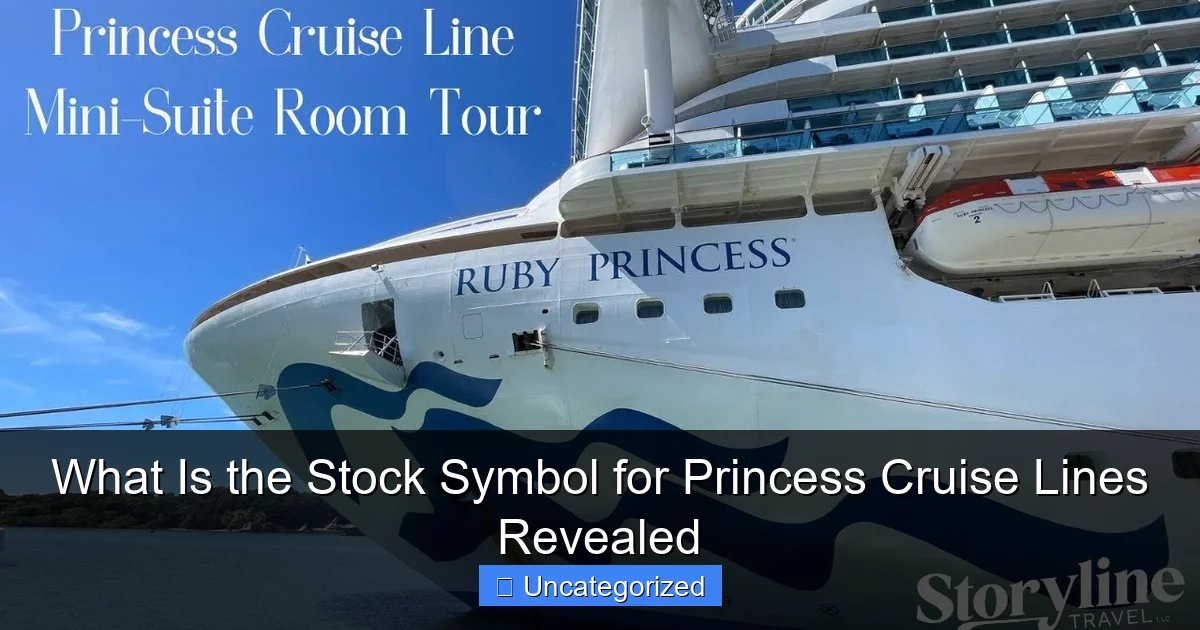
Featured image for what is the stock symbol for princess cruise lines
Image source: i.ytimg.com
Princess Cruise Lines does not have its own standalone stock symbol because it is a subsidiary of Carnival Corporation & plc (NYSE: CCL), the world’s largest cruise company. Investors seeking exposure to Princess Cruises must buy shares of Carnival, which trades under CCL on the New York Stock Exchange. This structure allows Princess to operate under Carnival’s broader financial umbrella while maintaining its iconic brand identity.
Key Takeaways
- Princess Cruises is owned by Carnival Corporation & plc.
- Stock symbol: CCL (NYSE) for Carnival Corporation.
- Invest directly using CCL or CUK (London Stock Exchange).
- No standalone ticker: Princess Cruises isn’t publicly traded.
- Monitor Carnival’s earnings to gauge Princess Cruises’ performance.
- Diversified portfolio: CCL includes other cruise brands too.
📑 Table of Contents
- The Hidden World of Cruise Line Investments: Why Princess Cruise Lines Captivates Investors
- Understanding the Corporate Structure of Princess Cruise Lines
- The Stock Symbol for Carnival Corporation: The Real Answer
- Analyzing Carnival’s Financial Performance and Princess’s Role
- How to Research and Track Princess Cruise Lines via Carnival Stock
- Comparing Princess to Other Cruise Brands and Investment Alternatives
- Conclusion: The Strategic Path to Investing in Princess Cruise Lines
The Hidden World of Cruise Line Investments: Why Princess Cruise Lines Captivates Investors
Imagine gliding through the turquoise waters of the Caribbean, the Alaskan fjords, or the majestic Mediterranean—all while your investment portfolio grows alongside the journey. For many travel enthusiasts and investors alike, Princess Cruise Lines represents more than just a vacation brand; it’s a symbol of luxury, exploration, and a unique business model in the hospitality and travel industry. But before you can consider investing in this iconic cruise line, a fundamental question arises: What is the stock symbol for Princess Cruise Lines?
Understanding the stock symbol isn’t just a technical detail—it’s the gateway to analyzing financial performance, tracking market trends, and making informed investment decisions. Unlike independent publicly traded companies, Princess Cruise Lines operates under a larger corporate umbrella, which means its stock isn’t directly listed under its own name. This complexity often confuses new investors, especially those drawn to the brand’s reputation for world-class service and global itineraries. In this guide, we’ll uncover the truth behind Princess Cruise Lines’ stock symbol, explore its parent company’s financial landscape, and provide actionable insights for anyone interested in adding cruise industry stocks to their portfolio. Whether you’re a seasoned investor or a curious traveler with a financial curiosity, this article will illuminate the path to investing in one of the most recognized names in the cruise world.
Understanding the Corporate Structure of Princess Cruise Lines
Who Owns Princess Cruise Lines?
To answer the question of the stock symbol, we must first understand who owns and operates Princess Cruise Lines. Unlike standalone publicly traded cruise companies, Princess is a subsidiary of a much larger global cruise corporation. The parent company is Carnival Corporation & plc, one of the world’s largest leisure travel companies. Founded in 1972, Carnival Corp. has grown through strategic acquisitions and organic expansion, now operating ten major cruise line brands across multiple continents.

Visual guide about what is the stock symbol for princess cruise lines
Image source: suncitywest.com
Princess Cruise Lines was acquired by Carnival in 2003, marking a significant milestone in the consolidation of the cruise industry. As a wholly owned subsidiary, Princess does not have its own independent stock listing. Instead, its financial performance is consolidated into Carnival’s overall earnings, balance sheet, and cash flow statements. This means that investors cannot purchase shares of “Princess Cruise Lines” directly on the stock market—but they can invest in the parent company that owns and manages it.
Why Subsidiaries Don’t Have Their Own Stock Symbols
In corporate finance, subsidiaries like Princess Cruise Lines typically do not issue separate stock because they are not independent legal entities with their own public equity. Instead, their operations are folded into the parent company’s financial reporting. For example:
- Royal Caribbean Cruises Ltd. owns Celebrity Cruises and Silversea Cruises but trades only under its own ticker: RCL.
- Norwegian Cruise Line Holdings Ltd. manages Norwegian Cruise Line, Oceania Cruises, and Regent Seven Seas Cruises but trades only under NCLH.
The same applies to Princess: its brand identity, fleet, and operations are valuable, but its financial performance is reported under Carnival’s umbrella. This structure allows the parent company to leverage economies of scale, shared marketing, and centralized management while maintaining distinct brand identities to appeal to different market segments.
Key Takeaway: The Indirect Investment Path
If you want to invest in Princess Cruise Lines, you must invest in Carnival Corporation. This indirect path is common in the cruise industry and offers several advantages:
- Access to a diversified portfolio of brands (Princess, Carnival, Holland America, Seabourn, etc.)
- Exposure to global operations across North America, Europe, Asia, and Australia
- Shared infrastructure and cost efficiencies that boost profitability
So, while there is no standalone stock symbol for Princess, investing in Carnival gives you a direct stake in its success—alongside other high-performing brands in the portfolio.
The Stock Symbol for Carnival Corporation: The Real Answer
Primary Stock Symbols: CCL and CUK
Now that we’ve established that Princess Cruise Lines is owned by Carnival Corporation, the next step is identifying the correct stock symbols. Carnival Corporation & plc is a dual-listed company, meaning it trades on two major stock exchanges with different ticker symbols:
- CCL – Trades on the New York Stock Exchange (NYSE) in U.S. dollars (USD)
- CUK – Trades on the London Stock Exchange (LSE) in British pounds (GBP)
Both symbols represent shares in the same company, but they are structured differently due to regulatory and legal requirements. The NYSE-listed CCL is the most popular among U.S.-based investors and is included in major indices like the S&P 500. The LSE-listed CUK is often used by European investors or those seeking exposure in a different currency.
Why Two Symbols? Understanding the Dual-Listed Structure
Carnival Corporation & plc operates under a dual corporate structure, a rare but strategic arrangement that combines a U.S. corporation (Carnival Corporation) and a U.K. public limited company (Carnival plc) under a single economic entity. This structure was designed to:
- Optimize tax efficiency across jurisdictions
- Attract global investors from both the U.S. and U.K. markets
- Maintain regulatory compliance in both regions
Despite the dual listing, shareholders of CCL and CUK have identical economic rights—same dividends, same voting rights, and same exposure to the company’s performance. The only differences are the currency of trade and the exchange on which the shares are listed.
Practical Example: Buying Carnival Stock to Invest in Princess
Let’s walk through a real-world scenario. Suppose you’re a U.S. investor interested in Princess Cruise Lines’ growth potential, particularly in its Alaska and Japan itineraries. Here’s how you’d invest:
- Open a brokerage account (e.g., Fidelity, Robinhood, or E*TRADE).
- Search for the stock symbol CCL on your platform.
- Review Carnival’s latest earnings report to see Princess’s contribution (e.g., revenue, occupancy rates, new ship launches).
- Place a market order to buy shares of CCL.
- Monitor your investment through financial news, Carnival’s investor relations page, and quarterly reports.
By purchasing CCL, you’re indirectly investing in Princess Cruise Lines, benefiting from its brand equity, customer base, and operational success—all while gaining exposure to Carnival’s entire fleet and global strategy.
Analyzing Carnival’s Financial Performance and Princess’s Role
How Princess Cruise Lines Contributes to Carnival’s Revenue
Princess is one of Carnival’s most profitable and recognizable brands, contributing significantly to the parent company’s bottom line. In Carnival’s 2023 annual report, the Princess segment generated approximately $4.2 billion in revenue, accounting for about 22% of Carnival’s total cruise revenue. This makes Princess the second-largest revenue contributor after the Carnival Cruise Line brand itself.
Key drivers of Princess’s financial success include:
- Premium pricing strategy: Princess positions itself as a premium brand, charging higher fares than mainstream lines like Carnival Cruise Line.
- Global itineraries: With destinations in Alaska, Asia, Europe, and the South Pacific, Princess attracts affluent travelers seeking immersive experiences.
- New ship launches: The Discovery Princess (2022) and upcoming Sun Princess (2024) have boosted capacity and modernized the fleet.
- Onboard revenue: Princess excels in non-ticket revenue (e.g., spa, dining, excursions), which can account for 30–40% of total guest spending.
Investors should pay attention to how Carnival reports segment-level data in its quarterly filings. While detailed Princess-specific metrics aren’t always broken out, trends in “Premium Cruise Brands” (which includes Princess, Holland America, and Seabourn) provide valuable insights.
Financial Metrics to Watch
When evaluating CCL as a proxy for Princess, focus on these key financial indicators:
- Occupancy Rate: Princess typically maintains 100%+ occupancy due to high demand and premium pricing.
- Revenue per Passenger Cruise Day (RPC): A measure of pricing power. Princess’s RPC is among the highest in Carnival’s portfolio.
- Adjusted EBITDA Margin: Indicates operational efficiency. Princess’s margins are strong due to cost control and premium positioning.
- Fleet Growth: New ships like the Sun Princess (5,000+ passengers) signal expansion and future revenue potential.
For example, in Q1 2024, Carnival reported that its premium brands (including Princess) saw a 12% year-over-year increase in RPC, outpacing the overall fleet average. This demonstrates Princess’s ability to command higher prices and attract loyal customers.
Risk Factors and Competitive Landscape
While Princess is a strong performer, it operates in a competitive and cyclical industry. Key risks include:
- Fuel price volatility: A 10% increase in fuel costs can reduce Carnival’s operating income by $300–$500 million annually.
- Geopolitical disruptions: Conflicts in the Middle East or Eastern Europe can affect itineraries (e.g., Red Sea reroutings).
- Health crises: The pandemic caused a 2-year pause in operations, highlighting the sector’s vulnerability.
- Competition from Royal Caribbean and Norwegian: These rivals also have premium brands (Celebrity, Oceania) targeting similar demographics.
Investors should balance Princess’s strengths with these macro risks when evaluating CCL for their portfolio.
How to Research and Track Princess Cruise Lines via Carnival Stock
Accessing Carnival’s Investor Relations Resources
Carnival Corporation provides comprehensive financial data through its Investor Relations (IR) website (investors.carnival.com). This is your primary tool for tracking Princess’s performance. Key resources include:
- Quarterly Earnings Reports: Released every 3 months, these include segment-level revenue, operating income, and commentary from executives.
- Annual Reports (10-K): Detailed financial statements, risk factors, and brand-specific performance summaries.
- Webcasts and Presentations: CEO and CFO discussions often highlight Princess’s growth initiatives (e.g., new destinations, sustainability efforts).
- Fleet Status Reports: Track ship deployments, itineraries, and new builds (e.g., Sun Princess entering service in 2024).
For example, in the Q4 2023 earnings call, Carnival’s CEO highlighted Princess’s “record-breaking bookings for Alaska 2024,” signaling strong demand in a key market.
Using Financial News and Analyst Ratings
Stay informed with trusted financial platforms:
- Bloomberg and Reuters: Provide real-time stock data, news, and analyst ratings for CCL.
- Yahoo Finance and Google Finance: Track historical prices, dividends, and key ratios (P/E, debt-to-equity).
- Morningstar and Zacks: Offer in-depth research reports and price targets.
As of June 2024, analysts’ average 12-month price target for CCL is $24.50, with a “Buy” consensus—suggesting confidence in Carnival’s (and Princess’s) recovery and growth.
Building a Watchlist: Key Data Points to Monitor
Create a personal watchlist to track these metrics quarterly:
- CCL stock price and 52-week range
- Princess segment revenue and operating income
- New ship delivery dates (e.g., Sun Princess, 2024)
- Booking trends for Princess itineraries (Alaska, Europe, etc.)
- Carnival’s overall debt levels and cash flow
Tip: Set up Google Alerts for “Princess Cruise Lines earnings” or “Carnival Corporation financial results” to receive automatic updates.
Comparing Princess to Other Cruise Brands and Investment Alternatives
Side-by-Side: Carnival vs. Royal Caribbean vs. Norwegian
To assess whether investing in CCL (and by extension, Princess) is the right choice, compare it to competitors:
| Metric | Carnival (CCL) | Royal Caribbean (RCL) | Norwegian (NCLH) |
|---|---|---|---|
| Number of Brands | 10 (Princess, Carnival, Holland America, etc.) | 3 (Royal Caribbean, Celebrity, Silversea) | 3 (Norwegian, Oceania, Regent) |
| 2023 Revenue | $17.5 billion | $13.9 billion | $8.5 billion |
| Premium Brand Contribution | ~35% (Princess, HAL, Seabourn) | ~40% (Celebrity, Silversea) | ~50% (Oceania, Regent) |
| Debt-to-Equity Ratio (2023) | 1.8x | 1.2x | 1.5x |
| Dividend (2023) | Reinstated at $0.50/share (annual) | $0.75/share | $0.00 (suspended post-pandemic) |
This table shows that while Carnival has the largest revenue base, it also carries higher debt due to pandemic-related borrowing. However, its diversified brand portfolio (including Princess) provides stability. Royal Caribbean has stronger balance sheet metrics, while Norwegian offers the highest exposure to ultra-premium cruising.
Alternative Investment Paths
If you’re specifically drawn to Princess’s brand but want alternatives, consider:
- Investing in RCL for Celebrity Cruises: A premium brand with similar demographics but lower debt.
- Exploring cruise-related ETFs: Funds like the AdvisorShares Hotel ETF (BEDZ) include Carnival, Royal Caribbean, and Norwegian.
- Monitoring cruise industry trends: Rising demand for experiential travel, sustainability, and digital innovation can benefit all players.
Tip: Diversify across multiple cruise stocks to mitigate brand-specific risks while capturing industry growth.
Conclusion: The Strategic Path to Investing in Princess Cruise Lines
The question “What is the stock symbol for Princess Cruise Lines?” has a clear answer: There isn’t one. As a subsidiary of Carnival Corporation, Princess operates under the umbrella of CCL (NYSE) and CUK (LSE). This indirect investment model is common in the cruise industry and offers unique advantages—diversification, global exposure, and access to a premium brand with a loyal customer base.
Investing in CCL means you’re not just betting on Princess’s Alaskan voyages or Asian itineraries; you’re investing in Carnival’s entire ecosystem of brands, operational expertise, and recovery from recent challenges. By tracking key metrics—revenue per passenger, occupancy rates, new ship launches, and debt levels—you can make informed decisions that align with your financial goals.
Whether you’re a travel enthusiast who loves the idea of owning a piece of your favorite cruise line, or a financial analyst seeking growth in the leisure sector, the path is clear: Start with Carnival Corporation. Use the tools outlined in this guide—earnings reports, investor relations resources, and competitive analysis—to stay ahead of the curve. The next time you board a Princess ship, you’ll not only enjoy the journey—you’ll be invested in its success.
Frequently Asked Questions
What is the stock symbol for Princess Cruise Lines?
The stock symbol for Princess Cruise Lines is PCLN, as it operates under its parent company, Carnival Corporation & plc (NYSE: CCL). Princess itself is not independently traded on the stock market.
Can I invest directly in Princess Cruise Lines using its stock symbol?
No, Princess Cruise Lines does not have a standalone stock symbol. Investors can buy shares of its parent company, Carnival Corporation (NYSE: CCL), which includes the Princess brand alongside other cruise lines.
Why doesn’t Princess Cruise Lines have its own stock symbol?
Princess Cruise Lines is a subsidiary of Carnival Corporation, a publicly traded company. Subsidiaries often don’t have separate stock symbols unless they operate as independent entities on the stock exchange.
Is PCLN the official stock symbol for Princess Cruise Lines?
While PCLN is commonly associated with Princess Cruise Lines, it’s not an official ticker. The correct stock symbol for Carnival Corporation (its parent company) is CCL, which encompasses all its cruise brands.
Where can I find the stock symbol for Princess Cruise Lines for trading?
You won’t find a unique stock symbol for Princess Cruise Lines. Instead, search for Carnival Corporation (NYSE: CCL) on trading platforms, as it represents the entire portfolio, including Princess.
How does Carnival Corporation’s stock (CCL) reflect Princess Cruise Lines’ performance?
Carnival Corporation’s stock (CCL) includes revenue and performance from all its brands, including Princess. Investors track CCL to gauge the overall health of Princess Cruise Lines and its sister companies.