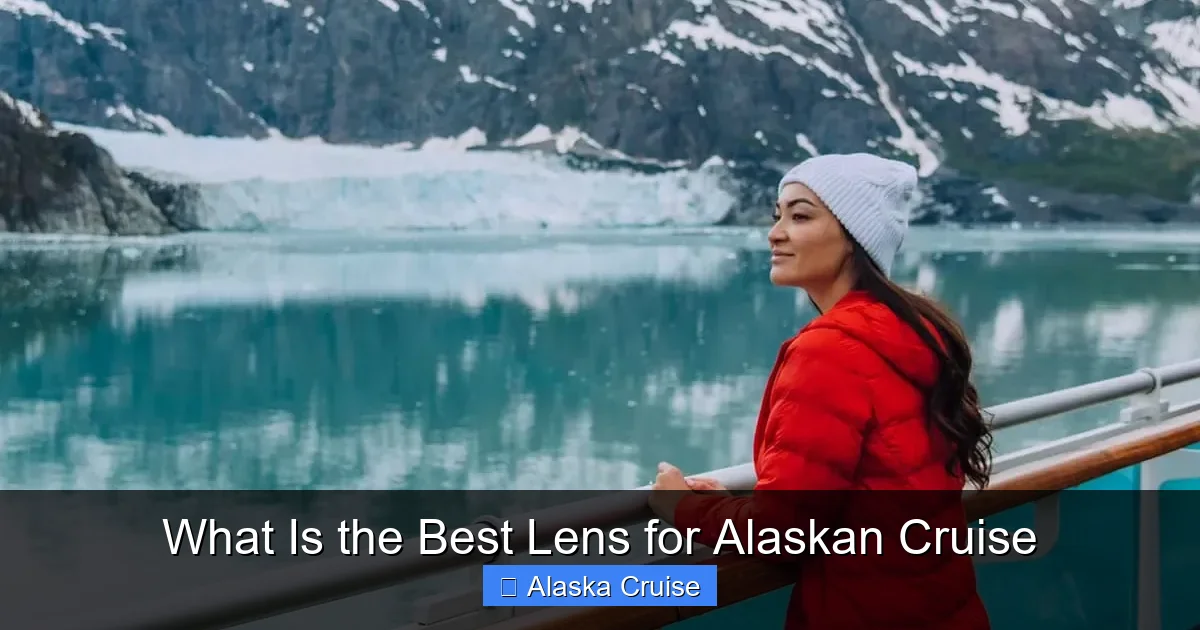
Choosing the best lens for an Alaskan cruise means balancing versatility, zoom range, and image quality in unpredictable weather. From towering glaciers to distant whales, the right lens ensures you capture every breathtaking moment with clarity and detail.
Key Takeaways
- Zoom versatility is essential: A telephoto lens (70-300mm or 100-400mm) lets you capture distant wildlife like whales, bears, and eagles without disturbing them.
- Wide-angle lenses enhance landscapes: Use a 16-35mm or 14-24mm lens to photograph vast glaciers, fjords, and mountain ranges in full glory.
- Weather sealing matters: Alaska’s damp, cold, and windy conditions demand lenses with robust build quality and moisture resistance.
- Image stabilization is a game-changer: Optical stabilization helps reduce blur from boat movement and low-light shooting during early mornings or overcast skies.
- Carry a versatile all-in-one zoom: A 24-105mm f/4 lens offers a great balance for everyday shots, from port towns to scenic decks.
- Prime lenses for low light: A fast prime like a 50mm f/1.8 can improve performance in dim cabins or twilight wildlife moments.
- Pack light but smart: Limit yourself to 2-3 lenses to avoid overpacking while covering wide, standard, and telephoto ranges.
📑 Table of Contents
What Is the Best Lens for Alaskan Cruise?
An Alaskan cruise is one of the most visually stunning travel experiences on Earth. From towering glaciers calving into icy waters to breaching humpback whales and bald eagles soaring above dense forests, every moment feels like a scene from a nature documentary. But capturing these fleeting, awe-inspiring moments requires more than just a good camera—it demands the right lens.
Choosing the best lens for an Alaskan cruise isn’t about picking the most expensive or technically advanced option. It’s about matching your gear to the unique conditions and subjects you’ll encounter. The lighting can shift rapidly, the weather is unpredictable, and many of the most memorable sights—like a bear fishing on a riverbank or a pod of orcas surfacing near the ship—happen at a distance. Add in the constant motion of a moving vessel, and you’ve got a photography challenge that calls for smart, practical lens choices.
Whether you’re a seasoned photographer or a casual snapshooter upgrading from a smartphone, understanding which lenses deliver the best results in Alaska can make or break your photo memories. In this guide, we’ll walk you through the top lens options, explain why they work, and help you build a compact, effective kit that won’t weigh you down on shore excursions.
Understanding Alaska’s Photography Challenges
Visual guide about What Is the Best Lens for Alaskan Cruise
Image source: i.pinimg.com
Alaska’s natural beauty is unmatched, but photographing it comes with a set of unique challenges that can trip up even experienced shooters. The first hurdle is distance. Much of what makes Alaska special—wildlife, glaciers, and remote landscapes—is often far from your vantage point, especially when you’re on a cruise ship. You might spot a bear on a hillside a mile away or see a whale breach just beyond the ship’s railing. Without a telephoto lens, these moments become blurry smudges rather than crisp, detailed images.
Lighting is another major factor. Alaska’s high latitude means long summer days with extended golden hours, but also frequent overcast skies, fog, and sudden rain showers. Early mornings and late evenings—prime times for wildlife activity—can be dim, requiring lenses that perform well in low light. At the same time, bright snow and ice can create harsh contrasts and overexposed skies if you’re not careful.
Then there’s the environment itself. Cruise ships move constantly, creating subtle vibrations that can blur photos, especially at long focal lengths. Add in wind, spray, and humidity, and you’ve got a recipe for equipment stress. Lenses without weather sealing can fog up or suffer internal damage, and dust or salt spray can ruin delicate optics.
Finally, space and weight are practical concerns. You’ll be carrying your gear on and off the ship, hiking trails, and navigating crowded decks. A heavy, bulky lens collection might seem ideal in theory, but in practice, it can slow you down and limit your spontaneity.
Why Distance Matters in Alaskan Photography
One of the most common regrets among cruise photographers is not bringing enough zoom. Alaska’s wildlife is often skittish and keeps its distance. Moose, bears, and mountain goats are rarely close enough for a wide-angle shot. Even marine life—like whales, sea lions, and porpoises—appears small from the deck of a ship unless you have serious reach.
A telephoto lens with at least 300mm of focal length (or more with a teleconverter) gives you the ability to frame distant subjects tightly. For example, a 100-400mm lens lets you zoom in on a glacier’s crevasses or isolate a bald eagle perched on a distant tree. Without that reach, you’re left cropping heavily in post-processing, which degrades image quality.
Dealing with Variable Lighting Conditions
Alaska’s weather is famously fickle. One minute it’s sunny and clear; the next, a thick fog rolls in. This means your lens needs to handle both bright, high-contrast scenes and dim, low-light situations. A lens with a wide maximum aperture (like f/2.8 or f/4) gathers more light, allowing faster shutter speeds and better performance in overcast or twilight conditions.
But aperture isn’t the only factor. Image stabilization (IS, VR, or OS, depending on the brand) is crucial when shooting from a moving ship or in low light. It compensates for hand shake and boat motion, letting you shoot at slower shutter speeds without blur. For example, a stabilized 70-200mm f/2.8 lens can make the difference between a sharp portrait of a kayaker in misty light and a unusable blur.
The Impact of Weather and Motion
Salt spray, rain, and condensation are constant threats in coastal Alaska. A lens with weather sealing—gaskets around the mount and control rings—helps protect against moisture and dust. Brands like Canon, Nikon, Sony, and Tamron offer sealed versions of popular lenses, such as the Canon RF 100-500mm f/4.5-7.1L IS USM or the Sony FE 70-200mm f/2.8 GM OSS.
Motion is another issue. Even on a large cruise ship, there’s a constant sway, especially in rough seas. This makes long exposures risky and telephoto shots harder to stabilize. Lenses with built-in stabilization are essential, but so is using a monopod or resting your elbows on a railing for extra support.
Top Lens Types for Alaskan Cruise Photography
Now that we’ve covered the challenges, let’s look at the lens types that rise to the occasion. The best lens for an Alaskan cruise is rarely a single option—it’s usually a combination of two or three lenses that cover different focal ranges and shooting scenarios.
Telephoto Zoom Lenses (70-300mm, 100-400mm)
If you could only bring one lens, a telephoto zoom would be the top contender. These lenses are essential for wildlife and distant landscapes. A 70-300mm lens is a great starting point, offering solid reach at a reasonable price and weight. For more serious wildlife photography, step up to a 100-400mm or 150-600mm lens.
For example, the Tamron 150-600mm f/5-6.3 Di VC USD G2 is a favorite among nature photographers for its sharpness, stabilization, and weather resistance. It’s perfect for capturing a bear catching salmon in a river or a pod of orcas swimming alongside the ship.
But telephoto lenses aren’t just for animals. They’re also useful for compressing perspective—making distant mountains appear closer and more dramatic. When a glacier calves, a 400mm lens lets you isolate the falling ice and splash, turning a chaotic event into a powerful image.
Wide-Angle Lenses (14-24mm, 16-35mm)
While telephoto lenses zoom in, wide-angle lenses do the opposite—they expand your view. These are ideal for capturing the grandeur of Alaska’s landscapes: massive glaciers, sweeping fjords, and endless skies.
A 16-35mm f/2.8 or f/4 lens is a versatile choice for full-frame cameras. It lets you shoot expansive scenes without losing detail at the edges. For example, standing on the deck at sunset with the ship framed against a glowing glacier is a moment made for a wide-angle lens.
Wide-angle lenses also work well in tight spaces, like the interior of a cabin or a small zodiac during a shore excursion. They allow you to include more of the environment, giving context to your shots.
However, be cautious with distortion. Wide lenses can exaggerate perspective, making people near the edges look stretched. Use them thoughtfully, especially in portraits or architectural shots.
Standard Zoom Lenses (24-70mm, 24-105mm)
For everyday shooting—portraits, street scenes in towns like Juneau or Ketchikan, and casual deck photos—a standard zoom is indispensable. The 24-70mm f/2.8 is a workhorse lens loved by professionals for its sharpness, speed, and versatility.
But for cruise travelers, the 24-105mm f/4 is often a better fit. It’s lighter, more compact, and still covers a useful range. You can shoot a wide group photo at 24mm, then zoom to 105mm for a tighter shot of a fellow passenger waving from the deck.
This lens is perfect for “walk-around” photography. Whether you’re exploring a historic cannery or snapping a selfie with a totem pole, the 24-105mm gives you flexibility without constant lens changes.
Prime Lenses for Low Light and Portraits
Prime lenses—fixed focal length, no zoom—might seem limiting, but they offer advantages in image quality and low-light performance. A 50mm f/1.8 lens, for example, is lightweight, affordable, and incredibly sharp. Its wide aperture lets in more light, making it ideal for dimly lit cabins, evening dinners, or twilight wildlife shots.
Prime lenses also encourage creativity. Without zoom, you’re forced to move your feet, which often leads to more dynamic compositions. A 35mm f/1.8 is great for environmental portraits—imagine a candid shot of a local artist at work in a small Alaskan village, with the workshop and tools in the background.
While not essential, a fast prime can be a valuable addition if you’re serious about photography and want to maximize image quality in challenging light.
Recommended Lens Combinations for Different Photographers
Not all travelers have the same goals or gear. Your ideal lens setup depends on your camera system, experience level, and photography priorities. Here are three practical combinations tailored to different needs.
For the Casual Traveler: Simple and Lightweight
If you’re more interested in memories than megapixels, a minimalist kit is best. Bring a 24-105mm f/4 lens and a 70-300mm telephoto zoom. This covers everything from wide landscapes to distant wildlife, with minimal weight and complexity.
Pair this with a mirrorless camera like the Sony a7 IV or Canon EOS R6, and you’ve got a powerful yet portable system. The 24-105mm handles most situations, while the 70-300mm gives you reach when needed. No need to swap lenses constantly—just zoom in and out.
This setup is ideal for someone who wants great photos without the hassle of managing multiple lenses. It’s also budget-friendly, as both lenses are available at mid-range prices.
For the Enthusiast Photographer: Balanced and Capable
If you’re passionate about photography and want to maximize image quality, consider a three-lens kit: a 16-35mm f/4 wide-angle, a 24-70mm f/2.8 standard zoom, and a 100-400mm telephoto.
This combination gives you full coverage from ultra-wide to super-telephoto. Use the 16-35mm for epic landscapes, the 24-70mm for portraits and everyday shots, and the 100-400mm for wildlife and distant details.
With this setup, you can adapt to almost any situation. For example, during a glacier tour, you might start with the wide-angle to capture the full scene, then switch to the telephoto to zoom in on ice formations or a nearby seal.
The trade-off is weight and cost, but for serious shooters, the flexibility is worth it.
For the Wildlife Specialist: Maximum Reach and Speed
If your main goal is photographing animals, prioritize reach and speed. Bring a 150-600mm telephoto lens and a 24-70mm f/2.8 for close-range work.
The 150-600mm lets you capture intimate details of bears, whales, and birds from a safe distance. Pair it with a camera with fast autofocus, like the Nikon Z9 or Canon R3, and you’ll be ready for action.
This kit is heavier and more expensive, but it’s unmatched for wildlife photography. Just be prepared to carry extra batteries and a monopod for stability.
Lens Features to Prioritize for Alaska
Beyond focal length, certain lens features make a big difference in Alaska’s demanding environment.
Weather Sealing
Look for lenses labeled as “weather-resistant” or “dust- and moisture-resistant.” These have rubber gaskets and sealed barrels to protect internal elements. In Alaska, where rain, fog, and salt spray are common, this feature can save your gear—and your photos.
Image Stabilization
Optical stabilization (IS, VR, OSS) is a must. It reduces blur from hand shake and boat motion, especially at long focal lengths. A stabilized lens lets you shoot at slower shutter speeds, which is crucial in low light or when using smaller apertures for depth of field.
Fast Autofocus
Wildlife moves quickly. A lens with fast, quiet autofocus (like Canon’s Nano USM or Sony’s Linear Motors) helps you lock onto subjects before they disappear. This is especially important for birds in flight or breaching whales.
Weight and Size
Cruise excursions often involve walking, climbing, and carrying gear. A heavy lens might be tempting for its specs, but if it slows you down, you’ll miss shots. Balance performance with portability.
Practical Tips for Using Your Lens on a Cruise
Even the best lens won’t help if you don’t use it well. Here are some practical tips to get the most out of your gear.
Protect Your Gear
Use a rain cover or plastic bag with a hole for the lens when shooting in wet conditions. Keep silica gel packs in your camera bag to absorb moisture. And always have a microfiber cloth handy to wipe condensation off the front element.
Use a Monopod or Railing
Stabilize your shots by bracing against the ship’s railing or using a compact monopod. This is especially helpful with telephoto lenses, where even slight movement causes blur.
Shoot in RAW
RAW files retain more detail and allow greater flexibility in editing. This is crucial for recovering shadows in dark forests or highlights in bright snow.
Plan for Golden Hours
The best light in Alaska is often at dawn and dusk. These times offer soft, warm light and increased wildlife activity. Be ready with your lens and settings adjusted.
Respect Wildlife
Never disturb animals for a photo. Use your telephoto lens to keep a safe distance. Remember, the goal is to capture nature, not interfere with it.
Conclusion
Choosing the best lens for an Alaskan cruise is about preparation, practicality, and passion. While no single lens can do it all, a smart combination—like a 24-105mm for versatility, a 70-300mm for reach, and a 16-35mm for landscapes—covers most scenarios.
Prioritize weather sealing, image stabilization, and fast autofocus to handle Alaska’s unpredictable conditions. And remember, the best gear in the world won’t help if you’re not ready to use it. Pack light, stay flexible, and keep your camera ready.
Alaska rewards those who are prepared. With the right lens, you won’t just see the wonders of the Last Frontier—you’ll capture them in stunning detail, creating photos that last a lifetime.
Frequently Asked Questions
What is the best all-around lens for an Alaskan cruise?
The 24-105mm f/4 is often considered the best all-around lens for an Alaskan cruise. It offers a versatile focal range, good image quality, and weather sealing, making it ideal for landscapes, portraits, and everyday shots without constant lens changes.
Do I need a telephoto lens for Alaska?
Yes, a telephoto lens (70-300mm or longer) is highly recommended. Much of Alaska’s wildlife and scenery is distant, and a telephoto lens lets you capture detailed shots of whales, bears, and glaciers without disturbing them or losing image quality.
Can I use a smartphone instead of a camera with lenses?
Smartphones are convenient and improving, but they lack the zoom range, low-light performance, and image quality of dedicated cameras with interchangeable lenses. For serious photography, a camera with the right lens is still the best choice.
Should I bring a tripod on an Alaskan cruise?
A full tripod is usually impractical on a cruise due to space and movement. A compact monopod or using the ship’s railing for support is a better option, especially for stabilizing telephoto shots.
What lens is best for photographing glaciers?
A wide-angle lens like a 16-35mm is ideal for capturing the full scale of glaciers and fjords. For detailed close-ups of ice formations, pair it with a telephoto lens like a 100-400mm.
How do I protect my lens from moisture in Alaska?
Use a weather-sealed lens, carry a rain cover, and store your gear with silica gel packs. Wipe condensation off the lens with a microfiber cloth before shooting, and avoid changing lenses in wet or humid conditions.