Featured image for what flag does carnival cruise line fly under
Image source: upload.wikimedia.org
Carnival Cruise Line sails under the Panamanian flag, a strategic choice that offers operational flexibility and tax advantages common among major cruise operators. This “flag of convenience” registration allows Carnival to maintain lower costs while complying with international maritime regulations, despite being headquartered in the U.S.
Key Takeaways
- Carnival sails under the Panamanian flag for regulatory and tax benefits.
- Flag choice impacts safety standards and crew labor laws significantly.
- Panama’s registry offers flexibility in operations and cost efficiency.
- Passenger rights vary by flag due to differing international maritime laws.
- Flag state influences inspections and compliance with global maritime regulations.
- No U.S. flag means fewer restrictions but less federal oversight protection.
📑 Table of Contents
- What Flag Does Carnival Cruise Line Fly Under Revealed
- The Concept of “Flag of Convenience” in the Cruise Industry
- Carnival Cruise Line’s Flag Strategy: A Fleet-by-Fleet Breakdown
- Legal and Regulatory Implications of Carnival’s Flag Choices
- Why Carnival Doesn’t Fly the U.S. Flag (And Why It Could)
- What This Means for Passengers and the Cruise Experience
- Data Table: Carnival Cruise Line Flag Distribution (2024)
- Conclusion: The Flag Behind the Fun
What Flag Does Carnival Cruise Line Fly Under Revealed
When you picture a Carnival Cruise Line ship gliding through crystal-blue waters, you might imagine the iconic red, white, and blue of the American flag fluttering proudly from the stern. But the truth is far more complex—and fascinating. The flag under which a cruise ship sails is more than just a symbol of national pride; it’s a critical legal, financial, and regulatory decision that affects everything from crew employment to tax obligations. For Carnival Cruise Line, one of the world’s most recognizable vacation brands, the flag of registry is a carefully chosen strategy that balances global operations, cost efficiency, and compliance with international maritime law.
So, what flag does Carnival Cruise Line fly under? The answer might surprise you. Despite being headquartered in Miami, Florida—a city synonymous with American maritime culture—Carnival Cruise Line does not sail under the U.S. flag for the vast majority of its fleet. Instead, its ships are registered under the flags of several countries, including Panama, the Bahamas, and Italy. This practice, known as using a “flag of convenience,” is not unique to Carnival but is a cornerstone of the modern cruise industry. In this in-depth exploration, we’ll uncover the reasons behind Carnival’s flag choices, the legal and financial implications, and what this means for passengers, crew, and the broader cruise ecosystem.
The Concept of “Flag of Convenience” in the Cruise Industry
What Is a Flag of Convenience?
A “flag of convenience” refers to the practice of registering a commercial vessel in a country other than the owner’s home country. This allows shipowners to take advantage of more favorable regulations, lower taxes, and reduced labor costs. The term originated in the early 20th century when American shipowners began registering their vessels in countries like Panama and Liberia to circumvent U.S. labor laws and safety standards. Today, the International Transport Workers’ Federation (ITF) recognizes over 30 countries as flag of convenience states, including Panama, the Bahamas, Bermuda, Malta, and the Marshall Islands.
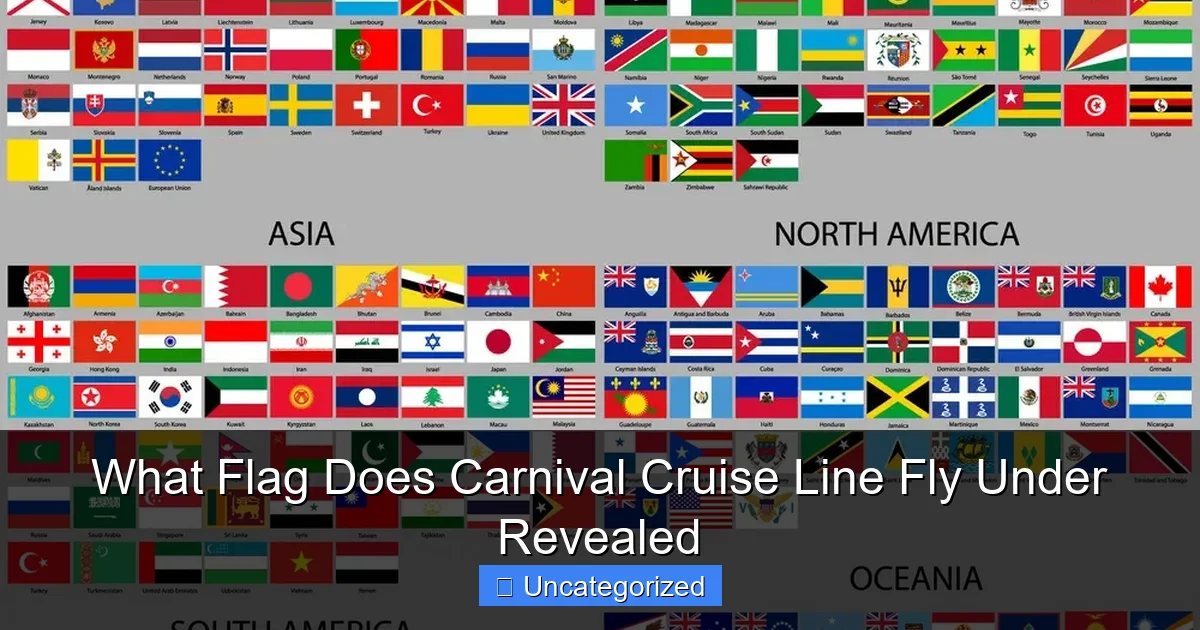
Visual guide about what flag does carnival cruise line fly under
Image source: cdn3.vectorstock.com
For cruise lines like Carnival, choosing a flag of convenience is not about evading responsibility—it’s about operational flexibility. Registering a ship under a foreign flag allows Carnival to:
- Comply with international maritime regulations while minimizing domestic tax burdens
- Employ a global crew without being subject to U.S. minimum wage or union requirements
- Streamline compliance with safety and environmental standards through the International Maritime Organization (IMO)
- Access international ports more easily, as foreign-flagged ships often face fewer diplomatic hurdles
Why Cruise Lines Choose Flags of Convenience
The cruise industry is highly competitive, with thin profit margins and high operational costs. Flagging a ship in a country like Panama or the Bahamas allows Carnival to:
- Reduce corporate income taxes: The U.S. corporate tax rate is significantly higher than those in flag-of-convenience nations. For example, Panama imposes no income tax on foreign-flagged vessels.
- Lower labor costs: U.S.-flagged ships must pay crew members under U.S. labor laws, including minimum wage and overtime. Foreign-flagged ships can hire international crews under contracts governed by the flag state’s laws, which often allow lower pay and fewer benefits.
- Simplify regulatory compliance: While all cruise ships must meet IMO standards, flag states conduct inspections and issue certifications. Some flag states are more lenient or faster in processing, reducing downtime.
For example, the Carnival Breeze, a 130,000-ton ship carrying over 4,000 passengers, is registered in Panama. This allows Carnival to operate the ship globally without being subject to U.S. Coast Guard inspections for crew wages or working conditions. Instead, Panama’s Maritime Authority oversees compliance—though Carnival still adheres to IMO safety and environmental standards.
Carnival Cruise Line’s Flag Strategy: A Fleet-by-Fleet Breakdown
Panama: The Most Common Flag for Carnival Ships
Panama is the most popular flag of registry for Carnival Cruise Line. As of 2024, over 70% of Carnival’s 27-ship fleet sails under the Panamanian flag. This includes major vessels like the Carnival Horizon, Carnival Panorama, and Carnival Celebration. Panama offers several advantages:
- No corporate income tax on foreign-flagged vessels
- Low registration and annual fees
- Streamlined documentation process
- Strong international recognition and port access
Panama also benefits from its geographic location—it’s a major maritime hub with the Panama Canal, making it a logical administrative base for global cruise operations. Carnival’s partnership with Panama is so strong that the company maintains a regional office in Panama City to handle flag-related compliance and inspections.
The Bahamas: A Strategic Choice for Newer Ships
While Panama dominates, the Bahamas is another key flag state for Carnival. Ships like the Carnival Mardi Gras (the first LNG-powered cruise ship in North America) and the Carnival Jubilee are registered in the Bahamas. The Bahamian government has invested heavily in modernizing its maritime administration to attract major cruise lines, offering:
- Competitive registration fees
- Robust safety and environmental oversight
- Proximity to major U.S. cruise ports like Miami and Port Canaveral
The Bahamas also has a reputation for high-quality maritime governance, which reassures passengers and investors. Carnival’s decision to flag LNG-powered ships in the Bahamas reflects a commitment to aligning environmental innovation with reputable flag states.
Italy: A Niche Choice for Carnival’s Sister Brands
It might come as a surprise, but some Carnival-owned ships fly the Italian flag—not under Carnival Cruise Line, but under sister brands like Costa Cruises. Costa, which Carnival acquired in 2000, is an Italian brand with a strong European identity. Ships like the Costa Smeralda and Costa Toscana are registered in Italy, reflecting:
- Brand authenticity and marketing appeal
- Compliance with EU maritime regulations
- Access to European labor markets and port privileges
While these ships aren’t part of the Carnival Cruise Line brand, they demonstrate how Carnival Corporation (the parent company) tailors flag choices to brand identity. This strategic flexibility allows Carnival to operate globally while maintaining regional authenticity.
Legal and Regulatory Implications of Carnival’s Flag Choices
Jurisdiction and Legal Oversight
The flag state is the primary legal authority for a cruise ship. This means that if a crime occurs onboard a Panamanian-flagged Carnival ship in international waters, Panama has jurisdiction—not the U.S. While Carnival adheres to U.S. Coast Guard and FBI protocols for serious incidents (especially those involving U.S. citizens), the flag state ultimately governs:
- Crew employment contracts and working conditions
- Ship safety inspections and certifications
- Environmental compliance (e.g., ballast water, emissions)
- Insurance and liability regulations
For example, in 2022, a passenger on the Carnival Freedom (Panama-flagged) reported a theft in the Caribbean. The investigation was led by Panamanian authorities, with assistance from the U.S. State Department. Carnival’s internal security team cooperated, but the legal process was governed by Panamanian maritime law.
Tax Advantages and Corporate Structure
Carnival Corporation, the parent company, is incorporated in Panama and has a complex global tax structure. By registering ships in low-tax jurisdictions, Carnival reduces its effective corporate tax rate. According to Carnival’s 2023 annual report, the company paid an effective tax rate of just 3.2%—significantly lower than the U.S. statutory rate of 21%. This tax efficiency is partly due to:
- Flag-based tax exemptions
- Profit allocation across international subsidiaries
- Use of tax treaties between flag states and the U.S.
While this structure is legal and common in the cruise industry, it has drawn criticism from labor unions and tax reform advocates. However, Carnival maintains that its tax strategy supports reinvestment in ship upgrades, sustainability initiatives, and crew training.
Labor Laws and Crew Welfare
One of the most debated aspects of flag of convenience is crew welfare. Carnival employs over 100,000 crew members from over 100 countries. On foreign-flagged ships, crew contracts are governed by the flag state’s labor laws, which may differ from U.S. standards. For example:
- A crew member on a Panamanian-flagged ship might earn $1,200/month, compared to $2,500+ on a U.S.-flagged ship (e.g., National Geographic Endurance, operated by Lindblad Expeditions).
- Overtime rules and rest periods are defined by the flag state, though Carnival often exceeds minimum requirements.
To address concerns, Carnival has implemented its own Global Crew Standards, which include:
- Minimum wage guarantees above flag state requirements
- Free Wi-Fi and recreational facilities
- Regular health and safety audits
Still, critics argue that flag of convenience undermines labor rights. Carnival counters that its global hiring model provides employment opportunities to workers from developing nations, with many crew members reporting high job satisfaction.
Why Carnival Doesn’t Fly the U.S. Flag (And Why It Could)
The Cost of U.S. Flagging
Flying the U.S. flag comes with significant financial and regulatory burdens. Under the Jones Act (Merchant Marine Act of 1920), any ship operating between U.S. ports must be U.S.-built, U.S.-owned, and U.S.-crewed. For a cruise line, this means:
- U.S. crew wages: Average $5,000+/month for officers
- U.S. shipbuilding costs: Up to 50% higher than foreign yards
- U.S. corporate taxes: 21% federal rate + state taxes
- U.S. Coast Guard inspections: Frequent and rigorous
As a result, only a handful of cruise ships fly the U.S. flag. The National Geographic Venture (Lindblad Expeditions) and American Countess (American Cruise Lines) are rare exceptions. Carnival’s largest ships—like the 180,000-ton Carnival Jubilee—would be financially unviable under U.S. flagging.
Could Carnival Fly the U.S. Flag in the Future?
There are signs that Carnival is exploring U.S. flagging for niche markets. In 2023, Carnival announced a partnership with U.S. shipbuilders to explore domestic construction options for smaller, river cruise vessels. This could allow Carnival to:
- Offer all-American itineraries (e.g., Mississippi River, Alaska)
- Appeal to patriotic travelers and U.S. government contracts
- Access U.S. tax incentives for domestic manufacturing
However, a full-scale shift to U.S. flagging is unlikely. The cost differential is too great, and Carnival’s business model relies on global flexibility. Instead, Carnival is likely to maintain its current flag strategy while expanding U.S.-flagged river and expedition cruises as a complementary offering.
What This Means for Passengers and the Cruise Experience
Safety and Security
Passengers often worry: Is a foreign-flagged ship less safe? The answer is no. All cruise ships, regardless of flag, must comply with International Maritime Organization (IMO) standards, including:
- SOLAS (Safety of Life at Sea): Lifeboats, fire safety, navigation
- MARPOL (Marine Pollution): Emissions, waste disposal
- STCW (Crew Training): Certification and competency
Carnival’s ships undergo regular inspections by flag states, the U.S. Coast Guard (when docking in U.S. ports), and independent auditors. In 2023, Carnival received a 98% safety compliance rating from the Cruise Line International Association (CLIA).
Environmental Impact
Flag state regulations influence environmental performance. Panama and the Bahamas are signatories to MARPOL and enforce strict emissions controls. Carnival’s LNG-powered ships (flagged in the Bahamas) emit 20-30% less CO2 than traditional fuel ships. Carnival’s Green Cruising initiative includes:
- Advanced wastewater treatment systems
- Shore power connections in ports
- Zero-discharge policies for plastics
Passenger Rights and Legal Protections
If you’re injured or experience a service failure on a Carnival cruise, your rights depend on the contract of carriage and the flag state’s laws. Carnival’s contract typically requires disputes to be resolved in U.S. courts (often Miami, Florida), even on foreign-flagged ships. This provides a layer of legal protection for U.S. passengers.
Tip for Passengers: Before booking, check the flag of registry (listed on Carnival’s website or the ship’s deck plans). While it won’t affect your vacation experience, it’s good to know where the ship is legally based—especially if you have concerns about labor practices or environmental policies.
Data Table: Carnival Cruise Line Flag Distribution (2024)
| Flag State | Number of Ships | Examples | Key Advantages |
|---|---|---|---|
| Panama | 19 | Carnival Horizon, Carnival Panorama | No income tax, low fees, global port access |
| Bahamas | 6 | Carnival Mardi Gras, Carnival Jubilee | Strong safety oversight, proximity to U.S. ports |
| Italy (Costa Cruises) | 12 (under Carnival Corp.) | Costa Smeralda, Costa Toscana | Brand authenticity, EU compliance |
| Other (e.g., Malta, Bermuda) | 3 (sister brands) | P&O Cruises, Princess Cruises | Regional market alignment |
Conclusion: The Flag Behind the Fun
So, what flag does Carnival Cruise Line fly under? The answer is: it depends. Carnival’s fleet is a mosaic of flags—Panama, the Bahamas, Italy, and others—each chosen for strategic, financial, and operational reasons. This flag of convenience strategy allows Carnival to deliver affordable, high-quality vacations to millions of passengers while navigating the complexities of global maritime law.
For travelers, the flag under which a ship sails doesn’t affect the onboard experience—you’ll still enjoy world-class dining, entertainment, and service. But understanding Carnival’s flag choices reveals a deeper story about globalization, corporate responsibility, and the delicate balance between cost and compliance. As the cruise industry evolves, with a focus on sustainability, crew welfare, and transparency, Carnival’s flag strategy will continue to adapt. One thing is certain: whether the flag is Panamanian, Bahamian, or Italian, the Carnival promise of fun, relaxation, and unforgettable memories remains proudly unfurled.
Frequently Asked Questions
What flag does Carnival Cruise Line fly under?
Carnival Cruise Line operates under the flag of Panama, one of the world’s largest and most reputable ship registries. This allows the company to benefit from favorable maritime regulations while maintaining high safety and operational standards.
Why does Carnival Cruise Line use a Panamanian flag?
The Panamanian flag offers Carnival Cruise Line operational flexibility, tax advantages, and adherence to international maritime laws. Many global cruise lines choose Panama due to its streamlined registration process and strong reputation in the shipping industry.
Is it common for cruise lines like Carnival to fly under foreign flags?
Yes, it’s standard practice for major cruise lines, including Carnival, to fly under foreign flags like Panama’s. This practice, known as “flag of convenience,” helps companies manage costs and comply with international maritime standards more efficiently.
Does the flag Carnival Cruise Line flies under affect passenger safety?
No, the Panamanian flag does not compromise safety. Carnival adheres to strict international maritime regulations, and Panama’s registry maintains rigorous safety inspections and compliance checks for all registered vessels.
Which Carnival ships fly under the Panamanian flag?
Most of the Carnival Cruise Line fleet, including popular ships like Carnival Breeze and Carnival Horizon, fly under the Panamanian flag. However, a few vessels may be registered under other flags depending on operational or legal requirements.
What flag does Carnival Cruise Line use in the Caribbean?
Carnival ships sailing in the Caribbean still fly the Panamanian flag, as it’s the primary registry for the fleet. The flag remains consistent regardless of the ship’s location or itinerary, ensuring uniform regulatory compliance.