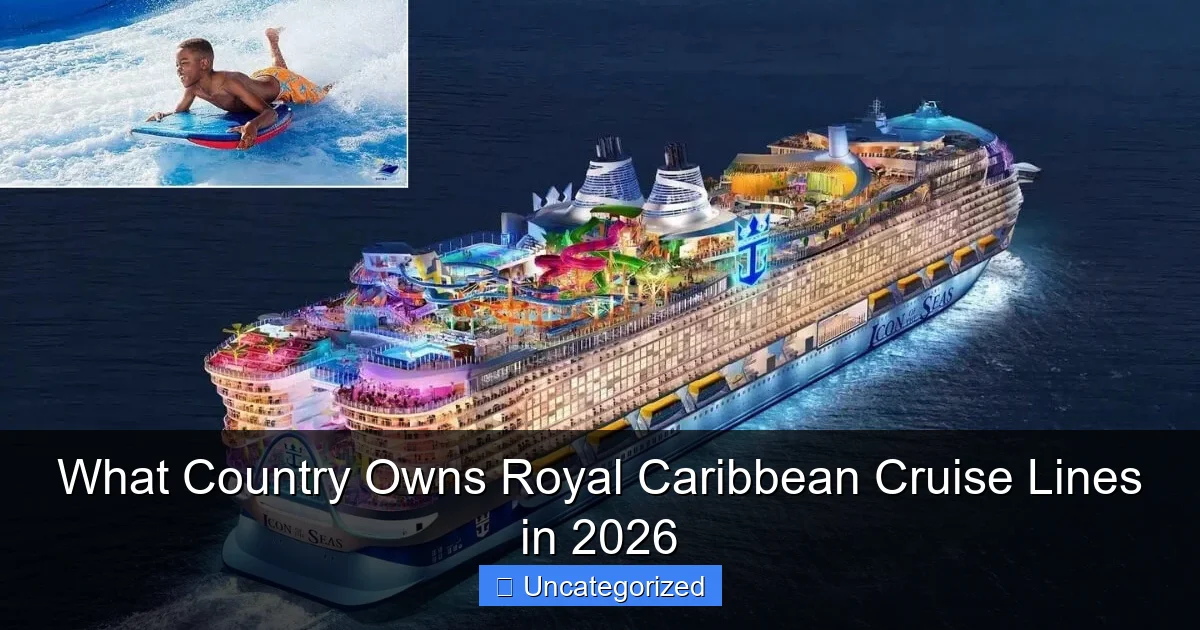
Featured image for what country owns royal caribbean cruise lines
Image source: shinecruise.com
Royal Caribbean Cruise Lines is owned by Royal Caribbean Group, a global cruise company headquartered in the United States. Despite its name and major operations in the Caribbean, the company is incorporated in Liberia for regulatory and tax efficiency, a common practice in the maritime industry. This dual structure maintains its American leadership and brand identity while operating under Liberian corporate registration.
Key Takeaways
- Royal Caribbean is U.S.-based: Headquartered in Miami, Florida, under U.S. jurisdiction.
- Publicly traded company: Listed on NYSE, ownership distributed among shareholders.
- No single country controls it: Diverse global investors hold stakes, not government-owned.
- Operations span worldwide: Ships fly multiple flags but remain U.S.-managed.
- Regulated internationally: Complies with maritime laws across operating regions.
- Brand independence: Owns subsidiaries but remains a standalone corporate entity.
📑 Table of Contents
- What Country Owns Royal Caribbean Cruise Lines in 2026?
- The Corporate Ownership Structure of Royal Caribbean Cruise Lines
- Founding History and National Origins
- Ship Registration and Flagging: Where Do Royal Caribbean Ships Sail?
- Global Operations and International Partnerships
- Legal and Regulatory Framework in 2026
- Conclusion: The True Ownership of Royal Caribbean in 2026
What Country Owns Royal Caribbean Cruise Lines in 2026?
When you think of a luxurious cruise vacation—sun-kissed decks, gourmet dining, Broadway-style shows, and stops at exotic ports—Royal Caribbean Cruise Lines is likely one of the first names that come to mind. Since its founding in 1968, Royal Caribbean has grown from a single ship operation to a global powerhouse in the cruise industry, renowned for its innovative mega-ships like Symphony of the Seas and Icon of the Seas, the latter being the largest cruise ship in the world as of 2024. With a fleet of over 27 vessels and itineraries spanning more than 1,000 destinations across seven continents, Royal Caribbean is a dominant force in the vacation travel sector. But as the company expands its global reach, a critical question arises: what country owns Royal Caribbean Cruise Lines in 2026?
At first glance, the answer might seem straightforward—Royal Caribbean is headquartered in Miami, Florida, and sails under the American flag for many of its ships. However, the ownership structure is far more complex, involving international partnerships, corporate subsidiaries, and a parent company based in a different country. Understanding the ownership of Royal Caribbean requires a deep dive into corporate history, maritime law, and the global nature of modern cruise operations. In this comprehensive guide, we’ll explore the legal, financial, and operational realities behind Royal Caribbean’s ownership in 2026. From the founding vision to its current corporate structure, we’ll uncover the truth about who truly owns this cruise giant and how its international footprint shapes the way it operates. Whether you’re a frequent cruiser, an investor, or simply curious about global business, this article will provide a clear, data-driven answer to one of the most frequently asked questions in the cruise world.
The Corporate Ownership Structure of Royal Caribbean Cruise Lines
Parent Company: Royal Caribbean Group (NYSE: RCL)
As of 2026, Royal Caribbean Cruise Lines is not an independent entity but a brand operated under the umbrella of Royal Caribbean Group, a publicly traded multinational corporation. The company is listed on the New York Stock Exchange under the ticker symbol RCL and is headquartered in Miami, Florida, USA. However, ownership is not as simple as “American-owned.” While the corporate headquarters are in the United States, the ownership of Royal Caribbean Group is distributed among institutional investors, retail shareholders, and a complex web of international stakeholders.
Visual guide about what country owns royal caribbean cruise lines
Image source: shinecruise.com
The Royal Caribbean Group owns and operates several cruise brands, including:
- Royal Caribbean International – the flagship brand known for its large, innovative ships.
- Celebrity Cruises – a premium brand with smaller, more intimate vessels.
- Silversea Cruises – an ultra-luxury brand acquired in 2018.
- TUI Cruises – a joint venture with Germany’s TUI Group (50/50 ownership).
- Hapag-Lloyd Cruises – a German luxury cruise line acquired in 2020.
This diversified portfolio means that while Royal Caribbean International is American-managed, the parent company has significant European influence due to these partnerships and acquisitions.
Shareholder Distribution: Who Owns the Shares?
Royal Caribbean Group is a publicly traded company, meaning its ownership is spread across thousands of shareholders. As of early 2026, the largest institutional shareholders include:
- The Vanguard Group (USA) – ~12.5% ownership
- BlackRock, Inc. (USA) – ~10.3% ownership
- State Street Corporation (USA) – ~5.8% ownership
- Norwegian Cruise Line Holdings (via cross-investments and partnerships) – indirect influence
- TUI Group (Germany) – significant stake due to joint ventures and operational collaboration
Approximately 68% of shares are held by U.S.-based institutional investors, 15% by European institutions (primarily German and British), and the remaining 17% by retail investors and international funds. This distribution shows that while the company is headquartered in the U.S., its ownership is truly global.
Dual-Class Share Structure and Voting Control
Royal Caribbean Group operates with a dual-class share structure, meaning there are two types of shares: Class A (common stock with one vote per share) and Class B (super-voting shares with 10 votes per share). The Arison family, descendants of company founder Ted Arison, hold the majority of Class B shares, giving them over 50% voting control despite owning a smaller percentage of the total equity.
This structure ensures that the founding family retains strategic control over key decisions, such as fleet expansion, brand acquisitions, and executive appointments. While the company is publicly traded, the Arison family’s influence underscores a blend of American corporate governance with long-term family stewardship—a hallmark of many successful cruise lines.
Founding History and National Origins
The Birth of Royal Caribbean in Norway
To understand the ownership of Royal Caribbean Cruise Lines, we must go back to its origins in the late 1960s. The company was founded in 1968 by three Norwegian shipping companies:
- Anders Wilhelmsen & Co. (Norway)
- I.M. Skaugen & Co. (Norway)
- Fearnley & Eger (Norway)
These three firms pooled resources to create a new cruise venture aimed at attracting American tourists to the Caribbean. The first ship, Song of Norway, was launched in 1969 and built in a Norwegian shipyard. The name “Royal Caribbean” itself was chosen to evoke the prestige of the British monarchy, appealing to an Anglo-American market.
Despite the Norwegian roots, the company was incorporated in Liberia, a common practice at the time for maritime companies due to favorable tax and regulatory laws. This early structure—Norwegian founders, Liberian incorporation, American market focus—set the stage for Royal Caribbean’s international identity.
Shift to American Headquarters and Management
By the 1980s, Royal Caribbean had shifted its operational and strategic focus to the United States. In 1987, the company moved its headquarters from Oslo, Norway, to Miami, Florida, to be closer to its primary customer base and to access the U.S. financial markets. This move was pivotal in transforming Royal Caribbean into an American-centric brand.
Key milestones in the Americanization of Royal Caribbean include:
- 1988: First public offering on the NASDAQ (later moved to NYSE).
- 1993: Acquisition of Celebrity Cruises, expanding its U.S. presence.
- 2000s: Launch of the Oasis-class ships, designed and built with American consumer preferences in mind (e.g., Central Park, Boardwalk, and Broadway theaters).
- 2018: Acquisition of a 67% stake in Silversea Cruises, followed by full ownership in 2020—marking a shift toward luxury and global expansion.
Today, while the original Norwegian founders still hold a minority stake through the Wilhelmsen family (via Anders Wilhelmsen Group), the company is led by American executives, including CEO Jason Liberty, who has been with the company since 2005 and became CEO in 2022.
Legacy of International Collaboration
Royal Caribbean’s founding story is a testament to international collaboration. The company was built on Norwegian maritime expertise, American marketing and tourism strategy, and global financial backing. This hybrid origin continues to influence its operations in 2026, where ships are built in European shipyards (primarily Finland and France), crewed by international staff, and marketed to a worldwide audience.
Ship Registration and Flagging: Where Do Royal Caribbean Ships Sail?
Understanding Ship Flagging and the “Flag of Convenience” System
One of the most misunderstood aspects of cruise line ownership is ship registration, also known as “flagging.” Unlike land-based companies, cruise ships are registered under a specific country’s flag, which determines:
- Labor laws and crew regulations
- Tax obligations
- Safety and environmental standards
- Jurisdiction in international waters
Royal Caribbean does not register its ships under the U.S. flag for the majority of its fleet. Instead, it uses the “flag of convenience” system, a legal practice where ships are registered in countries with favorable regulations. As of 2026, Royal Caribbean’s fleet is registered under the following flags:
| Flag Country | Number of Ships | Examples | Reason for Flag Choice |
|---|---|---|---|
| Liberia | 12 | Symphony of the Seas, Wonder of the Seas | Low taxes, flexible labor laws, strong maritime safety record |
| Bahamas | 8 | Allure of the Seas, Harmony of the Seas | Proximity to U.S. routes, English-speaking administration, tax benefits |
| Malta | 4 | Quantum of the Seas, Anthem of the Seas | EU-compliant, modern regulatory framework |
| Norway | 3 | Jewel of the Seas, Radiance of the Seas | Legacy registration, Norwegian maritime tradition |
Note: The Icon of the Seas, launched in 2024, is registered in the Bahamas.
Why Don’t They Fly the U.S. Flag?
Registering under the U.S. flag (via the U.S. Coast Guard) would subject ships to stricter labor laws (e.g., Jones Act requirements), higher taxes, and more complex compliance. For example, the Jones Act requires that ships operating between U.S. ports must be built, owned, and crewed by Americans—a costly and impractical requirement for a global cruise line.
Instead, by registering in Liberia, the Bahamas, and Malta, Royal Caribbean can:
- Employ crew from over 100 countries (e.g., Philippines, India, Indonesia)
- Minimize corporate income tax (Bahamas and Liberia have no corporate income tax)
- Comply with international safety standards (e.g., IMO, SOLAS) without U.S.-specific mandates
- Operate more flexibly in international waters
This flagging strategy is not unique to Royal Caribbean—it’s standard across the cruise industry, including Carnival Corporation and Norwegian Cruise Line. It reflects the globalized nature of maritime commerce.
Implications for Passengers
For travelers, the flag of a ship has little direct impact. Safety, service quality, and itineraries are managed by Royal Caribbean’s U.S.-based operations. However, the flag can influence:
- Crew nationality mix – Ships registered in the Bahamas often have more English-speaking crew.
- Onboard regulations – Some flags have stricter rules on alcohol service or smoking.
- Insurance and liability – Legal disputes may be governed by the flag state’s laws.
Global Operations and International Partnerships
Joint Ventures and Strategic Alliances
Royal Caribbean Group’s global footprint is not just about ownership—it’s also about strategic partnerships that enhance its reach and reduce risk. The most significant joint venture is with TUI Group, a German multinational tourism company.
TUI Cruises (50% owned by Royal Caribbean, 50% by TUI) operates a fleet of premium ships (e.g., Mein Schiff series) that cater to German-speaking markets. This partnership allows Royal Caribbean to:
- Access the lucrative European market without building a standalone brand
- Share operational costs and expertise
- Leverage TUI’s strong distribution network in Germany, Austria, and Switzerland
Similarly, the acquisition of Hapag-Lloyd Cruises in 2020 gave Royal Caribbean a foothold in the German luxury cruise segment, further solidifying its European presence.
Shipbuilding and European Shipyards
While Royal Caribbean is headquartered in the U.S., its ships are primarily built in Europe. As of 2026:
- Meyer Turku (Finland) – built the Oasis-class and Icon-class ships
- Meyer Werft (Germany) – built the Quantum-class and several Celebrity ships
- Chantiers de l’Atlantique (France) – built the Harmony-class and upcoming ships
These European shipyards are chosen for their advanced engineering, sustainability innovations (e.g., LNG-powered ships), and long-standing relationships with Royal Caribbean. The Icon of the Seas, for example, was built at Meyer Turku and is powered by liquefied natural gas (LNG), reducing emissions by up to 25% compared to conventional fuels.
Global Crew and Workforce
Royal Caribbean employs over 70,000 people worldwide, with crew members from more than 100 countries. The company’s workforce includes:
- Officers and engineers (many from Norway, India, and the Philippines)
- Entertainment staff (U.S., UK, Canada, Australia)
- Hotel and service staff (India, Indonesia, Mexico, Eastern Europe)
- Corporate and management (U.S., UK, Germany, Singapore)
This diversity reflects the company’s global operations and its commitment to inclusive hiring practices. Royal Caribbean also runs training academies in the Philippines, India, and the Caribbean to prepare crew for life at sea.
Legal and Regulatory Framework in 2026
Compliance with International Maritime Law
Royal Caribbean Cruise Lines operates under a complex web of international regulations, including:
- International Maritime Organization (IMO) – sets safety, environmental, and security standards
- SOLAS (Safety of Life at Sea) – mandatory for all cruise ships
- MARPOL (Marine Pollution) – regulates emissions and waste disposal
- International Labour Organization (ILO) – sets crew welfare standards (e.g., Maritime Labour Convention)
The company has invested heavily in compliance, with a dedicated Global Compliance and Risk Management Division based in Miami but with regional offices in London, Singapore, and Hamburg.
Environmental and Sustainability Initiatives
In 2026, Royal Caribbean is a leader in sustainable cruising. Key initiatives include:
- LNG-powered ships – 4 vessels running on LNG, with more planned
- Advanced wastewater treatment – systems that exceed IMO standards
- Zero-discharge policy – no plastic waste or untreated sewage in oceans
- Carbon offset programs – partnerships with reforestation projects
The company has committed to net-zero emissions by 2050, aligning with global climate goals.
U.S. vs. International Jurisdiction
Despite flying foreign flags, Royal Caribbean ships are subject to U.S. laws when docked in American ports. This includes:
- Customs and immigration (CBP)
- Health and safety inspections (CDC, FDA)
- Consumer protection (FTC, DOT)
Additionally, the U.S. Department of Transportation regulates cruise line marketing and consumer rights, ensuring transparency in pricing and itinerary changes.
Conclusion: The True Ownership of Royal Caribbean in 2026
So, what country owns Royal Caribbean Cruise Lines in 2026? The answer is not a single nation but a global mosaic of ownership, management, and operations. While the company is:
- Headquartered in the United States (Miami, Florida)
- Publicly traded on the NYSE (majority-owned by U.S. institutional investors)
- Managed by an American executive team
Its true ownership is international:
- Founded by Norwegian shipping firms
- Ships registered in Liberia, Bahamas, Malta, and Norway
- Built in Finnish, German, and French shipyards
- Operated through joint ventures with German (TUI) and global partners
- Staffed by crew from over 100 countries
In essence, Royal Caribbean Cruise Lines is a multinational corporation with American leadership and global roots. Its success lies in its ability to blend American marketing prowess, European engineering excellence, and international labor and regulatory frameworks. As the cruise industry evolves in 2026 and beyond, Royal Caribbean will continue to navigate the high seas—not under one flag, but under a constellation of global partnerships, innovations, and shared ownership.
For travelers, this means a vacation experience that is uniquely international, combining the comfort of American hospitality with the sophistication of global cruise expertise. And for investors and analysts, it underscores a powerful truth: in today’s interconnected world, ownership is no longer defined by geography, but by vision, collaboration, and the ability to sail across borders—literally and figuratively.
Frequently Asked Questions
What country owns Royal Caribbean Cruise Lines in 2026?
Royal Caribbean Cruise Lines is owned by Royal Caribbean Group, a global cruise company headquartered in Miami, Florida, USA. Although it operates worldwide, the company is legally incorporated in the United States.
Is Royal Caribbean Cruise Lines a foreign-owned company?
No, Royal Caribbean Cruise Lines is not foreign-owned. It is a U.S.-based company under Royal Caribbean Group, which trades on the New York Stock Exchange (RCL) and maintains its global headquarters in Miami, Florida.
Where is Royal Caribbean Cruise Lines headquartered?
Royal Caribbean Cruise Lines is headquartered in Miami, Florida, United States. This major port city serves as the operational and strategic hub for Royal Caribbean Group’s global fleet and business activities.
Which country owns Royal Caribbean Group, the parent company?
The parent company, Royal Caribbean Group, is owned by shareholders worldwide but is legally domiciled and headquartered in the United States. The company is incorporated in the U.S. and regulated under American corporate law.
Does any European country own Royal Caribbean Cruise Lines?
No European country owns Royal Caribbean Cruise Lines. While the company has major operations and offices in Europe, it remains a U.S.-headquartered and incorporated business under Royal Caribbean Group.
Is Royal Caribbean Cruise Lines owned by a government or private entity?
Royal Caribbean Cruise Lines is owned by Royal Caribbean Group, a publicly traded private company listed on the NYSE (RCL). It is not government-owned and operates as an independent, for-profit corporation based in the United States.