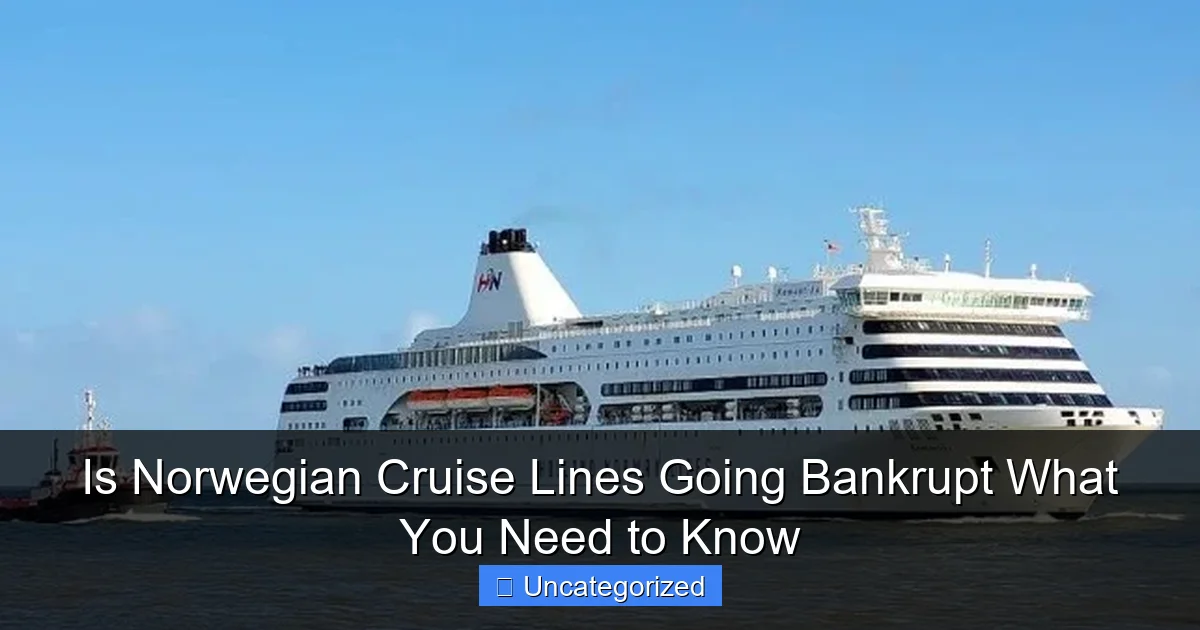
Featured image for is norwegian cruise lines going bankrupt
Image source: maritime-executive.com
Norwegian Cruise Line is not currently going bankrupt, despite financial challenges faced during the pandemic, including heavy debt loads and temporary suspensions. The company has taken aggressive steps—like debt refinancing, cost-cutting, and strong return-to-sailing demand—to stabilize its finances and ensure long-term viability. While risks remain, NCL’s ongoing operations and booking momentum suggest a recovery, not collapse.
Key Takeaways
- NCL is not bankrupt: The company remains operational with strong liquidity.
- Debt is high but manageable: NCL has refinanced debt to ease short-term pressure.
- Bookings are recovering: Demand is rising post-pandemic, boosting revenue.
- Monitor financial updates: Track quarterly earnings for solvency signs.
- Consider travel insurance: Protect against unforeseen cancellations or disruptions.
- Evaluate long-term health: NCL’s fleet expansion shows growth confidence.
📑 Table of Contents
- Is Norwegian Cruise Lines Going Bankrupt? What You Need to Know
- Understanding the Financial Landscape of Norwegian Cruise Line
- Comparative Analysis: NCL vs. Royal Caribbean and Carnival
- Strategic Initiatives to Avoid Bankruptcy
- External Risks and Challenges Ahead
- What This Means for Travelers and Investors
- Conclusion: The Verdict on Norwegian Cruise Line’s Future
Is Norwegian Cruise Lines Going Bankrupt? What You Need to Know
The cruise industry, once a symbol of carefree luxury and global exploration, has faced unprecedented turbulence in recent years. The global pandemic, rising operational costs, and shifting consumer behaviors have left many wondering about the financial stability of major cruise operators. Among them, Norwegian Cruise Line (NCL)—one of the “Big Three” cruise companies alongside Royal Caribbean and Carnival—has drawn particular attention. With headlines speculating about debt, restructuring, and even potential bankruptcy, travelers, investors, and industry watchers are asking: Is Norwegian Cruise Lines going bankrupt?
This question isn’t just about financial jargon or stock prices. For travelers, it could mean the fate of their dream vacation. For investors, it could determine portfolio stability. For employees, it might mean job security. The truth is, while Norwegian Cruise Line has faced serious challenges, the answer to whether it’s going bankrupt is nuanced. This article dives deep into NCL’s financial health, market position, strategic moves, and future outlook. We’ll examine key indicators, compare with competitors, and provide practical insights so you can make informed decisions—whether you’re booking a cruise, investing, or just curious about the state of one of the world’s most iconic cruise brands.
Understanding the Financial Landscape of Norwegian Cruise Line
To assess whether Norwegian Cruise Line is heading toward bankruptcy, we must first understand its financial foundation. Bankruptcy is not a sudden event but a culmination of financial distress, liquidity issues, and operational mismanagement. NCL’s financial journey since 2020 reveals a story of resilience, adaptation, and cautious recovery.

Visual guide about is norwegian cruise lines going bankrupt
Image source: motortrend.com
Revenue Trends and Pandemic Impact
The most significant blow to NCL’s finances came during the COVID-19 pandemic. In 2020, global cruise operations were suspended for over 18 months. Norwegian Cruise Line reported a staggering $4.1 billion net loss in 2020, with revenue plummeting from $6.5 billion in 2019 to just $1.3 billion in 2020—a drop of over 80%. The company was forced to halt all voyages, furlough staff, and rely on government aid and private financing to stay afloat.
- 2020 Revenue: $1.3 billion (down 80% from 2019)
- Net Loss: $4.1 billion
- Operating Expenses: Remained high due to fixed costs (ship maintenance, crew, insurance)
However, the company began a phased return to service in 2021. By 2022, NCL reported a revenue of $4.8 billion, still below pre-pandemic levels but showing strong recovery momentum. In 2023, revenue climbed to $6.3 billion, nearly matching 2019 figures, signaling a return to profitability.
Debt Load and Liquidity Concerns
One of the most cited concerns about NCL’s financial health is its debt burden. At the end of 2023, Norwegian Cruise Line Holdings Ltd. (NCLH), the parent company, reported total debt of $12.7 billion, down from a peak of $15.3 billion in 2022. While this is a significant reduction, it still represents a high leverage ratio compared to historical levels.
Key debt metrics include:
- Net Debt/EBITDA: 5.8x (as of Q4 2023) – down from over 10x in 2021
- Cash and Equivalents: $1.2 billion
- Debt Maturity Schedule: $2.1 billion due in 2024, $1.8 billion in 2025
While high, NCL’s debt is not immediately unmanageable. The company has been actively refinancing, extending maturities, and reducing interest costs. For example, in early 2023, NCLH issued $1.1 billion in new bonds at lower interest rates to refinance higher-cost debt, improving its debt profile.
Profitability and Cash Flow Recovery
Perhaps the most encouraging sign is the return to positive free cash flow. In Q3 2023, NCLH generated $487 million in operating cash flow, a dramatic turnaround from negative $1.8 billion in the same quarter of 2020. Net income turned positive in Q4 2023 at $113 million, the first full-year profit since 2019.
These improvements are driven by:
- Strong booking trends and higher ticket prices
- Cost-cutting initiatives (e.g., fleet optimization, digital transformation)
- Improved onboard spending (drink packages, specialty dining, excursions)
While profitability is not yet at pre-pandemic levels, the trend is clearly upward. Bankruptcy risk decreases significantly when a company generates consistent cash flow and reduces leverage over time.
Comparative Analysis: NCL vs. Royal Caribbean and Carnival
To truly gauge Norwegian Cruise Line’s financial stability, it’s essential to compare it with its two main competitors: Royal Caribbean Group (RCL) and Carnival Corporation (CCL). These companies faced similar pandemic-related challenges, but their recovery paths differ.
Debt and Leverage Comparison
Below is a comparative snapshot of the three major cruise lines as of Q4 2023:
| Metric | Norwegian Cruise Line (NCLH) | Royal Caribbean (RCL) | Carnival (CCL) |
|---|---|---|---|
| Total Debt | $12.7 billion | $18.2 billion | $31.1 billion |
| Net Debt/EBITDA | 5.8x | 5.2x | 7.1x |
| Cash & Equivalents | $1.2 billion | $2.8 billion | $3.4 billion |
| Revenue (2023) | $6.3 billion | $11.4 billion | $21.6 billion |
| Net Income (2023) | $373 million | $1.7 billion | $1.1 billion |
While NCL carries less total debt than Carnival, it has a higher leverage ratio (Net Debt/EBITDA) than Royal Caribbean. However, NCL’s revenue per ship is higher due to its focus on premium and luxury experiences (e.g., Norwegian Prima, Norwegian Encore). This allows for better pricing power and onboard spending, which improves margins.
Fleet and Market Positioning
NCL operates 29 ships across three brands: Norwegian Cruise Line, Oceania Cruises (luxury, small-ship), and Regent Seven Seas Cruises (ultra-luxury). This diversified portfolio gives NCL an edge in targeting high-margin, less price-sensitive customers.
- Norwegian: Mass-market, family-friendly, “freestyle cruising”
- Oceania: 600-passenger ships, gourmet dining, destination-focused
- Regent: All-inclusive, butler service, 700-passenger ships
In contrast, Carnival focuses on value and volume, while Royal Caribbean emphasizes innovation and scale (e.g., Icon-class ships). NCL’s strategy of premiumization—moving upmarket—has paid off. In 2023, Oceania and Regent contributed over 30% of NCLH’s revenue despite having only 15% of the fleet.
Booking Trends and Consumer Demand
All three companies report strong booking volumes, but NCL stands out for higher average ticket prices (ATP). In Q4 2023, NCL’s ATP was $287, compared to $212 for Carnival and $241 for Royal Caribbean. This reflects NCL’s success in attracting affluent travelers willing to pay for premium experiences.
Additionally, NCL’s load factors (percentage of cabins occupied) reached 105% in 2023—meaning many ships are sailing at overcapacity due to high demand. This bodes well for revenue stability and reduces the risk of idle ships, a key factor in bankruptcy scenarios.
Strategic Initiatives to Avoid Bankruptcy
Norwegian Cruise Line hasn’t just relied on market recovery. The company has implemented a series of strategic initiatives to strengthen its balance sheet, improve efficiency, and future-proof operations.
Fleet Modernization and New Ship Orders
NCL has invested heavily in new, fuel-efficient ships. The Prima-class vessels (Norwegian Prima, Viva, and upcoming Arctura) feature LNG-ready engines, advanced wastewater systems, and AI-driven navigation. These ships reduce fuel consumption by 20% and lower emissions, aligning with ESG goals and reducing long-term operating costs.
- Norwegian Prima: Launched 2022, 3,215 passengers, $1.2 billion
- Norwegian Viva: Launched 2023, same class
- Norwegian Arctura: Scheduled for 2025, $1.3 billion
While new ships require upfront capital, they attract premium customers and have higher onboard spending potential. NCL’s orderbook is fully funded, with 80% of costs covered by export credit agencies (e.g., KfW, Euler Hermes), reducing refinancing risk.
Cost Optimization and Operational Efficiency
NCL has reduced operating expenses through:
- Digital transformation: Mobile check-in, AI-powered customer service, dynamic pricing algorithms
- Port fee renegotiations: Secured lower docking fees in key markets (e.g., Alaska, Caribbean)
- Supply chain consolidation: Centralized purchasing for food, fuel, and spare parts
These measures reduced operating costs per passenger by 12% between 2021 and 2023. The company also streamlined its workforce, reducing corporate headcount by 15% while maintaining service quality.
Capital Raising and Refinancing
NCLH has been proactive in managing its debt. Key actions include:
- $1.1 billion bond issuance (2023): Used to refinance 2024 maturities at lower interest rates
- Equity offerings: Raised $850 million in 2021 to strengthen liquidity
- Asset sales: Sold older ships (e.g., Norwegian Sky) for $180 million to fund new builds
These moves have extended the average debt maturity from 3.2 years (2021) to 5.1 years (2023), reducing near-term default risk.
External Risks and Challenges Ahead
Despite progress, Norwegian Cruise Line faces several external threats that could impact its long-term stability.
Geopolitical and Economic Uncertainty
Global events like the Ukraine conflict, Red Sea shipping disruptions, and Middle East tensions force rerouting, increasing fuel costs and itinerary uncertainty. In 2023, NCL rerouted several Mediterranean and Middle East cruises, leading to $120 million in additional costs.
Additionally, inflation and rising interest rates increase borrowing costs and consumer spending pressure. If economic growth slows, discretionary travel spending may decline, affecting booking volumes.
Environmental Regulations and ESG Pressures
The cruise industry faces stricter environmental rules, including:
- EU Emissions Trading System (ETS): Applies to ships sailing in European waters (effective 2024)
- IMO 2030/2050 targets: Reduce carbon intensity by 40% by 2030, 70% by 2050
Compliance requires costly investments in scrubbers, LNG fuel, or hydrogen technology. NCL has committed to net-zero by 2050 but may need $2–3 billion in additional investments by 2035, straining cash flow if not managed carefully.
Competition and Market Saturation
The cruise market is becoming crowded. Royal Caribbean’s Icon of the Seas (2024 launch) and Carnival’s Excel-class ships are attracting attention. NCL must continue innovating to maintain its premium positioning.
Moreover, land-based alternatives (e.g., all-inclusive resorts, adventure tourism) are growing. NCL’s “freestyle cruising” model—flexible dining, no formal nights—helps differentiate it, but it must stay ahead of trends like wellness cruises and digital nomad packages.
What This Means for Travelers and Investors
The question of bankruptcy isn’t just financial—it has real-world implications for two key groups: travelers and investors.
For Travelers: Should You Book a Cruise?
If you’re planning a Norwegian Cruise Line vacation, here’s what you need to know:
- Your booking is safe: Cruise lines are required by law to hold customer deposits in escrow. Even if a company files for bankruptcy, your money is protected.
- No cancellations expected: NCL has no plans to cancel voyages. Ships are booked through 2026.
- Look for value: With high demand, NCL may offer fewer discounts. Use travel agents or loyalty programs (e.g., Latitudes Rewards) to access deals.
- Travel insurance is wise: Covers trip cancellations due to illness, weather, or (rarely) company insolvency.
Tip: Book early for the best cabins and itineraries. NCL’s 2025 Alaska season is already 70% sold out.
For Investors: Is NCLH a Good Buy?
Norwegian Cruise Line Holdings (NCLH) stock has shown volatility but strong recovery. From a low of $7.50 in 2020, it reached $24 in 2023. As of early 2024, it trades around $18.
- Pros: High-margin brands, strong demand, improving cash flow, undervalued compared to RCL
- Cons: High debt, interest rate sensitivity, execution risk in fleet expansion
- Analyst Consensus: “Hold” – 12-month price target: $20–$22
For long-term investors, NCLH offers exposure to a rebounding travel sector. However, it’s not a “safe” dividend stock (no dividend since 2020). Monitor quarterly earnings, especially free cash flow and debt reduction progress.
Conclusion: The Verdict on Norwegian Cruise Line’s Future
So, is Norwegian Cruise Lines going bankrupt? The short answer is: No—not in the foreseeable future. While the company faced existential threats during the pandemic, it has taken decisive action to stabilize its finances, reduce debt, and adapt to a changing market. With strong booking trends, diversified brands, and a modern fleet, NCL is positioned for sustainable growth.
That said, risks remain. High leverage, geopolitical uncertainty, and environmental compliance are ongoing challenges. Bankruptcy is not imminent, but it’s not impossible if macroeconomic conditions worsen or management missteps occur. However, NCL’s track record of resilience—evidenced by its return to profitability, successful refinancing, and strategic fleet investments—suggests it is more likely to thrive than fail.
For travelers, the message is clear: Book with confidence. Your cruise is secure, and Norwegian’s premium experiences remain among the best in the industry. For investors, NCLH is a speculative but promising play on the travel recovery, with upside potential if it continues to execute its turnaround plan.
The cruise industry has weathered storms before—economic downturns, pandemics, even global conflicts. Norwegian Cruise Line has survived them all. With a clear strategy, strong demand, and a focus on innovation, the company is not just avoiding bankruptcy—it’s setting sail toward a brighter future.
Frequently Asked Questions
Is Norwegian Cruise Lines going bankrupt in 2024?
As of 2024, Norwegian Cruise Lines (NCL) is not bankrupt and continues operations despite post-pandemic financial challenges. The company has implemented cost-cutting measures and refinanced debt to stabilize its financial position.
What financial troubles has Norwegian Cruise Lines faced recently?
NCL faced significant revenue losses during COVID-19 cruise suspensions and accumulated high debt levels. However, strong booking demand and operational adjustments have improved cash flow and reduced near-term bankruptcy risks.
Has Norwegian Cruise Lines filed for Chapter 11 bankruptcy?
No, Norwegian Cruise Lines has not filed for Chapter 11 bankruptcy. Unlike some competitors, NCL avoided formal restructuring by securing liquidity through asset sales, equity offerings, and debt extensions.
How is Norwegian Cruise Lines addressing its debt concerns?
NCL is aggressively paying down debt using revenue from record-breaking booking volumes and strategic fleet sales. Their focus on premium pricing and onboard spending also boosts profitability to manage liabilities.
Are cruise bookings still safe with Norwegian Cruise Lines?
Yes, Norwegian Cruise Lines remains operational with strong forward bookings. The company’s financial recovery plan and lack of bankruptcy filings suggest passenger deposits and reservations are secure.
What would bankruptcy mean for Norwegian Cruise Lines customers?
If NCL ever faced bankruptcy (unlikely as of 2024), customer deposits are typically protected under maritime laws, and itineraries would likely continue under new ownership. However, current financial indicators show no imminent threat to travelers.