
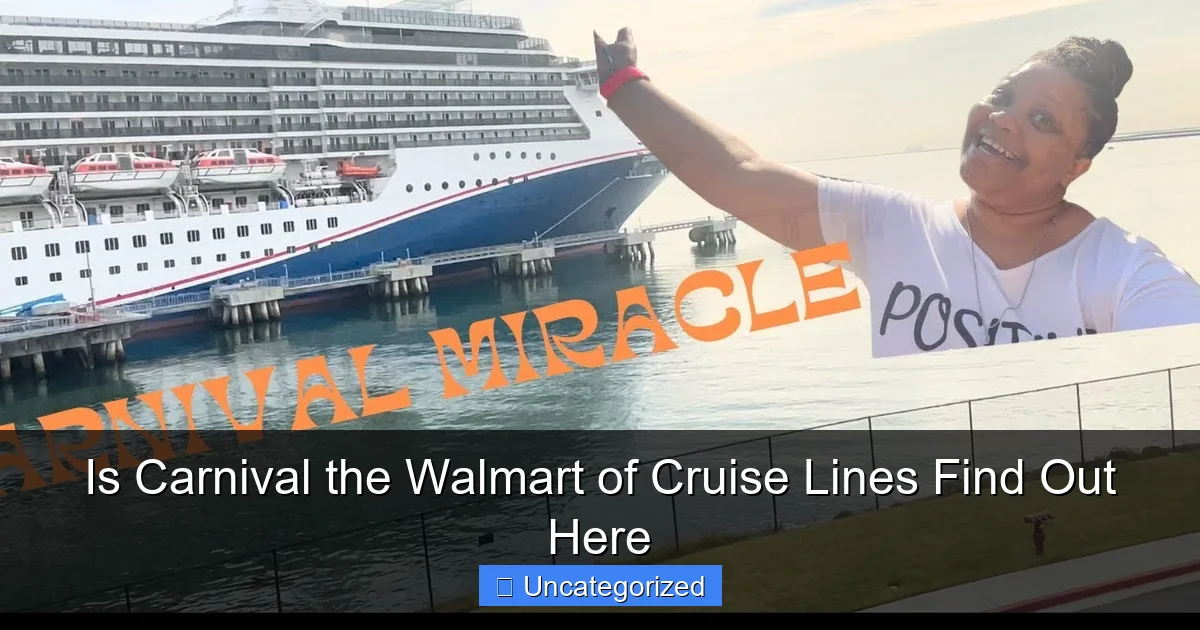
Featured image for is carnival the walmart of cruise lines
Image source: ic-cdn.flipboard.com
Carnival Cruise Line earns its “Walmart of cruising” reputation by offering affordable, mass-market vacations with consistent value and widespread accessibility. Much like Walmart, it emphasizes volume, convenience, and budget-friendly options over luxury, catering to first-time cruisers and families seeking fun at sea without the high-end price tag. With diverse itineraries and no-frills amenities, Carnival delivers no-surprise pricing and broad appeal—making it the go-to for value-driven travelers.
Key Takeaways
- Carnival offers budget-friendly cruises with diverse itineraries for cost-conscious travelers.
- Value doesn’t mean low quality: modern ships and fun amenities remain a priority.
- Compare pricing tiers to find the best deals, similar to Walmart’s value strategy.
- Onboard spending can add up; budget for extras like drinks and excursions.
- Target audience matters: families and first-timers benefit most from Carnival’s approach.
- Brand perception varies; weigh affordability against personal luxury expectations.
📑 Table of Contents
- Is Carnival the Walmart of Cruise Lines? Find Out Here
- The Origins of the Walmart Analogy
- Pricing and Value: How Carnival Compares to Budget and Luxury Lines
- Service, Amenities, and Onboard Experience
- Target Demographics and Brand Positioning
- Comparative Analysis: Carnival vs. Walmart – A Data Table
- Is the Walmart Analogy Fair? The Verdict
Is Carnival the Walmart of Cruise Lines? Find Out Here
The cruise industry has long been associated with luxury, exclusivity, and high-end experiences. But in recent decades, a shift has occurred. One major player, Carnival Cruise Line, has carved out a unique niche by offering a more affordable, accessible, and family-friendly alternative to the traditional “floating five-star hotel” model. With its vibrant branding, catchy slogans like “Fun Ships,” and a reputation for value, Carnival has often been compared to Walmart—a retail giant known for low prices, wide selection, and mass appeal. But is this comparison fair? Is Carnival truly the Walmart of cruise lines, or is it something more nuanced?
This article dives deep into the Walmart vs. Carnival analogy, exploring everything from pricing and amenities to service quality, target demographics, and brand positioning. We’ll examine whether Carnival’s strategy of affordability and volume truly mirrors Walmart’s retail dominance, or if the cruise line has evolved into a distinct player in the maritime tourism space. Whether you’re a first-time cruiser, a budget-conscious traveler, or a seasoned cruiser wondering where Carnival fits in the industry hierarchy, this comprehensive guide will help you understand the truth behind the popular comparison.
The Origins of the Walmart Analogy
Why the Comparison Exists
The phrase “Carnival is the Walmart of cruise lines” didn’t emerge in a vacuum. It’s rooted in observable business strategies, customer experiences, and brand perceptions. Walmart, founded in 1962, revolutionized retail by offering everyday low prices (EDLP), a massive product selection, and a no-frills shopping experience. Similarly, Carnival Cruise Line, founded in 1972, disrupted the cruise industry by making cruising accessible to the average American family. Before Carnival, cruising was seen as a luxury reserved for the wealthy. Carnival changed that by offering affordable fares, shorter itineraries, and a focus on fun rather than formal elegance.
Visual guide about is carnival the walmart of cruise lines
Image source: i.ytimg.com
Both companies prioritize volume over margin. Walmart doesn’t make much profit per item, but sells so many that it dominates the market. Carnival operates on a similar model: lower ticket prices, high passenger capacity (its ships often carry over 4,000 guests), and revenue from onboard spending (drinks, excursions, spa services, etc.) to boost profitability. This shared business model is the first reason for the analogy.
Brand Perception and Public Opinion
Public perception plays a huge role in the Walmart comparison. Walmart is often criticized for its warehouse-style stores, crowded aisles, and perceived lower quality of service. Carnival, while beloved by many, has faced similar critiques. Some cruisers describe Carnival ships as “cruise factories”—large, bustling, and occasionally overwhelming. The line’s focus on entertainment, casual dining, and family fun can feel less refined compared to luxury lines like Seabourn or Regent Seven Seas.
However, it’s important to note that perception is not always reality. Just as Walmart has evolved with online shopping, sustainability initiatives, and improved store layouts, Carnival has invested heavily in modernization. Ships like the Carnival Celebration and Mardi Gras feature cutting-edge technology, gourmet dining options, and even onboard roller coasters. The brand is no longer just about “cheap and cheerful”—it’s about accessible fun with modern upgrades.
Pricing and Value: How Carnival Compares to Budget and Luxury Lines
Affordability vs. Luxury: The Price Spectrum
To understand if Carnival is truly the “Walmart” of cruising, we must compare its pricing to both budget and luxury competitors. Carnival’s average price per person per day ranges from $80 to $130 for interior cabins on standard Caribbean itineraries. This includes accommodations, meals (excluding specialty restaurants), entertainment, and basic activities. In contrast:
- Royal Caribbean: $110–$160 per person/day (slightly higher, with more premium amenities)
- Norwegian Cruise Line (NCL): $100–$150 per person/day (similar value, but with “free-style” dining)
- Celebrity Cruises: $140–$200 per person/day (more upscale, modern design)
- Oceania Cruises: $350–$600 per person/day (luxury, all-inclusive, smaller ships)
- Regent Seven Seas: $600+ per person/day (ultra-luxury, all-inclusive)
Clearly, Carnival sits at the lower end of the price spectrum—closer to Walmart’s “everyday low prices” than to high-end retailers like Neiman Marcus. But is “low price” the same as “low quality”? Not necessarily.
Hidden Costs and Onboard Revenue
One of the key ways Carnival—and all cruise lines—makes money is through onboard spending. While the base fare is low, cruisers are encouraged to spend on:
- Alcohol packages ($50–$70/day)
- Specialty dining (steakhouse, Italian, Asian, $25–$40 per meal)
- Spa and fitness classes
- Excursions (shore tours, $70–$200 per person)
- Photo packages, arcade games, bingo, and more
This is where the Walmart analogy becomes more complex. Walmart profits from volume and low margins, but also from upselling—offering premium brands, extended warranties, and add-ons. Carnival does the same. For example, the Cheers! Beverage Package is a popular upsell that can cost hundreds per person. While not mandatory, many cruisers opt in, boosting Carnival’s revenue per passenger.
Tip: To avoid overspending, set a daily onboard budget. Use Carnival’s app to track expenses in real time. Consider skipping the drink package if you’re not a heavy drinker—individual cocktails are often cheaper than the flat rate.
Service, Amenities, and Onboard Experience
Service Quality: Staff-to-Passenger Ratio
One of the biggest concerns with budget-focused cruise lines is service quality. With large ships and thousands of passengers, can Carnival maintain a high level of service? Let’s look at the numbers.
Carnival’s newer ships (like the Excel-class) carry around 5,200 guests with approximately 1,700 crew members, resulting in a guest-to-crew ratio of about 3:1. This is comparable to Royal Caribbean (3:1) and NCL (3.2:1), but higher than luxury lines like Silversea (1.2:1) or Regent (1.5:1). While Carnival doesn’t offer the ultra-personalized service of a luxury line, its staff are generally friendly, attentive, and trained to handle high-volume operations.
Many cruisers report positive experiences with cabin stewards, dining room staff, and guest services. However, during peak times (embarkation, peak dining hours), service can feel rushed or inconsistent. This mirrors Walmart’s experience during Black Friday sales—efficient but occasionally chaotic.
Onboard Amenities: Fun, Fun, and More Fun
Carnival’s brand promise is fun, and it delivers with a wide range of amenities designed for all ages:
- WaterWorks: Multi-story water slides, splash zones, and pools
- SkyRide: A suspended bike track around the top deck (Mardi Gras, Celebration)
- BOLT: The first roller coaster at sea (Mardi Gras, Celebration)
- Serenity Adult-Only Retreat: Quiet space for adults to relax
- Playlist Productions: High-energy, Broadway-style shows
- Camp Ocean: Kids’ programs with age-specific activities
- Casino, comedy clubs, dance floors, and themed bars
These amenities are designed to appeal to families, couples, and solo travelers looking for entertainment. Unlike luxury lines, which emphasize relaxation, fine dining, and cultural enrichment, Carnival focuses on high-energy, interactive experiences. This is another reason for the Walmart comparison: both brands prioritize accessibility and variety over exclusivity.
Tip: Book activities and dining reservations early—especially for BOLT, specialty restaurants, and kids’ programs. Carnival’s app allows pre-booking up to 90 days before sailing.
Target Demographics and Brand Positioning
Who Cruises with Carnival?
Carnival’s target market is broad but specific: value-seeking families, first-time cruisers, and fun-loving groups. According to Carnival Corporation’s 2023 annual report, approximately:
- 45% of Carnival cruisers are under 45
- 60% are families with children
- 70% are first-time cruisers
- 55% live in the U.S., with strong markets in Texas, Florida, and the Midwest
This demographic aligns closely with Walmart’s core customers: middle-income families, price-conscious shoppers, and those seeking convenience. Carnival’s marketing emphasizes affordability, ease of planning, and guaranteed fun—just like Walmart’s “Save Money. Live Better.” slogan.
Brand Positioning: From “Cheap” to “Fun”
Over the past two decades, Carnival has worked hard to rebrand itself. The old image of “booze cruises” and outdated ships has been replaced with a focus on modernization, safety, and family-friendly fun. The company has invested over $2 billion in fleet upgrades since 2018, including:
- LNG-powered ships (more environmentally friendly)
- Smart cabins with app-controlled lighting, temperature, and service requests
- Expanded dining options (including Guy Fieri’s Burger Joint, JiJi Asian Kitchen)
- Enhanced health and safety protocols (especially post-pandemic)
This evolution is similar to Walmart’s shift toward e-commerce, sustainability, and improved store experiences. Both companies are trying to shed outdated stereotypes while maintaining their core value proposition: affordable access to mass-market experiences.
Comparative Analysis: Carnival vs. Walmart – A Data Table
Side-by-Side Comparison of Key Metrics
To truly evaluate the “Walmart of cruise lines” claim, let’s compare Carnival and Walmart across several dimensions:
| Metric | Carnival Cruise Line | Walmart | Comparison Insight |
|---|---|---|---|
| Founded | 1972 | 1962 | Both are mid-20th century disruptors in their industries. |
| Core Value Proposition | Affordable fun and family-friendly cruising | Everyday low prices and one-stop shopping | Both prioritize affordability and volume over exclusivity. |
| Revenue Model | Low base fare + high onboard spending | Low margins + high volume + upselling (e.g., warranties, premium brands) | Both rely on ancillary revenue to boost profitability. |
| Customer Base | Middle-income families, first-time cruisers | Middle-income families, budget shoppers | Overlap in target demographics and values. |
| Brand Perception | Fun, casual, sometimes chaotic; improving with modernization | Affordable, convenient, sometimes crowded; improving with tech and sustainability | Both are working to shed outdated stereotypes. |
| Innovation & Modernization | LNG ships, smart cabins, roller coasters, gourmet dining | Walmart+, online grocery, pickup services, sustainability initiatives | Both investing heavily in modernizing their offerings. |
| Global Presence | 25+ ships, global itineraries (Caribbean, Europe, Alaska, etc.) | 10,500+ stores, 24 countries | Both are global giants with massive footprints. |
| Customer Loyalty | Carnival World Mastercard, VIFP Club (Very Important Fun Person) | Walmart+, Rewards Card, Sam’s Club membership | Both use loyalty programs to drive repeat business. |
This table illustrates that while Carnival and Walmart operate in vastly different industries, their strategic DNA is remarkably similar. Both are volume-driven, value-focused, and continuously evolving to meet customer expectations in a changing marketplace.
Is the Walmart Analogy Fair? The Verdict
The Pros of the Comparison
There’s no denying that the Walmart analogy has merit in several areas:
- Affordability: Carnival offers some of the lowest cruise fares in the industry.
- Mass Appeal: It attracts a wide range of customers, from families to college students.
- High Capacity: Like Walmart’s big-box stores, Carnival’s ships are designed for volume.
- Ancillary Revenue: Both make significant income from add-ons and upselling.
- Brand Recognition: Carnival and Walmart are household names with strong marketing.
For travelers seeking a budget-friendly, fun-filled vacation with plenty of activities, Carnival delivers—just as Walmart delivers for shoppers seeking low prices and convenience.
The Limits of the Comparison
However, the analogy has its limits. Here’s where Carnival diverges from Walmart:
- Experience vs. Transaction: Cruising is a multi-day experience, not a transaction. The quality of food, entertainment, and service matters more than in a retail setting.
- Emotional Investment: People save for years to take a cruise. It’s not a weekly grocery run. The emotional stakes are higher.
- Modernization Efforts: Carnival has invested in luxury touches (e.g., Serenity areas, specialty dining) that go beyond “budget” expectations.
- Customer Loyalty: Many Carnival cruisers are repeat customers who appreciate the brand’s evolution, not just its price point.
- Environmental and Safety Standards: Cruise lines face stricter regulations than retailers, especially post-pandemic and with climate concerns.
Moreover, Carnival operates in a highly regulated, capital-intensive industry. Building and maintaining a cruise ship costs over $1 billion—far more than a Walmart Supercenter. The stakes are higher, and the margin for error is lower.
The Final Verdict: Carnival Is More Than Just a “Cruise Walmart”
So, is Carnival the Walmart of cruise lines? Partially, yes—but with important caveats. In terms of pricing, volume, and mass-market appeal, the comparison holds water. Carnival, like Walmart, democratized an industry that was once exclusive and expensive.
But Carnival has evolved into something more. It’s not just about low prices anymore. It’s about creating memorable, fun experiences with modern amenities, diverse dining, and innovative entertainment. The brand has invested in quality, safety, and customer satisfaction in ways that go beyond the “budget” label.
Ultimately, calling Carnival the “Walmart of cruise lines” is a simplification—a useful shorthand for its value proposition, but not a full picture. Just as Walmart isn’t just a warehouse of cheap goods, Carnival isn’t just a floating funhouse. It’s a dynamic, evolving company that offers affordable access to unforgettable vacations, with room for both fun and refinement.
Whether you’re a budget traveler, a family of five, or a solo cruiser looking for a good time, Carnival provides a compelling option. And while it may not offer the white-glove service of a luxury line, it delivers on its promise: fun, accessible, and unforgettable. In a world where travel is increasingly expensive, that’s a value proposition worth celebrating—no Walmart comparison needed.
Frequently Asked Questions
Is Carnival really the Walmart of cruise lines?
The comparison arises because Carnival offers budget-friendly fares and a high-volume, value-focused experience similar to Walmart’s retail model. However, Carnival differentiates itself with unique onboard themes, dining options, and entertainment that go beyond a purely “discount” label.
Why do people call Carnival the Walmart of cruise lines?
This nickname stems from Carnival’s reputation for affordable pricing, mass-market appeal, and frequent promotions, much like Walmart’s everyday-low-price strategy. Critics argue this approach can sometimes sacrifice luxury, but many travelers appreciate the accessible vacation options.
Is Carnival Cruise Line a budget-friendly choice compared to others?
Yes, Carnival is widely considered one of the most budget-friendly major cruise lines, with lower base fares and frequent deals on cabins and packages. While premium options exist, its core value proposition aligns with cost-conscious travelers.
Does Carnival’s “Walmart of cruise lines” reputation mean it lacks quality?
Not necessarily—while Carnival focuses on value, it maintains modern ships, diverse dining, and family-friendly activities. The experience is more about fun and affordability than high-end luxury, appealing to many demographics.
What makes Carnival different from Walmart despite the comparison?
Unlike Walmart’s retail focus, Carnival offers a full-service vacation with curated entertainment, global destinations, and all-inclusive perks like meals and shows. The “Walmart” label refers more to price and scale than the actual product.
Can Carnival compete with luxury cruise lines despite its Walmart-like pricing?
Carnival targets a different market: it prioritizes affordability and fun over opulence. While it won’t match luxury lines in service or amenities, it excels in delivering value-packed vacations for families and first-time cruisers.