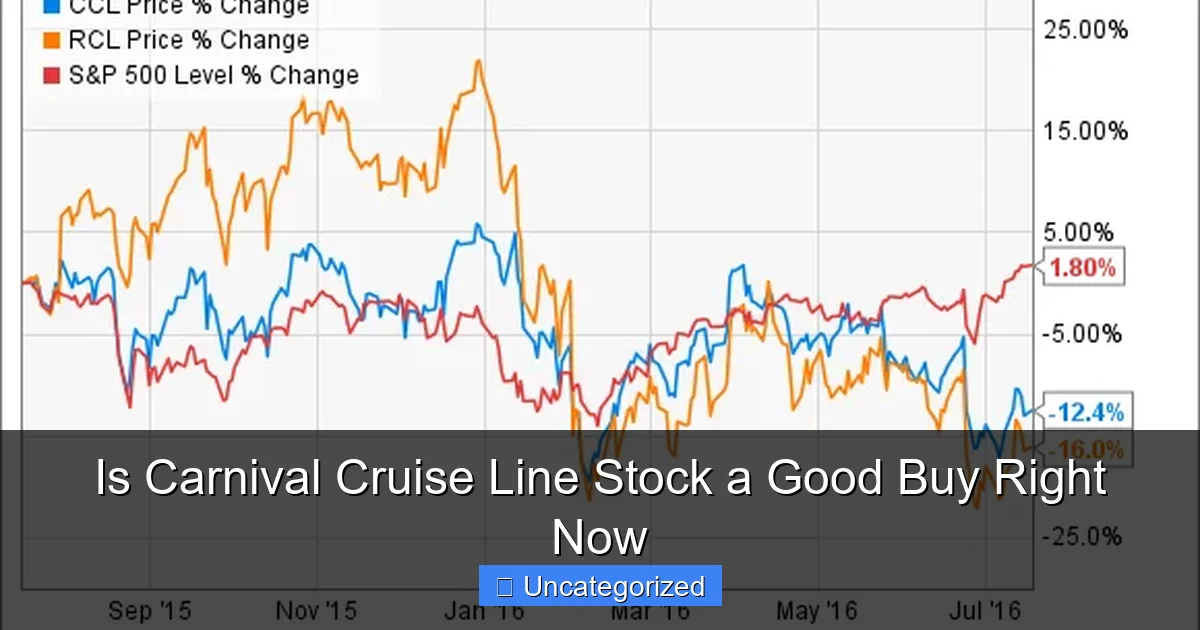
Featured image for is carnival cruise line stock a good buy
Image source: media.ycharts.com
Carnival Cruise Line stock presents a high-risk, high-reward opportunity as travel demand rebounds post-pandemic. With strong booking trends and cost-cutting measures improving margins, long-term investors may find value at current levels, but volatility remains a concern due to economic uncertainty and debt loads.
Key Takeaways
- Evaluate financial health: Review Carnival’s debt levels and cash flow before investing.
- Assess demand trends: Monitor booking volumes and pricing power for revenue signals.
- Watch interest rates: Rising rates may pressure Carnival’s high debt burden.
- Consider industry recovery: Cruise demand rebound is strong but faces macroeconomic risks.
- Diversify your portfolio: Avoid overconcentration in cyclical travel stocks like Carnival.
- Track operational updates: New ships and cost-cutting measures could boost profitability.
📑 Table of Contents
Is Carnival Cruise Line Stock a Good Buy Right Now?
The cruise industry has long been a fascinating segment of the travel and leisure sector, offering investors a unique blend of cyclicality, consumer demand, and global economic sensitivity. Among the most prominent players in this space is Carnival Cruise Line, a subsidiary of Carnival Corporation & plc (NYSE: CCL), the world’s largest cruise operator. With a fleet of over 90 ships under multiple brands including Princess Cruises, Holland America, and Seabourn, Carnival has built a diversified business model that spans continents and caters to a broad demographic. But as the world emerges from the shadow of the pandemic, investors are asking: Is Carnival Cruise Line stock a good buy right now?
This question is more nuanced than it appears. While the stock has seen a significant rebound since its 2020 lows—when it traded below $8—Carnival’s share price (as of mid-2024) hovers around $15–$18, reflecting cautious optimism rather than runaway enthusiasm. The company has navigated unprecedented challenges, including prolonged fleet idling, massive debt accumulation, and shifting consumer behavior. Yet, recent financial reports show signs of recovery, with record bookings, improved margins, and a strategic debt reduction plan. This blog post will explore the key factors influencing Carnival’s stock performance, including its financial health, industry trends, competitive positioning, valuation metrics, and long-term growth prospects. Whether you’re a value investor, growth seeker, or dividend hunter, understanding the full picture is essential before deciding if CCL stock deserves a place in your portfolio.
Financial Performance and Recovery Post-Pandemic
Revenue and Earnings Trends
Carnival Corporation’s financial journey since 2020 has been nothing short of a rollercoaster. In 2020, the company reported a staggering net loss of $10.2 billion, as global cruise operations were suspended for over 18 months. Revenue plummeted from $20.8 billion in 2019 to just $1.9 billion in 2021. However, the tide began to turn in 2022 and 2023. By Q4 2023, Carnival reported quarterly revenue of $5.4 billion, surpassing pre-pandemic levels in key markets like North America and Europe. For the full fiscal year 2023, revenue reached $21.6 billion, a 77% increase from 2022 and slightly above 2019’s $20.8 billion.

Visual guide about is carnival cruise line stock a good buy
Image source: i.ytimg.com
More importantly, the company achieved positive adjusted EBITDA in every quarter of 2023, totaling $3.7 billion for the year—up from $1.2 billion in 2022. This marks a critical milestone, indicating that Carnival is not just growing revenue but also improving operational efficiency. Net income remains a work in progress; Carnival reported a net loss of $75 million in 2023, but this is a dramatic improvement from the $6.1 billion loss in 2022. Management projects profitability on a GAAP basis by 2024, which would be a major catalyst for investor confidence.
Debt Management and Liquidity
One of the biggest concerns during the pandemic was Carnival’s ballooning debt. The company raised over $25 billion in capital through debt issuance and asset sales to survive the crisis. By mid-2022, its total debt stood at $35 billion, raising fears of insolvency. However, Carnival has since taken aggressive steps to reduce leverage. Through a combination of asset divestitures (including older ships), equity offerings, and cash flow generation, the company reduced its net debt to $29.8 billion by the end of 2023.
The company’s debt-to-EBITDA ratio improved from 28x in 2022 to 8.1x in 2023—a significant de-risking. Carnival’s management has committed to further reducing debt to below 6x by 2025, which would align it more closely with pre-pandemic levels (around 4x). Liquidity remains robust: Carnival ended 2023 with $8.3 billion in cash and equivalents, providing a buffer against economic downturns or unexpected disruptions.
Practical Tip: Investors should monitor Carnival’s quarterly debt reduction progress. A faster-than-expected paydown could signal stronger cash flow and improve credit ratings, potentially leading to a stock re-rating. Conversely, delays could raise concerns about refinancing risks, especially with interest rates still elevated.
Industry Trends and Competitive Landscape
Recovery of Cruise Demand
The cruise industry is experiencing a strong rebound, driven by pent-up demand and changing travel preferences. According to CLIA (Cruise Lines International Association), global cruise passenger volume reached 31.5 million in 2023, surpassing 2019’s 29.7 million. Carnival is leading this recovery: in Q1 2024, the company reported record booking volumes, with cumulative advance bookings 30% higher than 2019 levels for the same period. Pricing power has also returned—average ticket prices are up 15% year-over-year, reflecting strong consumer willingness to pay.
This demand surge is fueled by several macro trends:
- Experience-based spending: Post-pandemic, consumers are prioritizing experiences over goods, benefiting travel and leisure sectors.
- Demographic shifts: Millennials and Gen Z are increasingly embracing cruising as an affordable, all-inclusive vacation option.
- Globalization of cruising: Emerging markets in Asia and Latin America are seeing rising cruise participation.
Competitive Positioning
Carnival operates in a duopoly-dominated market, with Royal Caribbean (RCL) and Norwegian Cruise Line (NCLH) as its primary rivals. However, Carnival holds a distinct advantage:
- Fleet size and brand diversity: With 90+ ships across nine brands, Carnival offers a wider range of experiences—from luxury (Seabourn) to family-friendly (Carnival Cruise Line)—than any competitor.
- Geographic reach: Carnival sails to over 700 destinations worldwide, compared to Royal Caribbean’s 500+.
- Cost efficiency: Despite higher debt, Carnival has maintained lower operating costs per passenger-day than peers, thanks to economies of scale.
However, Royal Caribbean has gained market share in high-margin segments like premium cruising, while Norwegian has focused on innovation (e.g., larger ships with more amenities). Carnival’s challenge is to close this gap while maintaining its mass-market appeal.
Example: In 2023, Carnival launched the Excel-class ships (e.g., Mardi Gras, Carnival Celebration), featuring LNG propulsion and cutting-edge entertainment. These vessels have achieved 10% higher onboard spending per guest, demonstrating Carnival’s ability to innovate.
Valuation and Investment Metrics
Current Valuation Ratios
To assess whether Carnival stock is a good buy, we must evaluate its valuation against fundamentals. As of mid-2024, Carnival trades at the following key metrics:
| Metric | Carnival (CCL) | Royal Caribbean (RCL) | Norwegian (NCLH) | Industry Avg. |
|---|---|---|---|---|
| Price-to-Sales (P/S) | 1.1x | 1.8x | 1.3x | 1.4x |
| EV/EBITDA | 7.5x | 10.2x | 8.9x | 8.8x |
| Price-to-Book (P/B) | 2.3x | 3.1x | 2.7x | 2.7x |
| Forward P/E (2024 est.) | 18.5x | 15.8x | 16.3x | 16.9x |
| Debt-to-Equity | 4.2x | 2.8x | 3.5x | 3.5x |
These numbers reveal that Carnival is the most undervalued among the major cruise stocks on a P/S and EV/EBITDA basis. Its P/S ratio of 1.1x is significantly below Royal Caribbean’s 1.8x, suggesting that investors are pricing Carnival at a discount despite similar revenue growth. The EV/EBITDA of 7.5x is also attractive, especially given that Carnival’s EBITDA is expected to grow 25% in 2024.
Growth Projections and Catalysts
Analysts project strong earnings growth for Carnival in the coming years. According to Bloomberg consensus estimates:
- 2024: EPS of $0.85 (up from -$0.07 in 2023)
- 2025: EPS of $1.30 (65% YoY growth)
- 2026: EPS of $1.65 (27% YoY growth)
Key catalysts include:
- Fleet optimization: Carnival plans to retire 15 older, less efficient ships by 2025, reducing fuel and maintenance costs by 12%.
- Onboard revenue growth: The company is expanding its “Carnival Play” platform, which integrates digital payments, excursions, and retail, aiming to increase onboard spending by 20% by 2025.
- Sustainability investments: Carnival is investing $2 billion in LNG-powered ships and carbon capture technology, which could attract ESG-focused investors.
Practical Tip: Use discounted cash flow (DCF) analysis to model Carnival’s fair value. Assuming a 10% discount rate, 15% EBITDA growth through 2026, and a terminal EV/EBITDA of 8x, the stock could be undervalued by 30–40%, suggesting a target price of $22–$25.
Risks and Challenges to Consider
Macroeconomic Sensitivity
Carnival’s business is highly cyclical and sensitive to macroeconomic factors. A recession, rising unemployment, or inflation could reduce discretionary spending on vacations. For example, during the 2008 financial crisis, Carnival’s revenue dropped 12% year-over-year, and the stock lost 65% of its value. While the company is better capitalized today, a global downturn could still pressure margins and booking volumes.
Additionally, fuel price volatility remains a risk. Carnival spends over $2 billion annually on fuel. A sustained increase in oil prices (e.g., above $100/barrel) could erode profitability, especially for non-LNG-powered ships. However, Carnival’s new Excel-class ships use LNG, which is 25% cheaper and cleaner than traditional marine fuel, providing some insulation.
Regulatory and Operational Risks
The cruise industry faces increasing scrutiny from regulators, particularly around environmental impact. The EU’s Emissions Trading System (ETS) now includes maritime emissions, which could add $300 million in annual costs for Carnival by 2026. The company is investing in scrubbers and alternative fuels, but compliance costs could pressure margins.
Operational risks include:
- Geopolitical instability: Conflicts in the Middle East or Red Sea disruptions have forced Carnival to reroute ships, increasing costs and reducing itinerary attractiveness.
- Health outbreaks: While rare, norovirus or COVID-like outbreaks could damage consumer confidence. Carnival’s “Vacation Guarantee” program (full refunds for cancellations) helps mitigate this risk.
- Labor shortages: The cruise industry relies on 1.2 million global crew members. Post-pandemic staffing gaps have increased wage inflation by 8–10%.
Example: In 2023, Carnival canceled 12 sailings due to Red Sea diversions, costing an estimated $40 million in lost revenue. While the company recovered quickly, such events highlight the fragility of global supply chains.
Long-Term Growth and Strategic Outlook
Expansion into Emerging Markets
Carnival is aggressively targeting emerging markets to diversify revenue and reduce reliance on North America and Europe. The company has:
- Launched dedicated Asian itineraries from Shanghai and Singapore, with bookings up 45% in 2023.
- Partnered with local travel agencies in India and Brazil to promote cruising as a mainstream vacation.
- Introduced budget-friendly “Carnival Fun” packages in Latin America, priced 20% below U.S. rates.
The global cruise market is projected to grow at 6.8% CAGR through 2030, reaching $50 billion in revenue. Carnival aims to capture 40% of this growth, focusing on first-time cruisers in Asia and Latin America.
Digital Transformation and Customer Loyalty
Carnival is investing heavily in technology to improve customer experience and retention. Initiatives include:
- Carnival Play app: A unified platform for bookings, excursions, and onboard purchases, used by 70% of guests.
- AI-powered personalization: Using machine learning to recommend excursions and dining options based on past behavior.
- Loyalty program expansion: The “VIFP” (Very Important Fun Person) program now has 18 million members, with 60% returning within two years.
These efforts are paying off: Carnival’s customer satisfaction score (NPS) rose to 72 in 2023, up from 63 in 2019. High retention rates reduce marketing costs and increase lifetime customer value.
Practical Tip: Monitor Carnival’s customer acquisition cost (CAC) and lifetime value (LTV) ratios. A LTV/CAC ratio above 3x (currently 2.8x) would indicate efficient growth, making the stock more attractive.
Final Verdict: Should You Buy Carnival Stock?
After analyzing Carnival Cruise Line’s financial recovery, industry positioning, valuation, risks, and long-term strategy, the answer to “Is Carnival Cruise Line stock a good buy right now?” is nuanced but leans positive—with important caveats.
Reasons to Buy:
- Undervalued relative to peers: Carnival trades at a 20–30% discount to Royal Caribbean on key metrics despite similar growth.
- Strong demand recovery: Record bookings and pricing power suggest sustainable revenue growth.
- Debt reduction progress: The company is on track to achieve investment-grade leverage by 2025.
- Diversified growth levers: Fleet modernization, emerging markets, and digital innovation provide multiple upside drivers.
Risks to Monitor:
- Macroeconomic headwinds (recession, inflation).
- Regulatory compliance costs (carbon taxes, emissions rules).
- Geopolitical disruptions affecting itineraries.
For long-term investors with a 3–5 year horizon, Carnival offers compelling upside. The stock is not without risk, but its current valuation reflects a “recovery play” with significant room to re-rate as profitability improves. A target price of $22–$25 by 2025 appears achievable if management executes on debt reduction and margin expansion.
However, conservative investors or those averse to volatility may prefer to wait for clearer signs of sustained profitability (e.g., two consecutive quarters of GAAP net income) or a broader market pullback to buy at a lower entry point (e.g., below $14). Ultimately, Carnival Cruise Line stock is a high-conviction, moderate-risk buy for those who believe in the enduring appeal of cruising and the company’s ability to navigate a complex global landscape.
Frequently Asked Questions
Is Carnival Cruise Line stock a good buy right now?
Whether Carnival Cruise Line stock (CCL) is a good buy depends on your risk tolerance and market outlook. Recent improvements in booking trends and debt reduction efforts suggest potential, but lingering economic uncertainties and high leverage remain risks.
What factors should I consider before investing in Carnival Cruise Line stock?
Key factors include the company’s debt levels, booking volumes, fuel costs, and broader travel demand trends. Monitoring Carnival’s quarterly earnings and guidance can help assess its recovery trajectory and long-term profitability.
How does Carnival’s financial health affect its stock performance?
Carnival’s high debt from the pandemic remains a concern, but aggressive cost-cutting and improved cash flow are positive signs. If the company sustains its debt reduction and avoids liquidity crunches, it could boost investor confidence in the stock.
Is Carnival Cruise Line stock undervalued compared to its competitors?
Compared to rivals like Royal Caribbean and Norwegian, Carnival’s valuation appears more attractive based on price-to-sales ratios. However, its higher leverage and slower recovery pace may justify a discount, so thorough analysis is crucial.
What are analysts saying about Carnival Cruise Line stock?
Analyst opinions are mixed, with some seeing upside from pent-up travel demand, while others caution about macroeconomic risks. Reviewing consensus ratings and price targets can provide balanced insights before making a decision.
Could Carnival’s stock rebound as travel demand grows?
Yes, strong post-pandemic cruise demand and rising ticket prices could drive revenue growth. If Carnival maintains operational efficiency and avoids major disruptions, the stock has significant upside potential in a sustained travel boom.