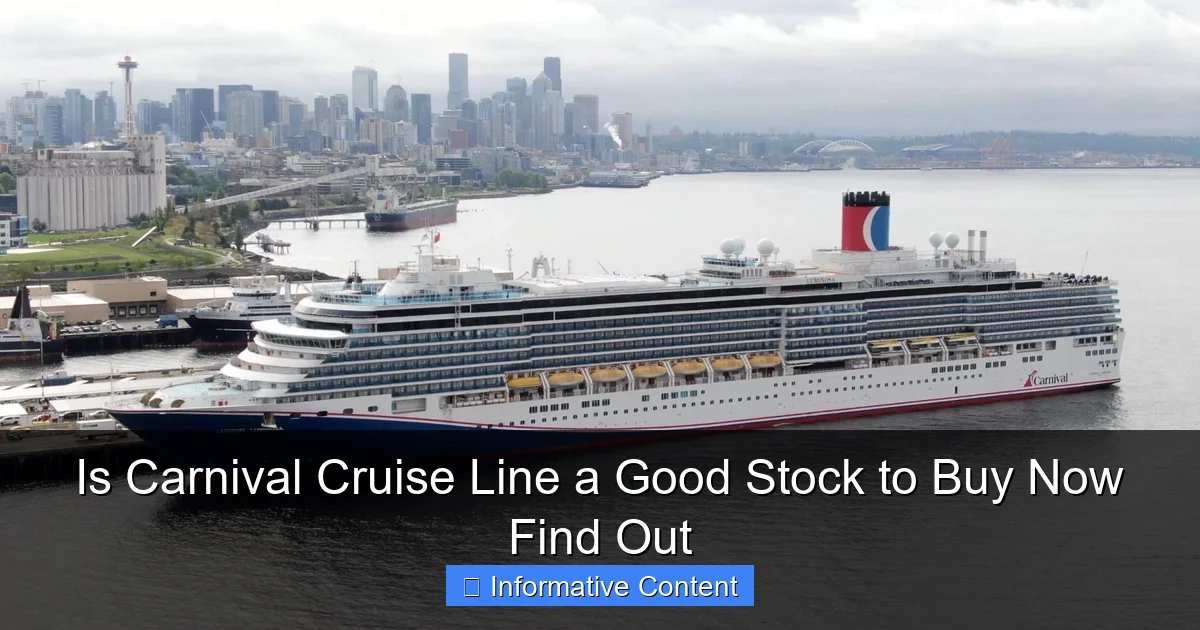
Featured image for is carnival cruise line a good stock to buy now
Image source: cruisefever.net
Carnival Cruise Line (CCL) presents a high-risk, high-reward opportunity as travel demand rebounds post-pandemic, but macroeconomic headwinds and debt concerns loom large. With strong booking trends and cost-cutting measures improving margins, the stock could surge if consumer spending holds—yet rising fuel prices and interest expenses may pressure profitability. For aggressive investors with a long-term horizon, CCL is a speculative buy, but those risk-averse should wait for clearer financial stability.
Key Takeaways
- Evaluate financial health: Check Carnival’s debt levels and cash flow stability.
- Monitor demand trends: Rising bookings signal strong recovery potential.
- Compare valuation metrics: Assess P/E and P/S ratios against industry peers.
- Watch fuel costs: High oil prices could squeeze profit margins.
- Consider dividend status: No dividends now; prioritize growth potential.
- Assess global risks: Geopolitical or health crises may impact travel demand.
📑 Table of Contents
- Is Carnival Cruise Line a Good Stock to Buy Now? Find Out
- 1. Carnival Cruise Line’s Financial Health: Where Does It Stand?
- 2. Industry Trends: Is the Cruise Market Recovering—or Thriving?
- 3. Carnival’s Growth Strategy: What’s Next?
- 4. Risks and Challenges: What Could Go Wrong?
- 5. Valuation and Stock Performance: Is It a Bargain or a Trap?
- 6. Should You Buy Carnival Stock Now? The Bottom Line
Is Carnival Cruise Line a Good Stock to Buy Now? Find Out
Imagine you’re on a Carnival Cruise Line ship, the sun setting over the ocean, a tropical drink in hand, and the deck buzzing with excitement. It’s easy to see why millions choose Carnival every year for a fun, affordable getaway. But when it comes to investing, the question isn’t about margaritas or poolside lounging—it’s about whether Carnival Cruise Line stock is a smart financial move right now.
As someone who’s watched the cruise industry rise, fall, and rise again (especially after the pandemic), I’ve had my fair share of late-night debates with friends about whether Carnival is a hidden gem or a sinking ship. The answer? It’s complicated. Like any investment, it depends on your goals, risk tolerance, and how much faith you have in the company’s recovery and long-term vision. In this post, we’ll break down everything you need to know—from financial performance and market trends to risks and opportunities—so you can decide if Carnival is a good stock to buy now. Let’s dive in.
1. Carnival Cruise Line’s Financial Health: Where Does It Stand?
Before buying any stock, especially in a post-pandemic world, it’s crucial to understand the company’s financial footing. Carnival Cruise Line (ticker: CCL) faced one of its toughest periods during 2020–2021, when global shutdowns grounded its fleet. But since then, the company has been rebuilding—aggressively.
Revenue Recovery and Earnings Trends
Let’s start with the good news. In 2023, Carnival reported $21.6 billion in revenue, a massive jump from $5.6 billion in 2021. This shows that demand is back—and stronger than ever. In fact, the company’s 2023 revenue was just 10% below its pre-pandemic peak in 2019. More importantly, Carnival turned a profit in Q3 2023, the first full quarter of profitability since 2019.
But here’s the catch: profitability is still fragile. Net income in 2023 was only $1.1 billion, and much of that was driven by one-time gains like asset sales and debt restructuring. Core operating margins remain tight, hovering around 8–10%, which is lower than rivals like Royal Caribbean (15%+).
Tip: When evaluating recovery stocks, look beyond headline revenue. Ask: “Is the company making money from its core operations?” For Carnival, the answer is slowly becoming “yes,” but it’s still not as strong as it was pre-2020.
Debt Load: A Heavy Anchor?
One of the biggest concerns for investors is Carnival’s debt. The company took on over $30 billion in debt during the pandemic to stay afloat. As of early 2024, it still carries $28.4 billion in long-term debt, with $5.2 billion due within the next 12 months.
That’s a lot of weight to carry. High debt means:
- Interest payments eat into profits (Carnival paid $1.4 billion in interest in 2023).
- Limited flexibility to invest in new ships or tech.
- Investor concerns about solvency if demand dips.
However, Carnival has been actively reducing debt through refinancing and asset sales. It’s also generating strong cash flow—$3.8 billion in operating cash flow in 2023—which helps chip away at the burden. Still, until debt is cut in half, it’s a red flag for conservative investors.
Balance Sheet Strength: Can It Weather Another Storm?
Carnival’s balance sheet shows signs of improvement. Its current ratio (assets vs. short-term liabilities) is now 1.3, up from 0.7 in 2021. That means it can cover near-term obligations. Plus, the company has $4.2 billion in liquidity, including cash and credit lines.
But remember: the cruise industry is cyclical and vulnerable to shocks (think: pandemics, hurricanes, or economic downturns). If another crisis hits, Carnival’s debt could become a serious liability.
2. Industry Trends: Is the Cruise Market Recovering—or Thriving?
To judge Carnival’s future, you need to understand the bigger picture. The cruise industry isn’t just bouncing back—it’s changing. And that affects whether Carnival Cruise Line stock is a good buy now.
Demand Is Surging—But Is It Sustainable?
Here’s a fun fact: in 2023, over 31 million people took a cruise worldwide—up 20% from 2019. Carnival alone carried 12.5 million guests, a record. Why? A few reasons:
- Post-pandemic “revenge travel”: People are making up for lost time.
- Affordable pricing: Carnival’s “fun, affordable” brand attracts budget-conscious travelers.
- New destinations: The company added 15+ new ports in 2023, including spots in Alaska, the Mediterranean, and Southeast Asia.
But here’s a word of caution: this demand surge may slow as inflation and high interest rates make travel more expensive. In Q4 2023, Carnival reported that booking volumes were slightly below expectations. That doesn’t mean demand is collapsing—it just means growth is normalizing.
Competition Heats Up: Carnival vs. Royal Caribbean vs. Norwegian
Carnival isn’t the only player in town. Its main rivals—Royal Caribbean (RCL) and Norwegian Cruise Line (NCL)—are also recovering fast. In fact, Royal Caribbean’s stock has outperformed Carnival’s by over 30% in the past two years.
Why? A few key differences:
- Fleet modernization: Royal Caribbean has invested heavily in new, fuel-efficient ships like the Icon of the Seas (a $2 billion floating city). Carnival’s fleet is older, with an average ship age of 15 years.
- Pricing power: Royal Caribbean charges premium prices for luxury experiences. Carnival relies more on volume and promotions.
- Global reach: Norwegian has a stronger presence in Europe and Asia, while Carnival is more U.S.-focused.
Tip: If you’re bullish on the cruise industry but want more innovation, Royal Caribbean might be a better bet. But if you believe in Carnival’s mass-market appeal, there’s still upside.
Environmental and Regulatory Pressures
The cruise industry is under scrutiny for its environmental impact. New regulations in Europe and the U.S. are pushing companies to reduce emissions and adopt cleaner fuels. Carnival has pledged to be carbon-neutral by 2050 and is investing in LNG-powered ships and shore power.
But these changes cost money. Carnival spent $1.2 billion on sustainability initiatives in 2023—money that could’ve gone to dividends or debt reduction. For long-term investors, this is a positive sign. For short-term traders, it might mean slower profit growth.
3. Carnival’s Growth Strategy: What’s Next?
So, how is Carnival planning to stay relevant and profitable? The company isn’t just relying on past success—it’s making bold moves.
Fleet Renewal and New Ships
Carnival is in the middle of a multi-billion-dollar fleet upgrade. In 2024 alone, it will launch three new ships:
- Carnival Jubilee (Texas homeport) – 6,631 guests, LNG-powered.
- Carnival Firenze (California) – Italian-themed, 4,126 guests.
- Sun Princess (Princess Cruises, a Carnival Corp. brand) – 4,300 guests, LNG-powered.
These new ships are more efficient, offer better guest experiences, and can command higher ticket prices. The Carnival Jubilee, for example, sold out its first season in record time.
Digital Transformation and Personalization
Remember when checking in at the port took hours? Not anymore. Carnival has rolled out:
- Mobile check-in: Guests can board in 15 minutes.
- AI-powered recommendations: The Carnival Hub app suggests excursions, dining, and shows based on preferences.
- Dynamic pricing: Prices adjust in real-time based on demand, boosting revenue.
This isn’t just about convenience—it’s about increasing revenue per passenger. In 2023, Carnival’s onboard spending (drinks, spa, shops) grew 18% year-over-year.
Expanding into New Markets
Carnival isn’t just targeting the U.S. and Caribbean. It’s growing in:
- Asia: New itineraries in Japan, Vietnam, and Thailand.
- Australia: A dedicated ship for the South Pacific market.
- Europe: More sailings from Barcelona, Rome, and Amsterdam.
This diversification helps reduce reliance on any single region and opens new revenue streams.
4. Risks and Challenges: What Could Go Wrong?
Let’s be real—no investment is risk-free. Carnival has some serious challenges ahead.
Economic Sensitivity
Cruises are a “discretionary” expense. When times are tough, families cut back on vacations. In a recession, Carnival’s revenue could drop 20–30% overnight. The company’s 2008–2009 performance is a cautionary tale: revenue fell 15%, and the stock lost 60% of its value.
Tip: If you’re worried about a recession, consider holding off on Carnival until economic indicators improve.
Geopolitical and Health Risks
The cruise industry is vulnerable to global events. Think:
- Hurricanes: A major storm can cancel dozens of sailings.
- Political unrest: Ports in the Middle East or Eastern Europe could become off-limits.
- Health scares: A norovirus outbreak or pandemic-like event could ground fleets again.
In 2023, a norovirus incident on the Carnival Freedom led to a 10% stock drop in one day. That’s how sensitive the market is.
Labor Shortages and Rising Costs
Like many industries, Carnival is struggling with staffing. Crew shortages in 2022 led to service cuts and guest complaints. Plus, wages are rising—especially in Europe and the U.S. Carnival’s labor costs increased 12% in 2023.
Higher costs mean thinner margins unless ticket prices rise—but that risks losing price-sensitive customers.
5. Valuation and Stock Performance: Is It a Bargain or a Trap?
Now, the million-dollar question: is Carnival undervalued or overpriced?
Stock Price Trends
Carnival’s stock (CCL) has had a wild ride. It hit a low of $8.51 in 2022 and peaked at $24.50 in 2023. As of early 2024, it trades around $16–$17. That’s still 40% below its 2019 high.
Compared to Royal Caribbean (trading near $130) and Norwegian ($18), Carnival looks cheap. But “cheap” doesn’t always mean “good value.”
Valuation Metrics
Here’s a quick look at key numbers (as of Q1 2024):
| Metric | Carnival (CCL) | Royal Caribbean (RCL) | Norwegian (NCL) | S&P 500 Avg. |
|---|---|---|---|---|
| Price-to-Earnings (P/E) | 14.2 | 16.8 | 12.5 | 25.3 |
| Price-to-Sales (P/S) | 1.1 | 2.3 | 1.0 | 2.8 |
| Debt-to-Equity | 2.1 | 1.4 | 1.8 | 0.6 |
| Forward P/E (2024 est.) | 10.8 | 14.2 | 9.7 | 22.1 |
What do these numbers tell us?
- Carnival is cheaper on P/E and P/S than Royal Caribbean, but that’s partly because investors are worried about its debt.
- Debt-to-equity is high—2.1 means for every $1 of equity, there’s $2.10 in debt. That’s risky.
- Forward P/E suggests growth—if Carnival hits 2024 earnings estimates, the stock could be a bargain.
Tip: Look at forward P/E, not just trailing. If Carnival’s profits grow 30% in 2024 (as analysts predict), the stock could rise 20–30%.
Analyst Sentiment
Wall Street is cautiously optimistic. Of 22 analysts covering CCL:
- 9 say Buy
- 10 say Hold
- 3 say Sell
The average 12-month price target is $19.50—about 15–20% upside from current levels.
6. Should You Buy Carnival Stock Now? The Bottom Line
So, after all this—is Carnival Cruise Line a good stock to buy now? The answer depends on you.
Who Should Consider Buying?
Carnival could be a smart pick if:
- You’re bullish on travel recovery and believe demand will keep growing.
- You’re comfortable with high-risk, high-reward stocks. Carnival is volatile but has big upside.
- You’re a long-term investor (5+ years). The company needs time to reduce debt and modernize.
- You believe in Carnival’s brand loyalty. Millions still choose Carnival for fun, affordable vacations.
Who Should Stay Away?
You might want to skip it if:
- You’re risk-averse or need stable dividends (Carnival doesn’t pay one).
- You’re worried about a recession or economic downturn.
- You prefer lower-debt companies with stronger balance sheets (like Royal Caribbean).
- You’re looking for short-term gains. Carnival’s stock could stagnate for months.
My Final Take
Here’s how I see it: Carnival isn’t the “best” cruise stock, but it’s the most affordable and undervalued right now. If the company can:
- Reduce debt to under $20 billion by 2026,
- Maintain strong demand,
- And keep innovating,
…then the stock could double in the next 3–5 years. But it won’t be a smooth ride. Expect volatility, headlines about outbreaks, and quarterly earnings drama.
My advice? If you decide to buy, start small. Maybe allocate 2–5% of your portfolio. Dollar-cost average in over 3–6 months to reduce risk. And keep an eye on debt reduction and booking trends.
At the end of the day, investing in Carnival isn’t just about numbers—it’s about believing in the joy of travel. If you’ve ever laughed on a deck, danced at a midnight party, or watched a sunset at sea, you know that feeling. Carnival is betting big on that feeling coming back. The question is: are you willing to bet on it too?
Frequently Asked Questions
Is Carnival Cruise Line a good stock to buy now for long-term growth?
Carnival Cruise Line (CCL) shows potential for long-term growth as travel demand rebounds post-pandemic, but it remains sensitive to economic downturns and fuel costs. Consider its debt levels and industry recovery pace before investing.
What are the biggest risks of investing in Carnival Cruise Line stock right now?
The stock faces risks like high debt from pandemic-era losses, fluctuating fuel prices, and potential recession impacts on consumer spending. These factors make it a volatile pick despite recent revenue improvements.
How does Carnival Cruise Line compare to other cruise stocks like Royal Caribbean or Norwegian?
Carnival has a larger fleet and broader market reach than peers, but Royal Caribbean’s premium positioning and Norwegian’s lower debt may appeal to risk-averse investors. Compare each company’s balance sheet and growth strategy.
Does Carnival Cruise Line pay dividends, and is it a good income stock?
Carnival suspended dividends in 2020 and hasn’t reinstated them as of 2023, making it unsuitable for income-focused investors. Prioritize other cruise stocks or sectors if dividend payouts are a priority.
What financial metrics should I check before buying Carnival Cruise Line stock?
Key metrics include debt-to-equity ratio (currently high), revenue growth (rebounding in 2023), and EBITDA margins (improving but below pre-pandemic levels). Monitor these to assess financial health.
Is Carnival Cruise Line a good stock to buy now amid rising travel demand?
With cruise bookings nearing 2019 levels, Carnival could benefit from pent-up demand, but inflation and interest rates may pressure margins. It’s a speculative buy tied closely to macroeconomic trends.