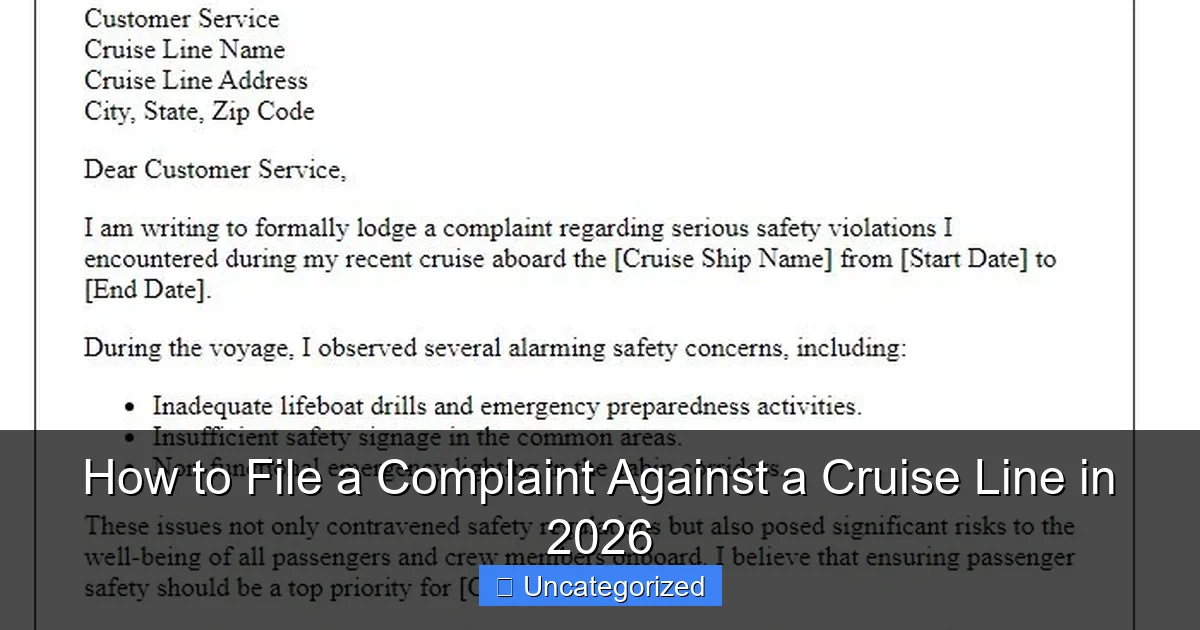
Featured image for how to file a complaint against a cruise line
Image source: letterin.net
File your complaint directly with the cruise line’s customer relations department via certified mail or their official online portal to ensure a documented, traceable record. Include key details like booking number, incident dates, and supporting evidence (photos, receipts, witness statements) to strengthen your case. Escalate to regulatory bodies like the FTC or DOT if unresolved within 30 days.
How to File a Complaint Against a Cruise Line in 2026
Key Takeaways
- Document everything: Keep records of incidents, photos, receipts, and communications as evidence.
- Report onboard first: File a formal complaint with the cruise line’s customer service before disembarking.
- Know your rights: Review your cruise contract and local maritime laws for legal leverage.
- Submit written complaints: Send detailed, dated letters to the cruise line’s corporate office.
- Escalate if unresolved: Contact the DOT, FTC, or a consumer protection agency for help.
- Consult a lawyer: Seek legal advice for serious issues like injuries or fraud.
Why This Matters / Understanding the Problem
Imagine this: You’ve saved for years, booked your dream cruise, and boarded with excitement. But instead of relaxation, you face a broken AC, rude staff, or a missed port due to poor planning. Now what?
Unfortunately, cruise lines don’t always deliver the luxury they promise. In 2026, with more travelers than ever, how to file a complaint against a cruise line in 2026 has become a crucial skill. Whether it’s food poisoning, overbooking, misleading advertising, or safety concerns, your voice matters—and you have rights.
Filing a complaint isn’t about revenge. It’s about accountability. When you report issues properly, you help improve standards for future passengers and may even get compensation. The process can feel intimidating, but with the right approach, you can make a real impact.
Many travelers don’t know where to start. Some give up after a bad experience. Others write angry emails that get ignored. This guide walks you through how to file a complaint against a cruise line in 2026—step by step—so you can act confidently, effectively, and with the best chance of a resolution.
What You Need
Before you begin, gather everything you’ll need. Being prepared saves time and strengthens your case. Think of this like building a puzzle: each piece matters.
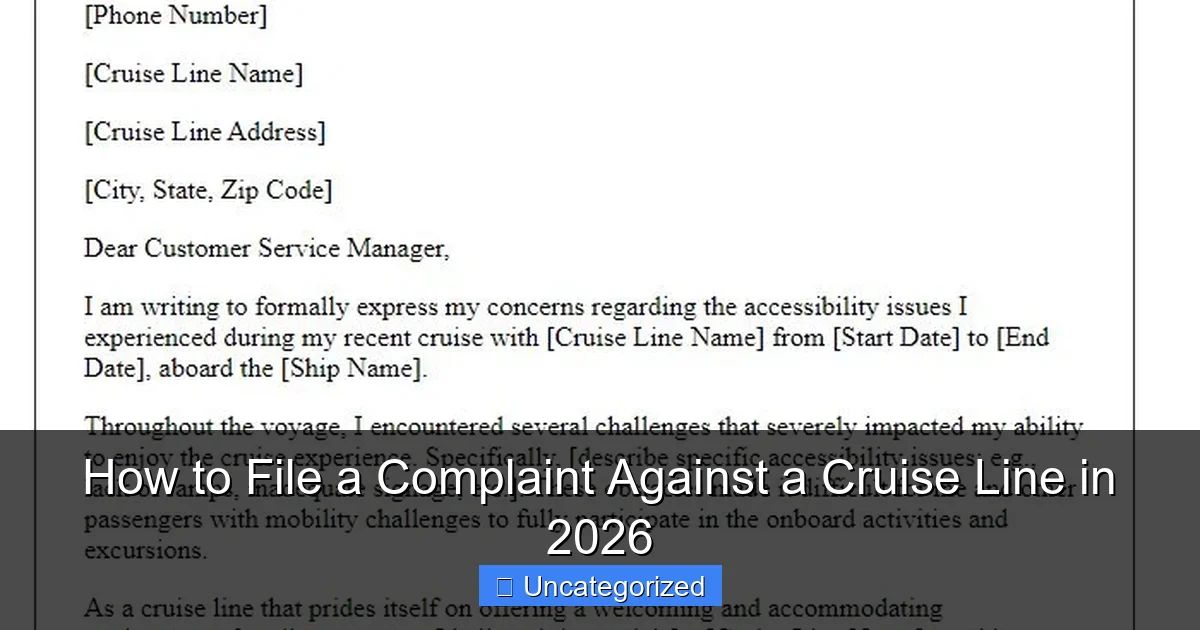
Visual guide about how to file a complaint against a cruise line
Image source: letterin.net
- Booking confirmation and itinerary: Your reservation number, dates, and cabin details.
- Photographs and videos: Document issues like broken amenities, unclean rooms, or hazardous conditions.
- Medical records (if applicable): Doctor’s notes, prescriptions, or hospital visits due to illness or injury.
- Receipts and expense records: For extra costs (e.g., missed shore excursions, medical bills, or hotel stays).
- Communication logs: Notes of conversations with staff, emails, or text messages.
- Witness statements: If others saw or experienced the same issue, ask them to write a short note.
- Access to cruise line’s website and customer service portals: Most complaints start online.
- Smartphone or computer: For uploading files and submitting forms.
Pro Tip: Start gathering evidence during your cruise. Don’t wait until you get home. Take photos of mold, broken furniture, or overcrowded pools. Write down names of crew members you speak with. Time-stamped evidence is gold.
You don’t need a lawyer to start, but keep all documents organized. Use folders (digital or physical) labeled by date and issue. This makes your complaint clear, professional, and harder to dismiss.
Step-by-Step Guide to How to File a Complaint Against a Cruise Line in 2026
Step 1: Address the Issue Onboard (If Possible)
The first rule of cruise complaints: don’t wait until the ship docks. Many cruise lines require you to report problems during the voyage to qualify for compensation.
Go to the Guest Services desk—usually on the main deck—and ask to speak with a supervisor or manager. Be calm but firm. Explain the issue clearly and provide evidence (photos, notes).
- For a broken AC: “My cabin has had no air conditioning for two days. I’ve reported it twice, but it’s still not fixed.”
- For food poisoning: “I’ve been sick since dinner last night. I’ve seen a doctor and have a medical note. I believe it was from the buffet.”
- For a missed port: “We were told we’d spend 8 hours in St. Thomas, but the ship left after 2 hours due to weather. This wasn’t communicated until we were already sailing.”
Ask for a written response or incident report. Request a copy for your records. If the issue is safety-related (e.g., a broken handrail, slippery deck), emphasize the risk to passengers.
Warning: Don’t accept vague promises like “we’ll look into it.” Ask for a timeline: “When will this be fixed?” or “Who will contact me by tomorrow?”
If the staff dismisses you or offers no solution, escalate. Ask for the Guest Relations Manager or Hotel Director. These roles are higher in rank and more likely to act.
Remember: how to file a complaint against a cruise line in 2026 starts with immediate action. The longer you wait, the harder it is to prove your case.
Step 2: Document Everything (Even After the Cruise)
After the cruise, your documentation becomes your strongest weapon. Cruise lines rely on data—so you should too.
Create a timeline of events. Use a simple table or list:
| Date & Time | Event | Evidence | Staff Contacted |
|---|---|---|---|
| July 5, 10:00 AM | Reported AC issue to Guest Services | Photo of room temperature gauge: 82°F | Sarah (Guest Services) |
| July 5, 3:00 PM | No repair; asked for room change | Email to supervisor (attached) | Mr. Patel (Supervisor) |
| July 6, 9:00 AM | Still no AC; spoke to Hotel Director | Video of broken vent | Ms. Lopez (Hotel Director) |
Include:
- Photos of damaged property, unclean areas, or hazardous conditions.
- Medical reports if you got sick or injured.
- Receipts for extra costs (e.g., taxi to a hospital, missed tour refund requests).
- Emails, text messages, or call logs with cruise staff.
Store everything digitally. Use cloud services like Google Drive or Dropbox. Label files clearly: “AC_issue_July5.jpg” or “Medical_Report_July6.pdf.”
Pro Tip: If you missed documenting something onboard, write a detailed summary now. Include what you remember, who you spoke to, and what was said. The more specific, the better.
This step is vital for how to file a complaint against a cruise line in 2026—because without proof, your complaint is just a story.
Step 3: Submit a Formal Complaint to the Cruise Line
Now it’s time to go official. Most major cruise lines have online complaint forms. Here’s how to find and use them:
- Carnival Cruise Line: Use the “Contact Us” form on carnival.com. Select “Post-Cruise Feedback” and attach files.
- Royal Caribbean: Visit royalcaribbean.com, click “Help & Support,” then “Submit Feedback.”
- Norwegian Cruise Line (NCL): Use the “Contact Us” section and choose “Complaints & Concerns.”
- MSC Cruises: Email [email protected] or use their online form.
- Disney Cruise Line: Submit via disneycruise.com/contact-us.
When filling out the form, be clear and concise. Use this structure:
- Subject line: “Formal Complaint: [Issue] on [Ship Name], [Sailing Date]”
- Summary: One sentence stating the problem (e.g., “I experienced food poisoning on the Symphony of the Seas, July 1–8, 2026”).
- Details: A 3–4 paragraph description. Use bullet points for clarity.
- Evidence: List attached files (photos, receipts, etc.).
- Request: State what you want (e.g., “I request a partial refund of $300 for the missed excursion and compensation for medical expenses”).
Example:
“On July 3, 2026, I became violently ill after eating at the Windjammer buffet. I visited the onboard clinic and was prescribed medication. I’ve attached my medical report and receipt for $120. I also missed my pre-booked shore excursion in St. Lucia due to illness. I’ve attached the non-refundable receipt for $180. I request compensation for both expenses and a partial refund for the disrupted cruise experience.”
Warning: Avoid emotional language. Say “I became ill” instead of “I was poisoned!” Stick to facts. Anger reduces credibility.
Submit the form and save the confirmation number. You should get an automated email. If not, follow up in 5 business days.
Step 4: Follow Up (And Keep Following Up)
Many complaints get lost in the shuffle. Cruise lines handle thousands of messages. Don’t assume silence means they’re working on it.
Wait 5–7 business days. If you haven’t heard back, send a polite follow-up email. Use a new subject line: “Follow-Up: Complaint #12345 – [Your Name]”
Example:
“Dear [Cruise Line] Customer Relations Team,
I submitted a formal complaint on July 10, 2026 (reference #12345), regarding food poisoning and a missed excursion on the Symphony of the Seas. I have not received a response and would appreciate an update. I’ve attached the original complaint and supporting documents for your review.
Thank you for your attention to this matter.
Sincerely, [Your Name]”
If you still don’t hear back after 10 days, escalate. Call the customer service number (usually on their website). Ask to speak with a supervisor. Reference your complaint number and say you’re following up.
Keep a record of every call:
- Date and time
- Name of representative
- What they said
- Any promises (e.g., “We’ll respond by Friday”)
Pro Tip: Use a free call recording app (like Google Voice or Otter.ai) if allowed by your state’s laws. It protects you if they deny the conversation later.
Persistence pays. Cruise lines often respond faster when they know you’re serious. This step is a key part of how to file a complaint against a cruise line in 2026—because follow-up turns silence into action.
Step 5: Escalate to External Agencies (If Needed)
If the cruise line ignores you or offers an unfair resolution, it’s time to go public—or to the authorities.
Here are your options:
1. File with the Federal Maritime Commission (FMC)
The FMC regulates cruise lines in U.S. waters. They can’t force refunds, but they investigate patterns of misconduct.
- Visit fmc.gov and click “File a Complaint.”
- Submit details, evidence, and your cruise line’s response (or lack of one).
- The FMC may contact the cruise line and ask for a response.
2. Contact the Consumer Financial Protection Bureau (CFPB)
The CFPB handles consumer disputes, including cruise issues.
- Go to consumerfinance.gov/complaint.
- Select “Travel” and “Cruise” as the product.
- Upload your complaint and evidence.
3. Report to the Better Business Bureau (BBB)
Many cruise lines are BBB-accredited. A complaint here can pressure them to respond.
- Search for your cruise line at bbb.org.
- Click “File a Complaint” and follow the steps.
- The BBB will notify the cruise line and ask for a response within 14 days.
4. Write a Review on Trusted Platforms
Public reviews matter. Cruise lines monitor sites like:
Write a detailed, factual review. Include dates, ship name, and what happened. Attach photos. Tag the cruise line. They often respond to public feedback faster than private emails.
Warning: Don’t exaggerate or use profanity. Stick to the facts. A well-written review is more effective than a rant.
5. Consult a Consumer Rights Attorney
If you suffered serious harm (e.g., injury, major financial loss), consider legal action. Many attorneys offer free consultations.
- Use the FindLaw directory to search for consumer rights lawyers.
- Look for those experienced in maritime law or cruise disputes.
- They may take the case on contingency (you pay only if you win).
Escalating isn’t about being confrontational. It’s about ensuring your voice is heard. This is a crucial part of how to file a complaint against a cruise line in 2026—because sometimes, the system needs a nudge.
Step 6: Know Your Rights and Legal Options
Cruise tickets include a “contract of passage.” It’s a legal document that outlines your rights. Most are buried in fine print, but here’s what matters:
- Timely refunds: If a port is missed due to the cruise line’s fault, you may be entitled to compensation.
- Medical care: You have the right to proper medical treatment onboard. If they deny it, document it.
- Safe environment: Cruise lines must maintain clean, safe conditions. Unsanitary food, broken railings, or overcrowding are violations.
- Accurate advertising: If the cruise didn’t match the brochure (e.g., “luxury dining” but only buffet food), you may have a case.
Under the Passenger Bill of Rights (adopted by major cruise lines), you also have:
- The right to be informed of itinerary changes.
- The right to a refund if a port is missed due to the cruise line’s negligence.
- The right to medical attention without being charged for the visit (though treatment may cost extra).
Read your contract. Look for clauses about:
- “Force majeure” (acts of nature) – These can excuse missed ports due to weather.
- “Limitation of liability” – Some contracts cap compensation.
Pro Tip: If your contract limits compensation, don’t give up. You can still file with the FMC or CFPB. Public pressure often leads to voluntary settlements.
Understanding your rights empowers you. This is a key element of how to file a complaint against a cruise line in 2026—because knowledge is power.
Pro Tips & Common Mistakes to Avoid
Pro Tip 1: Use the cruise line’s app. Many have a “Guest Feedback” feature. It’s faster than email and tracks your submission.
Pro Tip 2: Be specific with dates, names, and cabin numbers. “The AC broke on day 3” is weak. “Cabin 8523 had no AC from July 5–7, despite 3 reports” is strong.
Pro Tip 3: If you’re traveling with family or friends, have them file separate complaints. Multiple reports show a pattern, not just one unhappy guest.
Common Mistake 1: Waiting too long. Cruise lines often have a 30–60 day window to file complaints. Act fast.
Common Mistake 2: Not keeping records of communication. Save every email, text, and call note. Print them if needed.
Common Mistake 3: Expecting a full refund for minor issues. Realistic requests (e.g., $200 for a missed tour) are more likely to be approved than demanding $2,000.
Common Mistake 4: Posting publicly before trying private channels. Cruise lines often resolve issues faster when contacted directly. Use public reviews as a last resort.
Remember: The goal is a fair resolution, not a fight. Stay polite, persistent, and professional. This approach works best when learning how to file a complaint against a cruise line in 2026.
FAQs About How to File a Complaint Against a Cruise Line in 2026
Q1: How long do cruise lines have to respond to a complaint?
Most cruise lines aim to respond within 7–14 business days. If you don’t hear back, follow up. The FMC and CFPB typically take 30–60 days to investigate.
Q2: Can I get a full refund if I’m unhappy?
Not usually. Cruise lines rarely offer full refunds unless there was a major safety or operational failure (e.g., ship diverted due to a fire). Partial refunds, credit, or compensation are more common.
Q3: What if the cruise line says it was “weather” and won’t compensate?
Weather can excuse missed ports, but not if it was foreseeable. If they knew about a storm but didn’t inform passengers, file with the FMC. Also, check your contract—some offer “port guarantee” policies.
Q4: Should I post my complaint on social media?
Yes, but as a last resort. Tag the cruise line and use hashtags like #CruiseComplaint or #TravelRights. A polite, factual post often gets faster attention than a private email.
Q5: Can I sue a cruise line?
Yes, but it’s costly and time-consuming. Most cases are settled out of court. Consult a lawyer if you had a serious injury, financial loss, or the cruise line acted negligently.
Q6: Do I need a lawyer to file a complaint?
No. You can handle most complaints yourself. A lawyer is only needed for complex cases or if the cruise line refuses to cooperate after multiple attempts.
Q7: What if I was part of a group tour and the cruise line canceled an excursion?
Request a refund from the cruise line, not the tour operator. The cruise line is responsible for onboard and port activities. Provide proof of payment and the canceled tour details.
Final Thoughts
Filing a complaint doesn’t mean you’re difficult. It means you care about fairness and quality. In 2026, with rising travel demand, cruise lines need to know passengers won’t stay silent.
To recap how to file a complaint against a cruise line in 2026:
- Act fast—report issues onboard.
- Document everything with photos, receipts, and notes.
- Submit a formal complaint via the cruise line’s website.
- Follow up persistently.
- Escalate to the FMC, CFPB, or BBB if needed.
- Know your rights and stay professional.
You don’t have to accept subpar service. Every complaint helps improve the industry. Whether you get a refund, an apology, or just the satisfaction of being heard, you’ve made a difference.
Next time you set sail, pack your camera, your notes, and your confidence. Because now, you know how to file a complaint against a cruise line in 2026—and that’s power.