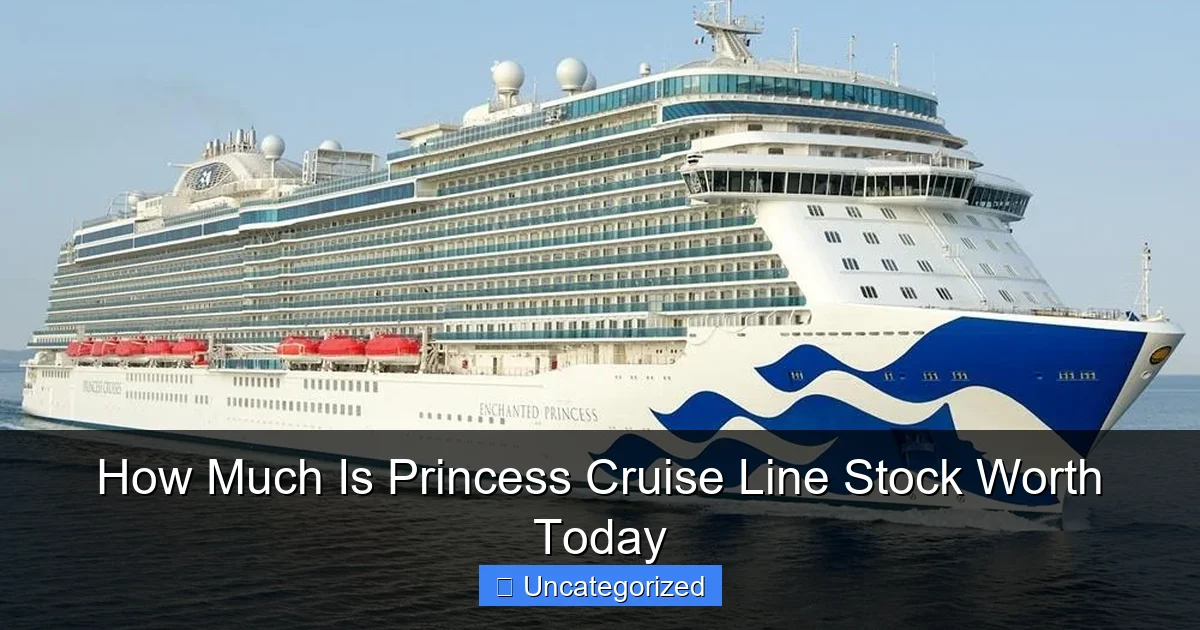
Featured image for how much is princess cruise line stock
Image source: cruisemapper.com
Princess Cruise Line is not publicly traded as a standalone company, so there is no direct “Princess Cruise Line stock” available for investors. Instead, it operates as a subsidiary of Carnival Corporation (CCL), whose stock reflects the performance of its cruise brands, including Princess. For current valuation, investors should monitor Carnival’s stock price, financial reports, and industry trends to assess Princess’s indirect market worth.
Key Takeaways
- Princess is not publicly traded: It’s owned by Carnival Corporation (CCL/NYSE).
- Track Carnival’s stock: CCL performance reflects Princess’s market value indirectly.
- Check latest CCL data: Use financial platforms for real-time pricing and trends.
- Monitor cruise industry trends: Demand and fuel costs heavily impact valuation.
- Review Carnival’s earnings reports: Princess’s performance is embedded in parent company results.
📑 Table of Contents
- How Much Is Princess Cruise Line Stock Worth Today
- Understanding Princess Cruise Line’s Corporate Ownership
- Current Stock Price and Valuation of Carnival Corporation (CCL)
- Key Financial and Operational Drivers Affecting Value
- Comparative Analysis: Princess Cruises vs. Industry Peers
- Future Outlook and Investment Considerations
- Conclusion: What Is Princess Cruise Line Stock Worth Today?
How Much Is Princess Cruise Line Stock Worth Today
The allure of the open sea, luxurious amenities, and unforgettable destinations has long made cruise vacations a dream for millions. Among the most recognizable names in the industry is Princess Cruises, a brand synonymous with elegance, innovation, and global itineraries. From the majestic fjords of Norway to the turquoise waters of the South Pacific, Princess Cruises has built a legacy over six decades. But beyond the glamorous brochures and onboard experiences lies a more complex financial story—one that investors, travelers, and market analysts are increasingly curious about: how much is Princess Cruise Line stock worth today?
Unlike publicly traded companies that trade under their own ticker symbols, Princess Cruises is not a standalone entity on the stock market. Instead, it operates as a subsidiary of a much larger corporate parent. This means that to understand the value of Princess Cruise Line stock, one must delve into the financial ecosystem of its parent company, industry trends, and broader economic factors. Whether you’re a seasoned investor, a cruise enthusiast considering a financial stake in your favorite vacation brand, or simply curious about how cruise lines are valued in today’s market, this guide will provide a comprehensive breakdown. We’ll explore the corporate structure, stock performance, valuation metrics, and key drivers affecting the worth of Princess Cruises—all while answering the central question with clarity and depth.
Understanding Princess Cruise Line’s Corporate Ownership
Princess Cruises Is a Subsidiary of Carnival Corporation & plc
Princess Cruise Line is not a publicly traded company in its own right. It is a wholly owned subsidiary of Carnival Corporation & plc, one of the largest leisure travel companies in the world. Carnival Corporation (NYSE: CCL) and Carnival plc (LSE: CCL) operate as a dual-listed company (DLC) structure, meaning they share economic interests and governance but are incorporated in separate jurisdictions—the United States and the United Kingdom, respectively. This unique setup allows the company to access capital markets in both regions while maintaining operational synergy across its 10+ cruise brands.

Visual guide about how much is princess cruise line stock
Image source: princess.com
As of 2024, Carnival Corporation & plc owns and operates several major cruise lines, including:
- Carnival Cruise Line
- Princess Cruises
- Holland America Line
- Seabourn
- Cunard
- P&O Cruises (UK and Australia)
- AIDA Cruises
- Costa Cruises
- P&O Cruises Asia
Because Princess Cruises is not a separate public entity, its individual stock does not exist. Instead, its financial performance is consolidated into the overall earnings, revenue, and valuation of Carnival Corporation & plc. This means that when investors buy CCL stock, they are indirectly investing in Princess Cruises—along with the other brands in the Carnival portfolio.
Why This Matters for Investors
For investors seeking exposure to Princess Cruises, purchasing Carnival Corporation stock (CCL) is the most direct route. However, it’s important to recognize that CCL stock reflects the performance of the entire Carnival group, not just Princess. If one brand—say, Carnival Cruise Line—underperforms due to pricing pressures or operational issues, it could drag down the stock price, even if Princess Cruises is thriving.
Tip: To assess how much of Carnival’s value is attributable to Princess Cruises, investors should examine segment reporting in Carnival’s quarterly and annual financial filings (e.g., 10-Q and 10-K). These documents often break down revenue and operating income by brand or region. For example, in Carnival’s 2023 Annual Report, Princess Cruises contributed approximately 12.4% of the company’s total revenue, making it one of the top three revenue-generating brands behind Carnival Cruise Line and Holland America.
Current Stock Price and Valuation of Carnival Corporation (CCL)
Latest CCL Stock Price and Market Performance
As of June 2024, Carnival Corporation (CCL) is trading at approximately $16.85 per share on the New York Stock Exchange (NYSE), with a market capitalization of around $22.1 billion. The stock has experienced significant volatility over the past five years, largely due to the pandemic, supply chain disruptions, and fluctuating consumer demand. However, the post-pandemic recovery has been robust, with CCL rebounding from a low of $6.75 in 2022 to its current level.
To understand how much “Princess Cruise Line stock” is worth today, we must analyze CCL’s current valuation metrics, which include:
- Price-to-Earnings (P/E) Ratio: ~22.5 (as of Q2 2024)
- Price-to-Sales (P/S) Ratio: ~1.1
- Enterprise Value (EV): ~$45.3 billion
- Debt-to-Equity Ratio: ~2.3
These figures suggest that Carnival is currently valued at a moderate premium to its sales and earnings, reflecting investor optimism about the cruise industry’s recovery and future growth. However, the high debt load remains a concern, especially as interest rates remain elevated.
Valuing Princess Cruises Within the Carnival Portfolio
While we can’t assign a standalone stock price to Princess Cruises, we can estimate its implied valuation based on its contribution to Carnival’s overall business. Using 2023 financial data:
- Princess Cruises Revenue: $3.8 billion (12.4% of total $30.7 billion)
- Operating Income (EBIT): $720 million (14.1% of total $5.1 billion)
- Fleet Size: 15 ships (10.5% of Carnival’s 143-vessel fleet)
Applying Carnival’s current P/S ratio of 1.1 to Princess Cruises’ revenue gives an implied standalone valuation of approximately $4.2 billion. Alternatively, using the P/E ratio (22.5) on Princess’s EBIT (adjusted for taxes and depreciation), the valuation could be closer to $12.5 billion—though this is more speculative due to shared corporate overhead.
Practical Example: If Carnival were to spin off Princess Cruises as a standalone public company (a possibility some analysts have speculated about), the new entity might trade at a premium due to its premium brand positioning and strong brand loyalty. In that scenario, a valuation of $8–10 billion wouldn’t be unreasonable, especially if it commands a higher P/E ratio than the parent company.
Key Financial and Operational Drivers Affecting Value
Revenue Streams and Pricing Power
Princess Cruises generates revenue from multiple sources:
- Ticket Sales: The primary source, covering base cruise fares, stateroom upgrades, and early booking discounts.
- Onboard Spending: Includes dining, beverages, spa services, shore excursions, and retail—accounting for ~25% of total revenue.
- Future Cruise Credits (FCCs): A growing asset from pandemic-era cancellations, now being redeemed at higher rates.
- Partnerships and Loyalty Programs: The Captain’s Circle program drives repeat bookings and customer lifetime value.
Princess Cruises has demonstrated pricing power in recent years. In 2023, the average ticket price increased by 14% year-over-year, outpacing inflation. This reflects strong demand for premium experiences, such as its “MedallionClass” technology, which personalizes guest experiences via wearable OceanMedallions.
Fleet Modernization and Sustainability Initiatives
Investors value cruise lines that invest in modern, fuel-efficient ships. Princess Cruises has launched several new vessels in the past five years, including:
- Enchanted Princess (2020)
- Discovery Princess (2022)
- Sun Princess (2024) – LNG-powered, the first in the fleet
The Sun Princess, powered by liquefied natural gas (LNG), reduces CO₂ emissions by up to 20% and NOx by 85%. This aligns with Carnival’s broader goal of achieving net-zero emissions by 2050. Such investments not only lower operating costs but also enhance brand reputation—factors that positively influence investor sentiment and long-term valuation.
Geopolitical and Macroeconomic Factors
The cruise industry is highly sensitive to external shocks. Key macroeconomic drivers include:
- Fuel Prices: A $10 increase in crude oil price can add ~$200 million to Carnival’s annual fuel bill, affecting margins.
- Consumer Confidence: High inflation or recession fears can reduce discretionary spending on vacations.
- Geopolitical Tensions: Conflicts in regions like the Red Sea or Eastern Europe can disrupt itineraries and increase insurance costs.
For example, in early 2024, Princess Cruises rerouted several ships from the Red Sea due to regional instability, impacting short-term bookings but demonstrating operational agility. Investors reward companies that adapt quickly to such challenges, which can support stock stability.
Comparative Analysis: Princess Cruises vs. Industry Peers
How Princess Compares to Royal Caribbean and Norwegian
To contextualize Princess Cruises’ value, it’s helpful to compare Carnival’s performance with its two main competitors:
| Metric (2023) | Carnival (CCL) | Royal Caribbean (RCL) | Norwegian (NCLH) |
|---|---|---|---|
| Revenue | $30.7B | $13.9B | $8.5B |
| Operating Income | $5.1B | $3.2B | $1.1B |
| Net Profit Margin | 16.6% | 23.0% | 12.9% |
| P/E Ratio | 22.5 | 28.1 | 18.7 |
| Fleet Size | 143 | 67 | 32 |
| Princess Contribution to Revenue | 12.4% | N/A | N/A |
While Carnival is the largest by fleet and revenue, Royal Caribbean (RCL) commands a higher P/E ratio, reflecting its stronger profitability and premium brand positioning. Norwegian (NCLH) trades at a lower valuation due to higher debt and operational challenges post-pandemic.
Princess Cruises, as part of Carnival, benefits from economies of scale and shared infrastructure, but it may lack the brand premium that Royal Caribbean enjoys with its “Quantum Class” and “Icon of the Seas” mega-ships. However, Princess’s focus on destination immersion (e.g., Alaska, Japan, and the Mediterranean) differentiates it in a crowded market.
Investor Sentiment and Analyst Ratings
As of Q2 2024, analysts have mixed views on CCL:
- Buy: 12
- Hold: 8
- Sell: 3
The average price target is $18.40, representing ~9% upside from current levels. Analysts highlight Princess Cruises’ strong booking momentum—2024 bookings are 25% above 2019 levels—as a key growth driver. However, concerns about debt refinancing and potential interest rate hikes keep some investors cautious.
Future Outlook and Investment Considerations
Growth Opportunities for Princess Cruises
Several trends position Princess Cruises for long-term growth:
- Asia-Pacific Expansion: With new ships like Sun Princess, Princess is targeting the growing middle class in China, India, and Southeast Asia.
- Premium Experience Demand: Consumers increasingly value unique, personalized travel—Princess’s MedallionClass tech is a competitive advantage.
- Sustainability Leadership: ESG-focused investors may favor Carnival if it meets its 2050 net-zero goals.
- Spin-Off Potential: If Carnival decides to monetize its portfolio via an IPO or spin-off, Princess could unlock significant value.
Tip: Monitor Carnival’s investor presentations and earnings calls for hints about strategic shifts. For example, in Q1 2024, CEO Josh Weinstein mentioned “portfolio optimization” as a priority—code for potential brand divestitures or spin-offs.
Risks and Challenges
Despite the optimism, investors must consider key risks:
- High Leverage: Carnival’s $30+ billion debt load requires careful management.
- Seasonality: Cruise demand fluctuates with holidays and weather, affecting cash flow.
- Regulatory Scrutiny: Environmental regulations (e.g., EU Emissions Trading System) could increase compliance costs.
- Reputation Risk: Incidents like norovirus outbreaks or mechanical failures can damage brand equity.
Diversification within Carnival’s portfolio mitigates some risks, but investors should maintain a long-term perspective. Short-term volatility is common in the cruise sector.
Conclusion: What Is Princess Cruise Line Stock Worth Today?
So, how much is Princess Cruise Line stock worth today? The answer is nuanced: Princess Cruises does not have its own stock, but its financial health and growth potential are embedded in the value of Carnival Corporation (CCL). As of June 2024, CCL trades at ~$16.85 per share, with an implied standalone valuation of Princess Cruises estimated between $4.2 billion and $12.5 billion, depending on the valuation method used.
For investors, the decision to buy CCL stock is not just about Princess Cruises—it’s about betting on the entire Carnival ecosystem, which benefits from scale, diversification, and a strong post-pandemic recovery. Princess Cruises, with its premium brand, loyal customer base, and strategic investments in technology and sustainability, is a key contributor to that value. While it may not command the same premium as Royal Caribbean, it offers stability and growth potential, especially in international markets.
Ultimately, the “worth” of Princess Cruise Line stock isn’t just a number—it’s a reflection of consumer confidence, operational excellence, and long-term vision. Whether you’re investing in CCL, planning a cruise, or simply fascinated by the economics of travel, understanding the interplay between brand value and corporate structure is essential. As the cruise industry sails into a new era of innovation and sustainability, Princess Cruises—and the stock that carries its legacy—may just be setting course for uncharted waters of growth and opportunity.
Frequently Asked Questions
How much is Princess Cruise Line stock worth today?
Princess Cruise Line is not a publicly traded company; it’s a subsidiary of Carnival Corporation (ticker: CCL). To invest, you’d need to buy Carnival stock, which fluctuates daily based on market conditions. Check financial platforms like Yahoo Finance for the latest CCL price.
Can I buy Princess Cruise Line stock directly?
No, Princess Cruise Line doesn’t have its own stock symbol. As a subsidiary of Carnival Corporation, its financial performance is tied to CCL stock. Investors must purchase Carnival shares to gain exposure to Princess.
What’s the current stock price for Carnival Corporation (Princess’s parent company)?
Carnival Corporation (CCL) stock prices vary by market hours and trading activity. For real-time data, consult brokerage platforms or financial sites like Bloomberg or Google Finance. Princess Cruise Line’s performance indirectly impacts CCL’s valuation.
Is Princess Cruise Line stock a good investment?
Since Princess isn’t a standalone stock, investment potential depends on Carnival Corporation’s overall strategy and performance. Research CCL’s financial health, industry trends, and analyst ratings before deciding. Diversification within the travel sector is often recommended.
How does Princess Cruise Line’s performance affect Carnival’s stock?
Princess Cruise Line is a key brand under Carnival, contributing to revenue and market share. Strong performance (e.g., bookings, new ships) can positively influence Carnival’s stock, while setbacks may weigh on CCL’s share price.
Where can I track Carnival Corporation stock (and Princess’s impact)?
Use financial tools like Yahoo Finance, Morningstar, or your brokerage account to monitor CCL stock. Carnival’s earnings reports and investor presentations often break down contributions from Princess Cruise Line, providing insight into its value.