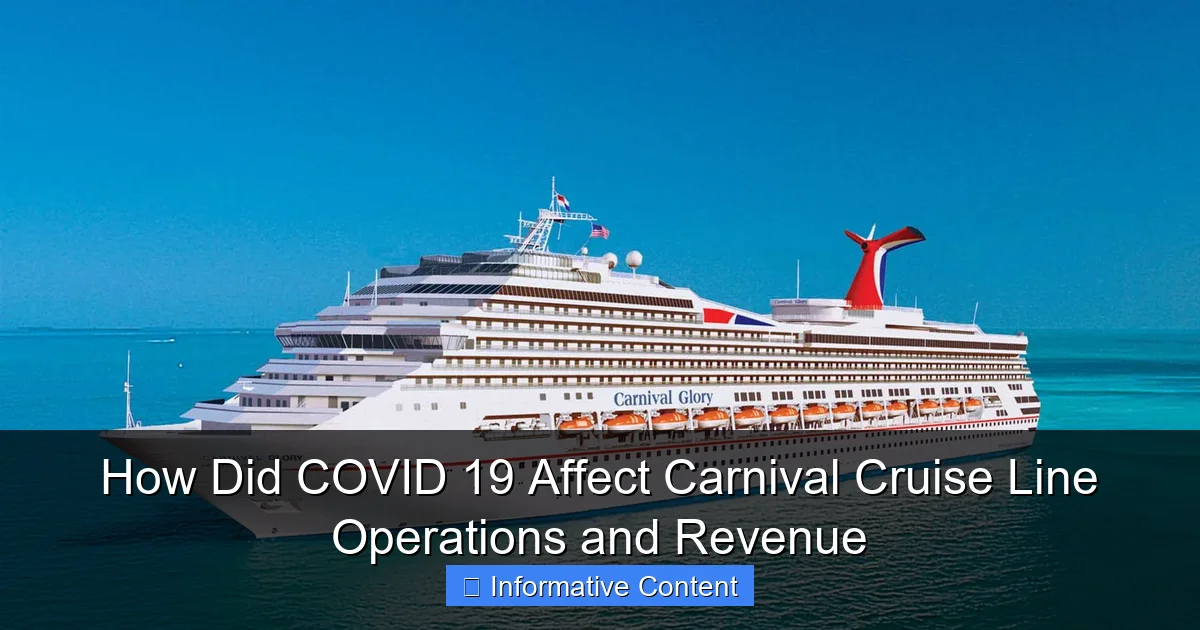
Featured image for how did covid 19 affect carnival cruise line
Image source: lh3.ggpht.com
The COVID-19 pandemic brought Carnival Cruise Line to a near-total operational halt in 2020, resulting in an unprecedented $10 billion revenue drop and the suspension of all voyages for over a year. With health protocols, fleet repatriations, and massive debt accumulation, Carnival faced its worst financial crisis in decades. Despite gradual 2021–2022 restarts and vaccine mandates, recovery remains slow, with long-term impacts on pricing, capacity, and consumer confidence in cruise travel.
Key Takeaways
- Revenue plummeted due to global sailing suspensions and reduced consumer demand.
- Cost-cutting measures included layoffs, ship sales, and delayed new builds.
- Health protocols became central, increasing operating costs and reshaping guest experience.
- Debt surged from emergency financing to sustain operations during prolonged shutdowns.
- Itinerary redesigns focused on short trips and local markets for faster recovery.
- Digital transformation accelerated with virtual bookings and contactless onboard services.
📑 Table of Contents
- The Storm Before the Calm: Carnival’s Pandemic Journey
- The Immediate Fallout: Grounded Ships and Empty Decks
- Health and Safety: The New Frontier
- Financial Survival: Pivoting to Stay Afloat
- The Road to Recovery: Rebuilding Trust and Demand
- Lessons Learned: What the Future Holds
- Conclusion: Sailing Toward Calmer Waters
The Storm Before the Calm: Carnival’s Pandemic Journey
Picture this: It’s early 2020. You’re sipping a piña colada on the Lido Deck, the sun setting over the Caribbean, and the ship’s band is playing your favorite song. Life feels perfect. Then, the news hits—COVID-19 is spreading fast, and cruise ships are suddenly in the spotlight. For Carnival Cruise Line, the world’s largest cruise operator, this wasn’t just a hiccup; it was a full-blown crisis. Ships were stranded at sea, passengers were quarantined, and bookings dried up overnight. The industry that once thrived on packed decks and all-you-can-eat buffets was suddenly grounded.
Carnival, like its competitors, had to navigate uncharted waters. The pandemic didn’t just pause operations—it rewrote the rules of the game. From health protocols to financial survival, every aspect of the business was tested. But here’s the thing about crises: they reveal resilience. And Carnival, despite the chaos, found ways to adapt, pivot, and even innovate. In this deep dive, we’ll explore how COVID-19 affected Carnival Cruise Line, from the early days of uncertainty to the slow road to recovery. Whether you’re a loyal cruiser, a curious traveler, or just love a good comeback story, this one’s for you.
The Immediate Fallout: Grounded Ships and Empty Decks
When the Music Stopped
By March 2020, the writing was on the wall. The CDC issued a No Sail Order, grounding all U.S.-based cruise ships. For Carnival, this meant 27 ships sitting idle—a logistical nightmare. Imagine a floating city with no one to power it, feed it, or maintain it. Crew members were stranded, some for months, while ports refused to let ships dock. The infamous Diamond Princess (operated by Carnival’s Princess Cruises) became a cautionary tale, with over 700 cases onboard. The media frenzy didn’t help. Headlines like “Floating Petri Dishes” and “Cruise Ships of Doom” painted the industry as reckless, even as Carnival scrambled to respond.

Visual guide about how did covid 19 affect carnival cruise line
Image source: who.int
The Financial Domino Effect
With no sailings, revenue vanished. Carnival’s Q2 2020 earnings call revealed a staggering $4.4 billion quarterly loss. To put that in perspective, the company made $500 million in profit during the same quarter in 2019. The domino effect was brutal:
- Cash flow dried up: No ticket sales meant no money to pay staff, suppliers, or port fees.
- Debt skyrocketed: Carnival raised $12.4 billion in emergency funding through loans and bond sales, pushing its total debt to over $20 billion.
- Stock prices crashed: Carnival’s stock (CCL) dropped from $45 in February 2020 to $8 by April, a 82% plunge.
Tip: If you’re an investor, remember that even “recession-proof” industries can face existential threats. Diversification matters.
The Human Cost
Behind the numbers were real people. Crew members—often from developing countries—faced uncertainty about wages and repatriation. Carnival eventually repatriated over 100,000 crew members, but the process took months. Meanwhile, loyal customers who’d saved for years for a cruise felt cheated. Many demanded refunds, while others accepted future cruise credits (FCCs), which later caused headaches when rebooking. One passenger told me, “I booked a 2020 Alaska trip for my 50th birthday. By 2022, the same cruise cost 30% more—and my FCC didn’t cover it.”
Health and Safety: The New Frontier
From Buffets to Bubbles
When cruising resumed, it wasn’t business as usual. Carnival had to overhaul its entire safety playbook. The CDC’s Conditional Sail Order (2021) required:
- Vaccination mandates (95% of passengers and 100% of crew).
- Pre-boarding testing (PCR or rapid antigen).
- Mask rules (initially strict, later relaxed).
- Enhanced sanitation (think hospital-grade disinfectants and UV light systems).
The result? A “bubble” experience. Gone were the days of mingling freely with strangers. Dining became reservation-based, buffets turned into staff-served stations, and entertainment shifted to smaller, spaced-out venues. One cruiser joked, “I felt like I was in a sci-fi movie—everyone in masks, sanitizer stations everywhere, and no self-serve ice cream!”
The Cost of Compliance
These changes didn’t come cheap. Carnival invested over $1 billion in health measures, including:
- Upgrading HVAC systems for better air filtration.
- Building onboard testing labs (yes, really).
- Hiring “sanitation officers” to monitor protocols.
The upside? Carnival’s “Travel Safe” program earned praise from health experts. The downside? Higher costs meant pricier cruises. A 7-day Caribbean trip that cost $800 in 2019 now averaged $1,200 in 2022.
Outbreaks and Adaptation
No system is perfect. In late 2021, the Delta variant forced Carnival to pause several sailings after breakthrough infections. The company responded by:
- Extending vaccine mandates to children (initially only for 12+).
- Partnering with local health departments for contact tracing.
- Offering flexible cancellation policies (e.g., “Book with Confidence”).
Tip: If you’re booking a cruise today, always check the line’s health policies—and buy travel insurance with pandemic coverage.
Financial Survival: Pivoting to Stay Afloat
The Cash Crunch
By mid-2020, Carnival was burning $500 million a month. To survive, the company:
- Sold ships: Retired 13 older vessels (including the Carnival Fantasy), saving $500 million annually in operating costs.
- Cut dividends: Suspended shareholder payouts, a rare move for a company with a 30-year dividend history.
- Furloughed staff: Reduced corporate headcount by 30% and cut executive pay.
These moves weren’t pretty, but they bought time. As CFO David Bernstein put it, “We’re not just surviving—we’re positioning for recovery.”
The Rise of the “Future Cruise Credit”
With refunds impossible for many, Carnival leaned on FCCs. Passengers who canceled 2020-2021 cruises received 100% FCCs (plus a 10-25% bonus). This was a double-edged sword:
- Pros: Kept customers loyal and provided liquidity.
- Cons: By 2022, $2.5 billion in FCCs were still outstanding, straining future revenue.
One cruiser told me, “I got a $2,000 FCC, but by the time I used it, prices had jumped. I ended up paying $500 more.”
New Revenue Streams
Carnival got creative. In 2021, it launched:
- “Staycation” cruises: Short 2-3 day sailings for locals, with no port stops.
- “Cruise to Nowhere”: A tongue-in-cheek name for round-trip sailings with no destinations.
- Private island rentals: Exclusive access to Half Moon Cay for groups.
These weren’t blockbusters, but they kept ships moving and crews employed.
The Road to Recovery: Rebuilding Trust and Demand
When the CDC Lifted the Ban
In October 2021, the CDC lifted its No Sail Order. But the comeback wasn’t instant. Carnival’s phased restart plan prioritized:
- Short sailings (3-5 days) to rebuild confidence.
- Vaccinated-only cruises (until 2022, when mandates eased).
- Transparent communication (e.g., daily health updates).
By early 2022, Carnival had 23 ships back in service—but occupancy was just 60%. Compare that to 110% in 2019 (yes, overbooking was common!).
The Marketing Blitz
Carnival launched a $100 million ad campaign, “Come Back New,” focusing on:
- Health safety (“We’ve got your back”).
- Value (“Book now, pay later”).
- Nostalgia (“Remember how good it felt?”).
The campaign worked. By Q3 2022, bookings hit 75% of 2019 levels. But the real test was pricing. With higher costs, Carnival had to balance demand and profitability.
The Omicron Hiccup
Just as things improved, Omicron hit in late 2021. Carnival’s Q4 2021 earnings showed a $2.6 billion loss—but the company remained optimistic. Why? Because:
- Bookings for 2023 were up 30% vs. 2019.
- Customers were willing to pay more (average ticket price rose 15%).
- Health protocols were now a selling point, not a liability.
Lessons Learned: What the Future Holds
Health as a Priority (Forever)
Carnival’s pandemic playbook is here to stay. Even as masks and testing eased in 2023, the company:
- Maintained enhanced sanitation.
- Kept flexible booking policies.
- Invested in telehealth for medical emergencies.
As one executive said, “We’re not going back to pre-COVID. Health is now part of the cruise experience.”
The Shift to Smaller, Safer Cruises
Carnival is retiring older, larger ships and focusing on smaller, more efficient ones. The Carnival Celebration (2022) and Mardi Gras (2021) are designed for:
- Better ventilation (100% fresh air in cabins).
- More outdoor space (e.g., expanded Lido Decks).
- Modular layouts (easier to isolate infected areas).
The Rise of the “Workation” Cruise
With remote work booming, Carnival added:
- Enhanced Wi-Fi (now $15/day, up from $20).
- Dedicated workspaces (quiet zones with charging stations).
- Longer stays (14-day “workation” packages).
Tip: If you’re working remotely, check the ship’s internet reliability before booking. Some older ships still have spotty coverage.
Data Table: Carnival’s Financial Snapshot (2019-2022)
| Year | Revenue (Billion) | Net Profit/Loss (Billion) | Ships in Service |
|---|---|---|---|
| 2019 | $20.8 | $2.7 | 27 |
| 2020 | $5.6 | -$10.2 | 0 (suspended) |
| 2021 | $1.9 | -$9.5 | 10 (partial restart) |
| 2022 | $12.2 | -$6.1 | 23 |
Source: Carnival Corporation Annual Reports
Conclusion: Sailing Toward Calmer Waters
So, how did COVID-19 affect Carnival Cruise Line? It was a rollercoaster—one that tested every fiber of the company’s resilience. From the early days of stranded ships to the slow rebuild of trust, Carnival faced challenges few could have predicted. But here’s the takeaway: The pandemic didn’t break Carnival; it forced it to evolve. The company emerged leaner, safer, and more adaptable. Yes, the debt is still high, and the road to full recovery isn’t over. But as of 2023, Carnival is profitable again, with bookings surpassing 2019 levels.
For cruisers, the lesson is clear: Flexibility is key. The days of “set it and forget it” vacations are gone. Today, you need to research health policies, compare FCCs vs. refunds, and pack masks—just in case. But the magic of cruising? That’s still there. Whether it’s the sunrise over the Caribbean or the laughter at a midnight deck party, the experience remains unforgettable. As one passenger told me, “I was nervous at first, but once I got onboard, I forgot about the pandemic. It felt like coming home.”
So, if you’re dreaming of your next cruise, go for it—but do it wisely. And to Carnival: Here’s to smoother sailing ahead. 🌊⛴️
Frequently Asked Questions
How did COVID-19 impact Carnival Cruise Line’s operations?
The pandemic forced Carnival Cruise Line to suspend all sailings globally in March 2020, leading to a 15-month operational halt. This unprecedented pause disrupted itineraries, crew employment, and onboard services, requiring extensive health protocol overhauls before resuming in mid-2021.
What financial losses did Carnival Cruise Line face due to the pandemic?
Carnival Cruise Line reported a staggering $10 billion net loss in 2020 alone, with revenue dropping 73% compared to pre-pandemic levels. The company relied on debt financing and asset sales to offset the revenue decline and maintain liquidity.
How did Carnival Cruise Line adapt its health and safety policies post-COVID-19?
The cruise line implemented enhanced sanitation, mandatory vaccination requirements, and pre-embarkation testing. These measures, aligned with CDC guidelines, were critical to regaining passenger trust and complying with international travel regulations.
Did Carnival Cruise Line lay off employees during the pandemic?
Yes, Carnival temporarily furloughed thousands of crew members and corporate staff in 2020 due to suspended operations. The company gradually rehired employees as sailings resumed, but some roles were eliminated permanently to cut costs.
How did customer demand for Carnival cruises change after COVID-19?
Initial demand was sluggish due to health concerns, but bookings rebounded in 2022 as vaccination rates rose. Carnival Cruise Line noted strong demand for shorter, domestic itineraries, reflecting travelers’ preference for lower-risk options.
What long-term changes did COVID-19 bring to Carnival Cruise Line?
The pandemic accelerated Carnival’s focus on flexible booking policies, digital health verification, and smaller ship capacity trials. These changes aim to build resilience against future disruptions while maintaining the brand’s core value proposition.