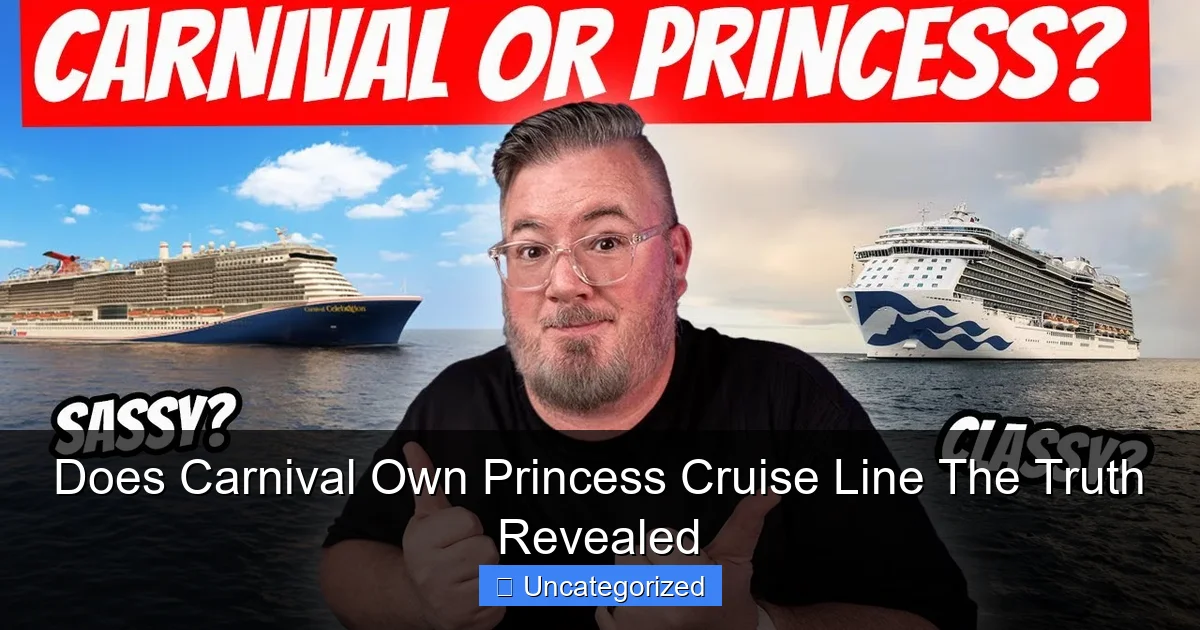
Featured image for does carnival own princess cruise line
Image source: i.ytimg.com
Yes, Carnival Corporation owns Princess Cruise Line, making it a key subsidiary in the world’s largest cruise company portfolio. This ownership means shared resources, global reach, and similar corporate oversight, though each brand maintains its own identity, ships, and customer experience.
Key Takeaways
- Carnival Corporation owns Princess: Princess Cruise Line is a subsidiary under Carnival’s portfolio.
- Shared resources, distinct brands: Princess operates independently but leverages Carnival’s scale.
- No direct booking overlap: Book Princess cruises separately despite parent company ties.
- Unique onboard experiences: Princess maintains its own identity in dining, service, and itineraries.
- Financial transparency: Carnival’s earnings reports include Princess as a separate segment.
- Regulatory compliance: Both adhere to strict maritime laws despite shared ownership.
📑 Table of Contents
- Does Carnival Own Princess Cruise Line? The Truth Revealed
- The Corporate Ownership Structure: Who’s Really in Charge?
- A Brief History of Princess Cruises and the Merger
- Brand Identity: How Princess Cruises Stands Apart from Carnival
- Operational Synergies: Shared Resources, Separate Brands
- Financial Performance and Market Impact
- Conclusion: The Truth About Ownership and Brand Identity
Does Carnival Own Princess Cruise Line? The Truth Revealed
When it comes to cruising, few names carry as much weight as Carnival Cruise Line and Princess Cruises. Both are synonymous with ocean travel, offering unforgettable vacations to millions of passengers annually. But have you ever wondered: Does Carnival own Princess Cruise Line? The answer isn’t as straightforward as you might think, and it involves a complex web of corporate ownership, branding strategies, and decades of industry evolution.
At first glance, the two cruise lines appear distinct. Carnival is known for its vibrant, party-centric atmosphere, while Princess Cruises positions itself as a more refined, destination-focused experience. Yet, behind the scenes, their fates are deeply intertwined through a shared parent company. Understanding this relationship is key for travelers, investors, and cruise enthusiasts alike. In this comprehensive guide, we’ll peel back the layers of corporate structure, explore the history of both brands, and reveal the truth about their ownership—complete with practical insights, industry data, and expert analysis to help you navigate the modern cruise landscape.
The Corporate Ownership Structure: Who’s Really in Charge?
The Role of Carnival Corporation & plc
The answer to “Does Carnival own Princess Cruise Line?” lies in a unique corporate structure known as a dual-listed company. Carnival Corporation & plc (often referred to as Carnival Corp) is the world’s largest leisure travel company, owning and operating nine major cruise brands across the globe. Despite the name, Carnival Corp is not the same as Carnival Cruise Line—the latter is just one of its many subsidiaries. Think of Carnival Corp as the “holding company” and Carnival Cruise Line as a “brand under management.”

Visual guide about does carnival own princess cruise line
Image source: static.zippia.com
As of 2024, Carnival Corporation & plc owns 100% of Princess Cruises. This ownership is not a recent development. It dates back to 2003, when Carnival Corp completed the acquisition of P&O Princess Cruises plc, the British company that operated the Princess brand. The merger created what is now the dual-listed entity: Carnival Corporation (NYSE: CCL) and Carnival plc (LSE: CCL), operating as a single economic unit.
How the Dual-Listed Structure Works
The dual-listed structure allows Carnival Corp to maintain listings on both the New York Stock Exchange (NYSE) and the London Stock Exchange (LSE), while coordinating operations, strategy, and branding across all nine brands. This includes:
- Carnival Cruise Line
- Princess Cruises
- Holland America Line
- Seabourn
- Cunard
- Costa Cruises
- AIDA Cruises
- P&O Cruises (UK and Australia)
- Fathom (defunct)
Each brand retains its own identity, marketing, and operational teams, but they share centralized functions such as procurement, IT, finance, and fleet management. This structure enables cost savings and operational efficiency while preserving brand differentiation—a critical factor in a competitive market.
Why Own Multiple Brands?
Carnival Corp’s multi-brand strategy is a deliberate move to capture diverse market segments. For example:
- Carnival Cruise Line targets families and budget-conscious travelers seeking fun, casual vacations.
- Princess Cruises appeals to middle-aged and older travelers looking for immersive destinations, enrichment programs, and a more relaxed ambiance.
- Holland America and Seabourn cater to luxury and premium travelers.
By owning Princess Cruises, Carnival Corp can capture a broader demographic without diluting the Carnival Cruise Line brand. This is a classic example of portfolio diversification in the travel industry.
A Brief History of Princess Cruises and the Merger
Origins of Princess Cruises
Princess Cruises began in 1965 when Stanley B. McDonald founded the company as Princess Cruises Ltd. in Los Angeles. The company gained early fame by pioneering the concept of the “destination cruise,” with itineraries focused on Alaska, the Panama Canal, and the South Pacific. Its breakthrough came in 1977 when it was featured in the popular television series The Love Boat, which aired for 10 seasons and cemented Princess Cruises as a household name in American culture.
Over the decades, Princess expanded its fleet and global reach, acquiring ships from defunct lines and launching innovative vessels like the Grand Princess in 1998—the first ship designed with a central atrium and a full promenade deck. By the late 1990s, Princess was a major player in the premium cruise segment, competing with Royal Caribbean and Celebrity Cruises.
The P&O Princess Era (1999–2003)
In 1999, the original Princess Cruises was acquired by P&O (Peninsular and Oriental Steam Navigation Company), a British shipping giant. The merged entity was renamed P&O Princess Cruises, and it became the second-largest cruise company in the world at the time. P&O Princess operated both the Princess brand and P&O Cruises (UK), creating a transatlantic cruise powerhouse.
However, P&O Princess faced increasing competition and rising costs. In 2002, it received a merger proposal from both Carnival Corporation and Royal Caribbean Cruises. The bidding war was intense, but Carnival ultimately won with a cash-and-stock deal valued at approximately $5.4 billion. The merger was finalized in April 2003, creating the world’s largest cruise company.
Post-Merger Integration: What Changed?
After the acquisition, Carnival Corp retained the Princess Cruises brand and integrated its operations into the Carnival Corp umbrella. Key changes included:
- Fleet optimization: Older ships were phased out or transferred to other brands (e.g., the Ocean Princess was sold to Azamara).
- Technology integration: Princess adopted Carnival Corp’s reservation systems, loyalty programs, and digital platforms.
- Portfolio expansion: New ships like the Royal Princess (2013) and Discovery Princess (2022) were built under Carnival Corp’s investment strategy.
- Shared services: Back-office functions (HR, finance, IT) were centralized, reducing costs.
Importantly, Princess Cruises did not become Carnival Cruise Line. The brand maintained its distinct identity, marketing, and onboard experience. This careful balance between integration and brand autonomy has been crucial to its success.
Brand Identity: How Princess Cruises Stands Apart from Carnival
Target Audience and Market Positioning
Despite being owned by the same parent company, Princess Cruises and Carnival Cruise Line serve very different customer segments. Here’s how they differ:
| Aspect | Princess Cruises | Carnival Cruise Line |
|---|---|---|
| Target Audience | Middle-aged to older travelers, couples, retirees | Families, young adults, budget travelers |
| Onboard Atmosphere | Relaxed, elegant, destination-focused | Energetic, fun, entertainment-heavy |
| Signature Features | Discovery at Sea, MedallionClass tech, enrichment programs | WaterWorks, comedy clubs, deck parties |
| Average Passenger Age | 50+ | 35–45 |
| Price Range (7-day cruise) | $1,200–$2,500 | $700–$1,500 |
| Key Itineraries | Alaska, Mediterranean, World Cruises | Caribbean, Bahamas, Mexico |
MedallionClass: Princess’s Technological Edge
One of Princess Cruises’ most significant differentiators is MedallionClass, a wearable technology system introduced in 2017. The OceanMedallion is a quarter-sized device that:
- Acts as a room key, payment method, and boarding pass
- Enables contactless check-in and boarding
- Personalizes entertainment and dining recommendations
- Allows crew to anticipate passenger needs (e.g., delivering a drink to a lounge chair)
This tech-forward approach is not replicated across all Carnival Corp brands. While Carnival Cruise Line has introduced similar features (like the HUB app), it lacks the full MedallionClass integration. This shows that Carnival Corp allows its brands to innovate independently when it aligns with their market positioning.
Destination Focus vs. Onboard Experience
Princess Cruises emphasizes destination immersion. Its ships spend more time in port, offer longer stays, and provide curated shore excursions. For example, a Princess Alaska cruise might include a 10-hour visit to Skagway with a gold panning tour and a White Pass Railway ride. In contrast, Carnival ships often focus on onboard entertainment, with shorter port stays and more time at sea.
This difference is intentional. Carnival Corp understands that brand loyalty is built on consistent experiences. A Princess cruiser expects quiet lounges and educational lectures; a Carnival cruiser wants water slides and live music. By maintaining these distinctions, Carnival Corp avoids brand cannibalization and maximizes customer satisfaction.
Operational Synergies: Shared Resources, Separate Brands
Fleet Management and Shipbuilding
While Princess Cruises operates its own fleet, it benefits from Carnival Corp’s massive shipbuilding contracts. Carnival Corp negotiates with shipyards like Fincantieri (Italy) and Meyer Werft (Germany) to build vessels for multiple brands under a single contract. This economy of scale reduces costs and ensures consistency in design and technology.
For example, the Princess MedallionClass ships (e.g., Regal Princess, Sky Princess) share design elements with Carnival’s Excel-class ships (e.g., Mardi Gras)—such as the “Oceania” interior layout and advanced HVAC systems—but are customized for their respective audiences. Carnival Corp’s centralized engineering team oversees safety, fuel efficiency, and sustainability standards across all brands.
Shared Back-Office Functions
Behind the scenes, Princess Cruises leverages Carnival Corp’s shared services:
- Procurement: Bulk purchasing of food, fuel, and supplies reduces costs by 10–15%.
- IT Infrastructure: Centralized reservation systems, cybersecurity, and data analytics.
- Human Resources: Global recruitment, training programs, and employee benefits.
- Marketing: While brands create their own campaigns, Carnival Corp provides market research and media buying power.
This shared model allows Princess Cruises to operate efficiently without reinventing the wheel. For instance, when Princess launched its World Cruise program, it used Carnival Corp’s existing logistics network for provisioning and crew rotations.
Port Partnerships and Itinerary Planning
Carnival Corp’s global presence gives Princess Cruises access to exclusive port agreements. For example, Princess has a long-term partnership with Skagway, Alaska, where it operates the White Pass & Yukon Route Railroad—a key excursion for its Alaska itineraries. This partnership was negotiated at the corporate level, demonstrating how Carnival Corp’s scale benefits individual brands.
Similarly, Princess’s MedallionNet Wi-Fi service is powered by Carnival Corp’s global satellite network, ensuring high-speed internet across remote destinations like Antarctica and the South Pacific.
Financial Performance and Market Impact
Princess Cruises’ Contribution to Carnival Corp
As of 2023, Princess Cruises operates 15 ships with a total capacity of over 40,000 passengers. It accounts for approximately 20% of Carnival Corp’s global capacity and is a top performer in the premium segment. In the company’s annual reports, Princess is consistently highlighted for:
- High guest satisfaction scores (NPS of 60+)
- Strong repeat customer rates (over 50%)
- Premium pricing power (higher ticket yields than Carnival Cruise Line)
During the pandemic, Princess Cruises was slower to resume operations due to its focus on international and longer-duration itineraries. However, it rebounded strongly in 2023, with occupancy rates exceeding 100% on key Alaska and Europe routes.
Investor Perspective: Why Ownership Matters
For investors, Carnival Corp’s ownership of Princess Cruises is a strategic asset. The multi-brand model provides:
- Revenue diversification: If one brand underperforms (e.g., Carnival Cruise Line during a family travel slump), others can offset losses.
- Market reach: Carnival Corp can capture 70% of the global cruise market through its portfolio.
- Innovation testing: New concepts (e.g., MedallionClass) can be piloted in one brand before wider rollout.
Analysts note that Princess Cruises’ premium positioning helps stabilize Carnival Corp’s earnings during economic downturns, as its customer base is less price-sensitive.
Future Outlook: Expansion and Sustainability
Looking ahead, Princess Cruises is investing in sustainability and digital transformation. Upcoming ships like the Sun Princess (2024) feature LNG propulsion and advanced wastewater treatment systems—technologies developed at the Carnival Corp level. The brand is also expanding into new markets, such as Australia and Asia, where it sees growth potential.
Carnival Corp’s ownership ensures that Princess Cruises has the financial backing to innovate while maintaining its brand integrity. As cruise travel evolves, this dual focus on corporate strength and brand autonomy will remain key to its success.
Conclusion: The Truth About Ownership and Brand Identity
So, does Carnival own Princess Cruise Line? Yes—but with a critical nuance. Carnival Corporation & plc owns 100% of Princess Cruises, but it operates as a separate brand with its own identity, target audience, and onboard experience. The ownership structure is not about assimilation; it’s about leveraging corporate resources to empower brand differentiation.
This model has proven successful. Princess Cruises thrives as a premium, destination-focused brand, while Carnival Cruise Line dominates the value and family markets. Together, they form a powerful portfolio under the Carnival Corp umbrella—one that balances innovation, efficiency, and customer satisfaction.
For travelers, the takeaway is clear: You can enjoy the benefits of a large, financially stable company (Carnival Corp) without sacrificing the unique experience of a specialized brand (Princess Cruises). Whether you’re booking a 14-day Mediterranean voyage or a 7-day Caribbean getaway, understanding this relationship helps you make informed choices—and appreciate the intricate machinery behind your dream cruise.
As the cruise industry continues to evolve, one thing is certain: Carnival Corp’s ownership of Princess Cruises isn’t just a corporate footnote—it’s a strategic advantage that benefits everyone, from shareholders to sunseekers.
Frequently Asked Questions
Does Carnival own Princess Cruise Line?
Yes, Carnival Corporation owns Princess Cruise Line. The two brands operate under the same parent company but maintain distinct identities, itineraries, and onboard experiences.
Are Princess Cruises and Carnival Cruise Line the same company?
While both are owned by Carnival Corporation, they are separate brands with different target markets. Princess focuses on premium cruising with destination-rich itineraries, while Carnival emphasizes fun, casual vacations.
Does Carnival Corporation control Princess Cruise Line operations?
Although Carnival Corporation owns Princess Cruise Line, day-to-day operations, branding, and management remain largely independent. Each brand retains its unique style, pricing, and customer experience.
Is Princess Cruise Line a subsidiary of Carnival?
Yes, Princess Cruise Line is a wholly owned subsidiary of Carnival Corporation. It operates alongside other brands like Holland America and Seabourn under the Carnival umbrella.
Why does Carnival own multiple cruise lines like Princess?
Carnival Corporation owns diverse brands, including Princess Cruise Line, to cater to different traveler preferences. This strategy allows them to dominate multiple market segments, from luxury to budget-friendly cruising.
Can I use Carnival Cruise loyalty perks on Princess Cruise Line?
No, Carnival and Princess have separate loyalty programs. However, Carnival Corporation occasionally offers cross-brand promotions, but points and elite benefits do not transfer between the two lines.