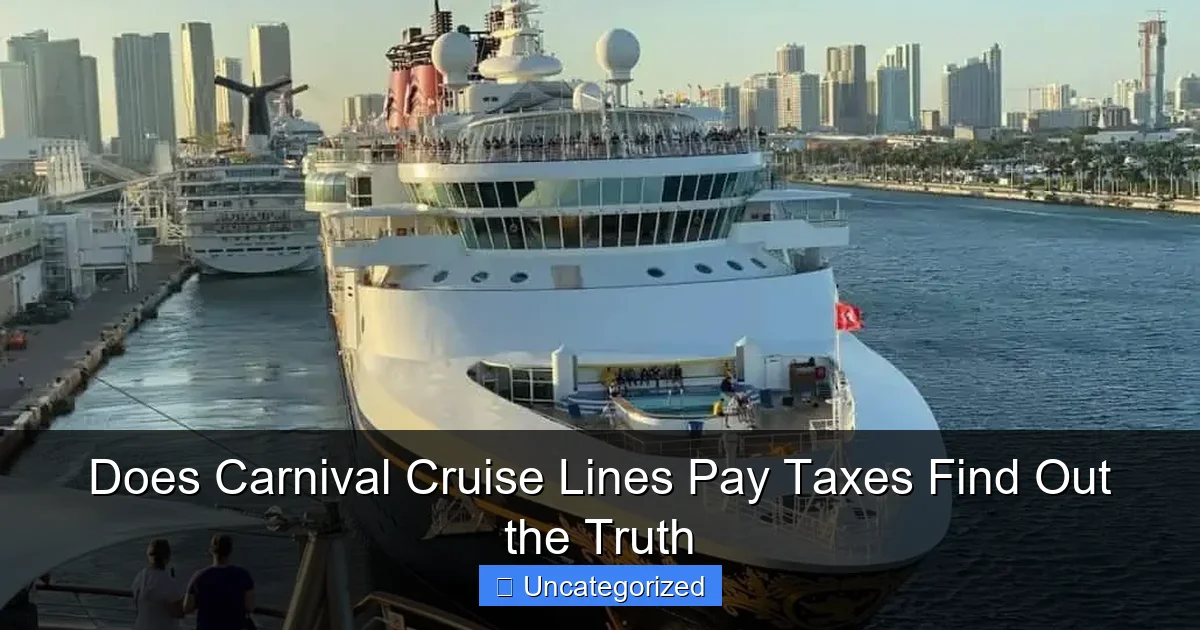
Featured image for does carnival cruise lines pay taxes
Image source: cruiseradio.net
Carnival Cruise Lines does pay taxes, but its effective tax rate is significantly reduced through legal strategies like offshore registration and tax incentives. The company leverages international maritime laws and subsidiaries in low-tax jurisdictions to minimize U.S. tax obligations, a common practice in the cruise industry that often sparks public debate.
Key Takeaways
- Carnival pays taxes in multiple countries, not just the U.S.
- Jurisdiction matters: Taxes depend on where ships dock and operate.
- Corporate structure helps Carnival legally minimize tax burdens.
- Public filings reveal tax payments, but details are often limited.
- Tax incentives from governments reduce effective tax rates.
📑 Table of Contents
- Does Carnival Cruise Lines Pay Taxes? Find Out the Truth
- How Cruise Lines Are Taxed: A Global Overview
- Carnival’s Tax Strategy: Legal, But Controversial
- Types of Taxes Carnival Cruise Lines Actually Pays
- Comparing Carnival to Other Cruise Lines: Who Pays More?
- Public Perception, Policy, and the Future of Cruise Taxation
- Conclusion: The Truth About Carnival’s Tax Payments
Does Carnival Cruise Lines Pay Taxes? Find Out the Truth
When you think about Carnival Cruise Lines, images of sun-soaked decks, lively parades, and all-you-can-eat buffets probably come to mind. The company, known for its vibrant ships and affordable vacation packages, is a household name in the cruise industry. However, behind the glitz and glamour lies a complex financial structure that raises an important question: Does Carnival Cruise Lines pay taxes?
This isn’t just a matter of curiosity for the financially savvy. It’s a topic that touches on global tax laws, corporate ethics, and the broader implications of how multinational corporations operate. In recent years, the tax practices of large corporations—especially those in the leisure and travel sectors—have come under scrutiny. Critics argue that some companies exploit legal loopholes to minimize or even eliminate their tax burden, while supporters claim these strategies are simply smart business moves within the framework of existing laws. Whether you’re a shareholder, a potential customer, or just a concerned citizen, understanding Carnival’s tax obligations helps you grasp how the cruise industry intersects with national economies and international regulations.
How Cruise Lines Are Taxed: A Global Overview
To understand whether Carnival Cruise Lines pays taxes, it’s essential to first grasp how cruise companies are taxed globally. Unlike traditional brick-and-mortar businesses, cruise lines operate on an international scale, often navigating through multiple jurisdictions. This complexity creates unique challenges and opportunities when it comes to taxation.
The Nature of Maritime Tax Jurisdiction
Maritime law plays a pivotal role in determining tax liability. According to international maritime conventions, a ship is considered a “floating jurisdiction” — meaning it falls under the legal authority of the country where it is registered, also known as its flag state. Most major cruise lines, including Carnival Corporation & plc (the parent company of Carnival Cruise Lines), register their ships under foreign flags such as Panama, the Bahamas, or Liberia. These countries are known as flags of convenience because they offer favorable tax treatment, minimal regulation, and lower operating costs.
For example, Panama does not levy income tax on foreign-earning vessels registered under its flag. This means that a Carnival ship sailing from Miami to the Caribbean, even if it carries mostly American passengers and generates revenue in U.S. dollars, may not be subject to corporate income tax in the country where it’s registered.
Corporate Structure and Dual Headquarters
Carnival Corporation & plc operates under a dual-incorporated structure: one entity is based in the United States (Delaware), and the other is based in the United Kingdom (England). This unique setup allows the company to take advantage of both U.S. and U.K. tax laws while maintaining operational flexibility. While the U.S. entity handles American marketing, sales, and some management functions, the international fleet is largely managed through subsidiaries in low-tax jurisdictions.
As a result, the company can legally allocate profits to entities in countries with minimal or zero corporate tax rates. This practice, known as profit shifting, is not illegal but is often criticized for reducing tax contributions in countries where the company conducts significant business.
Tax Treaties and International Agreements
Countries enter into bilateral tax treaties to prevent double taxation and encourage cross-border investment. These agreements often include provisions for shipping income. For instance, the U.S. has tax treaties with several nations that exempt shipping profits earned by foreign-flagged vessels from U.S. corporate income tax — provided the income arises from international operations.
So, if a Carnival ship sails from Miami to Cozumel, Mexico, the revenue generated during that trip is considered international shipping income. Under U.S. tax code Section 883, such income is generally exempt from federal corporate income tax. This exemption applies not only to Carnival but to all qualifying foreign-flagged cruise lines operating internationally.
Carnival’s Tax Strategy: Legal, But Controversial
Carnival Cruise Lines has long been a focal point in discussions about corporate tax avoidance. While the company maintains full compliance with international and domestic tax laws, its strategies have drawn criticism from tax transparency advocates and policymakers alike.
Use of Flags of Convenience
One of the most significant tools in Carnival’s tax strategy is the use of flags of convenience. As of 2023, over 95% of Carnival’s global fleet is registered in Panama, the Bahamas, or Liberia — all jurisdictions with zero corporate income tax on international shipping income. This allows the company to avoid paying income tax on the vast majority of its cruise operations.
For example, consider the Carnival Horizon, a 135,000-ton ship that sails year-round from Miami to the Eastern and Southern Caribbean. Registered in the Bahamas, the ship is not subject to Bahamian income tax on its international earnings. Even though the ship departs from a U.S. port and sells tickets to American consumers, the revenue is treated as foreign-source income under U.S. tax law — and thus largely untaxed.
Profit Allocation and Transfer Pricing
Another key element of Carnival’s tax strategy is transfer pricing — the method by which profits are allocated among subsidiaries in different countries. For instance, Carnival might charge its U.S. marketing division a “management fee” for services provided by a subsidiary in the Cayman Islands, effectively moving profits to a tax-free jurisdiction.
While transfer pricing is a standard accounting practice, it becomes controversial when used to artificially reduce tax liabilities. The Organisation for Economic Co-operation and Development (OECD) has issued guidelines to curb abusive transfer pricing, but enforcement remains inconsistent. Carnival, like many multinationals, adheres to these guidelines, but critics argue that the rules still allow too much leeway for tax minimization.
Public Financial Disclosures
According to Carnival’s annual 10-K filings with the U.S. Securities and Exchange Commission (SEC), the company reported a global effective tax rate of approximately 1.5% to 3% over the past five years — significantly lower than the U.S. corporate tax rate of 21% and the global average of around 23%. This low rate is not due to tax evasion but rather a combination of legal exemptions, foreign earnings, and tax credits.
For example, in its 2022 fiscal year, Carnival reported $12.1 billion in revenue and $1.4 billion in operating income. Despite this, the company paid only $41 million in income taxes worldwide — a rate of just 2.9%. A breakdown shows that most of the tax burden came from payroll taxes, local property taxes, and sales taxes, not corporate income tax.
Types of Taxes Carnival Cruise Lines Actually Pays
While Carnival may not pay much in corporate income tax, it is far from a tax-free entity. The company pays a wide range of taxes across various categories, many of which are less visible to the public but essential for funding local and national services.
Payroll Taxes
With over 150,000 employees worldwide, Carnival is one of the largest private employers in the travel industry. The company pays significant amounts in payroll taxes, including Social Security, Medicare (in the U.S.), and equivalent social contributions in other countries.
For example, U.S.-based crew members and office staff contribute to federal and state payroll taxes. Even crew members working on foreign-flagged ships may be subject to U.S. payroll taxes if they are U.S. citizens or residents. In 2022, Carnival reported paying over $200 million in payroll-related taxes globally.
Sales and Use Taxes
Every time a customer books a cruise, purchases a drink package, or buys a souvenir onboard, sales tax applies — depending on the jurisdiction. In the U.S., Carnival collects and remits state and local sales taxes on goods and services sold at its Miami headquarters, online booking platforms, and port operations.
For instance, a cruise booked through Carnival.com is subject to sales tax in the customer’s home state if Carnival has a physical presence (nexus) there. With offices in over 30 states, Carnival collects millions annually in sales tax, which is then passed on to state governments.
Property and Port Fees
Carnival owns or leases numerous properties, including terminals, office buildings, and parking facilities. These assets are subject to property taxes in the jurisdictions where they are located.
Additionally, Carnival pays substantial port fees and docking charges to cities like Miami, New York, Seattle, and San Diego. These fees are not technically taxes but are mandatory payments for using public infrastructure. In 2022, Carnival paid over $150 million in port-related fees — funds that support harbor maintenance, security, and local economic development.
Environmental and Regulatory Taxes
As part of its sustainability initiatives, Carnival pays various environmental compliance fees and carbon-related charges. For example, the European Union’s Emissions Trading System (EU ETS) requires ships calling at EU ports to purchase carbon allowances. While Carnival’s primary operations are in the Caribbean and North America, its European brands (such as AIDA Cruises) are subject to these rules.
Moreover, the company invests in cleaner technologies, such as LNG-powered ships and exhaust scrubbers, which may qualify for tax credits or grants in certain jurisdictions. These incentives indirectly reduce tax burdens while promoting environmental responsibility.
Corporate Income Taxes (Where Applicable)
While international shipping income is largely exempt, Carnival does pay corporate income tax on certain activities. For example:
- U.S.-based land operations (e.g., hotels, tour companies)
- Domestic cruise services (e.g., river cruises in U.S. waters)
- Non-shipping business units (e.g., Carnival’s travel agency partnerships)
These segments are subject to standard corporate tax rates in their respective countries. However, they represent a small fraction of Carnival’s overall revenue.
Comparing Carnival to Other Cruise Lines: Who Pays More?
To put Carnival’s tax practices in perspective, it’s helpful to compare them with other major cruise companies: Royal Caribbean Group, Norwegian Cruise Line Holdings, and MSC Cruises.
Royal Caribbean Group
Like Carnival, Royal Caribbean registers most of its ships under flags of convenience (Panama, Bahamas, Liberia). It also has a dual-incorporated structure (U.S. and U.K.). However, Royal Caribbean has a slightly higher effective tax rate — around 4% to 6% — due to a larger presence in European markets, where VAT and corporate taxes are higher.
For example, Royal Caribbean’s German brand, TUI Cruises, pays corporate income tax in Germany, increasing the group’s overall tax burden. Additionally, Royal Caribbean has been more aggressive in adopting sustainability investments, some of which qualify for tax deductions.
Norwegian Cruise Line Holdings
Norwegian also uses foreign flags (Panama, Bahamas) and reports a low effective tax rate (3% to 5%). However, it has faced scrutiny from the IRS over transfer pricing practices. In 2021, the company settled a $120 million tax dispute related to intercompany transactions — a reminder that even legal tax strategies can attract regulatory attention.
MSC Cruises
MSC, an Italian-Swiss company, operates a different model. While its ships are also foreign-flagged, MSC Cruises has a stronger presence in European waters and pays VAT on many onboard sales. As a result, its effective tax rate is higher — around 8% to 10% — due to VAT, port fees, and corporate taxes in EU countries.
Data Table: Effective Tax Rates and Key Tax Strategies (2022)
| Cruise Line | Effective Tax Rate | Primary Flags Used | Key Tax Strategy | Notable Tax Payments |
|---|---|---|---|---|
| Carnival | 2.9% | Panama, Bahamas | International shipping exemption, transfer pricing | Payroll: $200M; Port fees: $150M |
| Royal Caribbean | 5.2% | Panama, Bahamas | Dual incorporation, VAT compliance in EU | Payroll: $180M; VAT: $120M |
| Norwegian | 4.1% | Panama, Bahamas | Transfer pricing, IRS settlement | Payroll: $160M; IRS payment: $120M (one-time) |
| MSC Cruises | 9.5% | Panama, Malta | EU VAT, port fees | VAT: $200M; Port fees: $100M |
Source: Company 10-K filings, OECD tax reports, and port authority disclosures (2022)
Public Perception, Policy, and the Future of Cruise Taxation
The low tax rates paid by cruise lines like Carnival have sparked public debate. While the strategies are legal, they raise ethical questions about fairness and corporate responsibility.
Criticism from Tax Advocacy Groups
Organizations like Tax Justice Network and Public Citizen argue that cruise lines receive substantial public benefits — such as port infrastructure, emergency services, and tourism marketing — without contributing proportionally in taxes. They advocate for:
- Repealing the international shipping exemption in U.S. tax law
- Implementing a global minimum corporate tax (as proposed by the OECD)
- Requiring greater transparency in tax reporting
Policy Changes on the Horizon
The OECD’s Global Minimum Tax Agreement (Pillar Two), effective in 2024, aims to set a 15% minimum tax rate for large multinationals. While this won’t directly affect shipping exemptions, it could limit profit shifting to tax havens. Carnival and other cruise lines may need to restructure some subsidiaries to comply.
Additionally, the U.S. Congress has introduced bills to phase out the Section 883 exemption for foreign-flagged vessels, especially those with significant U.S. operations. If passed, such legislation could increase Carnival’s U.S. tax liability significantly.
Carnival’s Response and Corporate Responsibility
Carnival maintains that it complies with all applicable tax laws and contributes to communities through job creation, tourism spending, and environmental initiatives. The company also highlights its investments in:
- Green technology (e.g., LNG-powered ships)
- Local hiring and training programs
- Disaster relief and charitable partnerships
In its 2023 Sustainability Report, Carnival emphasized its commitment to “ethical tax practices” and pledged greater transparency in tax reporting — a move likely aimed at improving public perception.
Conclusion: The Truth About Carnival’s Tax Payments
So, does Carnival Cruise Lines pay taxes? The answer is nuanced. While Carnival does not pay significant corporate income tax on its international cruise operations — thanks to legal exemptions, foreign flag registration, and international tax treaties — it pays millions in other forms of taxation. These include payroll taxes, sales taxes, port fees, environmental charges, and income taxes on non-shipping activities.
The company’s low effective tax rate is not the result of illegal tax evasion but of strategic, legal tax planning within a global regulatory framework. This approach is common among multinational corporations, especially in the maritime industry. However, it remains controversial, as it highlights disparities in how different industries and countries share the tax burden.
For consumers, the takeaway is clear: when you book a Carnival cruise, your money supports not just the company but also local economies, public services, and environmental programs through indirect tax contributions. At the same time, policymakers, advocacy groups, and the public must continue to scrutinize whether the current tax system fairly balances corporate efficiency with social responsibility.
As the cruise industry evolves and global tax norms shift, Carnival and its peers will face increasing pressure to adapt. Whether through new legislation, public demand for transparency, or corporate self-regulation, the future of cruise taxation will likely involve more accountability — and possibly higher tax contributions. For now, the truth is that Carnival pays taxes — just not the kind most people assume.
Frequently Asked Questions
Does Carnival Cruise Lines pay taxes in the United States?
Yes, Carnival Cruise Lines pays U.S. federal and state taxes, including payroll, sales, and excise taxes, despite being incorporated in Panama. Its U.S.-based operations and employees make it subject to domestic tax obligations.
How can Carnival Cruise Lines afford to pay low prices if they pay taxes?
Carnival Cruise Lines offsets costs through economies of scale, onboard revenue, and strategic tax planning. While they do pay taxes, international incorporation helps reduce corporate tax burdens in certain jurisdictions.
Does Carnival Cruise Lines pay taxes on their ships?
Yes, Carnival pays various maritime-related taxes, including port fees, docking charges, and property taxes on U.S.-based terminals. However, ships registered in foreign countries benefit from lower international corporate tax rates.
Why do people question if Carnival Cruise Lines pays taxes?
Because Carnival is incorporated in Panama and operates globally, many assume it avoids taxes entirely. In reality, the company pays taxes where it has legal presence or economic activity, such as in the U.S. and Europe.
Are Carnival Cruise Lines’ tax practices legal?
Yes, Carnival’s tax structure complies with international maritime laws and U.S. tax regulations. While controversial, using foreign flags of convenience is a legal practice common among cruise lines.
Do Carnival Cruise Lines pay taxes on passenger revenue?
Carnival pays taxes on revenue generated from U.S. passengers and domestic operations, such as port fees and transportation taxes. However, revenue from international sailings may be taxed under different jurisdictions.