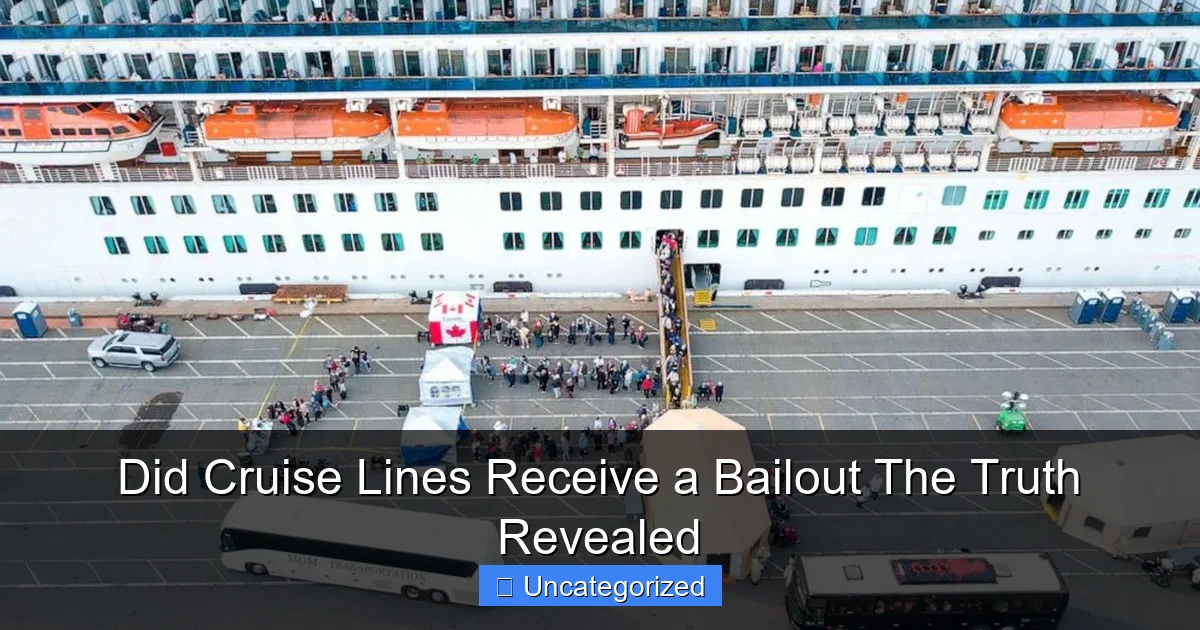
Featured image for did cruise lines receive a bailout
Image source: s.abcnews.com
Cruise lines did not receive a direct government bailout during the pandemic, despite widespread speculation and public outcry. Instead, major companies accessed capital through loans, private financing, and stock offerings—not taxpayer-funded relief programs. This distinction reveals how the industry navigated financial turmoil without the federal bailouts seen in aviation or other sectors.
Key Takeaways
- Cruise lines did not get direct federal bailouts like airlines during COVID-19.
- Indirect aid came via PPP loans to contractors and suppliers, not cruise operators.
- Most funding was private through debt restructuring and equity raises.
- Government support focused on port cities to sustain local economies, not cruise giants.
- Transparency gaps persist—full financial relief details remain undisclosed by many lines.
📑 Table of Contents
- Did Cruise Lines Receive a Bailout? The Truth Revealed
- The Pandemic’s Impact on the Cruise Industry
- Types of Government Aid Received by Cruise Lines
- Controversies and Public Backlash
- Private Financing and Industry Restructuring
- Long-Term Implications and Lessons Learned
- Conclusion: The Verdict on Cruise Line Bailouts
Did Cruise Lines Receive a Bailout? The Truth Revealed
The cruise industry, once a symbol of luxury and carefree vacations, faced unprecedented turbulence during the global pandemic. With ships docked, thousands of employees furloughed, and billions in lost revenue, the sector was one of the hardest-hit by the economic fallout of COVID-19. Amid the chaos, a burning question emerged: Did cruise lines receive a bailout? The answer isn’t as straightforward as it might seem. While some cruise companies accessed government assistance, the nature and extent of that support varied significantly from traditional “bailouts” seen in other industries, such as automotive or banking during the 2008 financial crisis.
This article dives deep into the financial lifelines extended to cruise lines during the pandemic. We’ll explore the types of aid provided, the controversies surrounding it, and the long-term implications for the industry. Whether you’re a curious traveler, an investor, or simply someone interested in how governments respond to economic crises, this comprehensive analysis will reveal the truth behind the headlines. From tax relief and loan programs to public backlash and industry restructuring, we’ll uncover the full story behind the question: Did cruise lines receive a bailout?
The Pandemic’s Impact on the Cruise Industry
Financial Freefall: Revenue Losses and Operational Shutdowns
When the World Health Organization declared a global pandemic in March 2020, cruise lines were among the first industries to face immediate shutdowns. The U.S. Centers for Disease Control and Prevention (CDC) issued a No Sail Order, effectively grounding all major cruise operations in American waters. By April 2020, over 80% of global cruise capacity was idle. According to the Cruise Lines International Association (CLIA), the industry lost an estimated $77 billion in economic activity and over 500,000 jobs in 2020 alone.
Visual guide about did cruise lines receive a bailout
Image source: i.pinimg.com
Major players like Carnival Corporation, Royal Caribbean Group, and Norwegian Cruise Line Holdings reported staggering losses:
- Carnival: $10.2 billion net loss in 2020
- Royal Caribbean: $5.8 billion net loss in 2020
- Norwegian: $2.1 billion net loss in 2020
Without revenue from ticket sales, onboard spending, or port fees, these companies faced existential threats. The question of government intervention became inevitable.
Why Cruise Lines Were in a Unique Position
Unlike airlines or hotels, cruise lines operate as mobile international businesses. Ships are registered in foreign countries (often Panama, Liberia, or the Bahamas), and companies structure their corporate headquarters to minimize tax obligations. For example:
- Carnival Corporation is headquartered in Miami but incorporated in Panama.
- Royal Caribbean is based in Miami but incorporated in Liberia.
This offshore registration meant that U.S.-based cruise lines didn’t qualify for certain types of federal aid under the Coronavirus Aid, Relief, and Economic Security (CARES) Act, which required companies to be incorporated in the U.S. to receive direct payroll support. This loophole became a focal point of public criticism and political debate.
Types of Government Aid Received by Cruise Lines
1. Paycheck Protection Program (PPP) Loans
The PPP, part of the CARES Act, provided forgivable loans to small businesses to cover payroll costs. While large cruise lines couldn’t access PPP directly due to their foreign incorporation, subsidiaries and U.S.-based employees were eligible. For example:
- Royal Caribbean’s U.S. subsidiaries received $10.5 million in PPP loans.
- Carnival’s U.S. operations secured $15 million in PPP funds.
These loans helped retain staff in areas like customer service, marketing, and port operations. However, the amounts were a drop in the bucket compared to the companies’ total losses. Critics argued that the aid was insufficient, while supporters noted it prevented deeper layoffs.
2. Tax Relief and Deferrals
The U.S. government and other nations offered tax deferrals and relief programs to struggling industries. Cruise lines benefited from:
- Payroll tax deferrals: Companies could delay paying Social Security taxes (6.2% of wages) until 2021–2022.
- Property tax abatements: Port cities like Miami and Seattle waived docking fees and property taxes for idle ships.
- Customs and duty relief: Reduced fees for ship repairs and supply imports.
For instance, Miami-Dade County granted $12 million in tax breaks to Carnival in 2020. These measures were not direct cash injections but reduced operating costs during the shutdown.
3. International Aid and Port Support
Cruise lines also accessed aid from foreign governments and international bodies:
- Norway: Provided $250 million in loan guarantees to Hurtigruten (a hybrid cruise/ferry operator).
- Italy: Offered $1.1 billion in state-backed loans to Costa Cruises (part of Carnival).
- European Union: Approved €400 million in state aid to MSC Cruises (a Swiss-based company).
Additionally, the International Maritime Organization (IMO) relaxed regulations on crew repatriation and medical supplies, easing operational burdens.
Controversies and Public Backlash
“Bailouts for Billionaires”: The Public Perception Problem
The cruise industry’s offshore tax structure sparked outrage. Headlines like “Carnival Got a Bailout While Workers Lost Jobs” dominated media coverage. Critics pointed out:
- Carnival paid $1.4 billion in dividends to shareholders in 2019 but laid off 10,000 employees in 2020.
- Top executives received bonuses during the pandemic. For example, Norwegian Cruise Line’s CEO earned $12 million in 2020, down from $36 million in 2019—but still substantial amid layoffs.
Senator Elizabeth Warren (D-MA) called for “no bailouts for tax-avoiding corporations,” arguing that aid should come with conditions like tax compliance and wage protections.
Environmental and Labor Concerns
The pandemic also exposed long-standing issues:
- Environmental impact: Cruise ships are major polluters. The International Council on Clean Transportation found that a single cruise ship emits as much particulate matter as 1 million cars per day. Critics argued that aid should require greener ships.
- Crew welfare: Over 100,000 crew members were stranded on ships for months due to travel restrictions. The International Transport Workers’ Federation (ITF) reported cases of “modern slavery” conditions.
In response, some governments tied aid to reforms. For example, the EU required MSC Cruises to invest in LNG-powered ships as a condition for its €400 million loan.
Private Financing and Industry Restructuring
Debt Issuance and Equity Raises
While government aid was limited, cruise lines turned to private markets to survive. In 2020–2021, they raised over $20 billion through:
- High-yield bonds: Carnival issued $4 billion in bonds at 11% interest—double its pre-pandemic rates.
- Equity offerings: Royal Caribbean raised $1.5 billion by selling new shares, diluting existing investors.
- Asset sales: Norwegian Cruise Line sold two older ships for $200 million.
These moves came with trade-offs. High debt loads increased financial risk, and equity dilution angered shareholders.
Operational Changes and New Health Protocols
To regain trust, cruise lines implemented sweeping changes:
- Vaccine mandates: Royal Caribbean required all passengers and crew to be vaccinated (with rare exemptions).
- Enhanced sanitation: Carnival invested $200 million in air filtration systems and touchless check-in.
- Reduced capacity: Ships operated at 50–70% capacity during the 2021 restart phase.
These measures were costly but essential. A 2022 CLIA survey found that 78% of travelers felt safer on cruises post-protocols.
Long-Term Implications and Lessons Learned
The Industry’s Financial Health in 2023–2024
By 2023, the cruise industry had largely recovered. Key indicators include:
- Passenger volumes: CLIA reported 31.5 million passengers in 2023, surpassing 2019’s 30 million.
- Revenue growth: Carnival’s revenue reached $21.6 billion in 2023 (up from $5.6 billion in 2020).
- Debt reduction: Royal Caribbean paid down $1.2 billion in debt through 2023.
However, challenges remain. Interest payments on pandemic-era debt continue to strain cash flow. For example, Norwegian Cruise Line spent $1.1 billion on interest in 2023—double its 2019 levels.
Policy Changes and Future Preparedness
The pandemic prompted regulatory shifts:
- Tax reform: The U.S. Inflation Reduction Act (2022) closed some offshore loopholes, though cruise lines still benefit from foreign incorporation.
- Emergency protocols: The CDC’s Conditional Sail Order now requires cruise lines to have outbreak response plans.
- Insurance requirements: Ports like Nassau and Cozumel now mandate higher liability coverage for docked ships.
Experts argue that future aid should be conditional, requiring companies to:
- Maintain U.S. payrolls
- Invest in sustainable technology
- Improve crew living standards
Data Table: Cruise Industry Financials (2019–2023)
| Company | 2019 Revenue (Billions) | 2020 Revenue (Billions) | 2023 Revenue (Billions) | Debt (2023) | Government Aid Received |
|---|---|---|---|---|---|
| Carnival Corp | $20.8 | $5.6 | $21.6 | $27.5 billion | $15M PPP + $12M tax breaks |
| Royal Caribbean | $10.9 | $2.2 | $13.9 | $22.1 billion | $10.5M PPP + $50M port fees waived |
| Norwegian | $6.5 | $1.3 | $8.5 | $13.2 billion | $7M PPP + $300M EU loan guarantees |
| MSC Cruises | $4.2 | $1.8 | $6.1 | $15.3 billion | €400M EU state aid |
Conclusion: The Verdict on Cruise Line Bailouts
So, did cruise lines receive a bailout? The answer is yes—but not in the traditional sense. Unlike the 2008 bank bailouts, where governments directly injected cash into failing institutions, cruise lines accessed a mix of targeted aid, tax relief, and private financing. The PPP loans and tax deferrals provided critical lifelines, but they were far smaller than the industry’s losses. Most of the financial recovery came from the companies themselves—through debt, equity, and operational changes.
The controversy surrounding this aid highlights a larger debate about corporate responsibility, tax fairness, and crisis preparedness. While cruise lines survived the pandemic, they emerged with heavier debt loads and heightened scrutiny. For travelers, the takeaway is clear: the industry has adapted, but its long-term sustainability depends on addressing environmental, labor, and financial challenges. As for future crises, governments now have a blueprint for aid—but with stricter conditions. The truth is, the cruise industry’s bailout wasn’t about handouts; it was about survival in a world that had stopped moving.
Frequently Asked Questions
Did cruise lines receive a government bailout during the pandemic?
Yes, major cruise lines like Carnival, Royal Caribbean, and Norwegian received financial assistance through the CARES Act and other relief programs during the COVID-19 pandemic. These funds were part of broader airline and travel industry aid, not direct “bailouts” but loans and grants to prevent collapse.
Were cruise lines eligible for the same bailout funds as airlines?
While cruise lines didn’t receive identical treatment as airlines, they accessed portions of the $2.2 trillion CARES Act through loan programs and payroll support. Unlike airlines, they weren’t prioritized for direct grants, but many secured low-interest loans tied to employment retention.
How much money did cruise lines receive in pandemic bailouts?
Exact figures are unclear, but reports estimate major cruise companies secured over $10 billion combined in federal loans, tax credits, and private-public partnerships. For example, Carnival alone accessed $6 billion in liquidity through debt financing backed by government programs.
Did taxpayers fully cover cruise line losses through the bailout?
No, the relief funds were structured as loans or conditional grants requiring repayment or equity stakes. Taxpayer funds helped offset operational costs but didn’t fully compensate for lost revenue, with cruise lines still reporting billions in pandemic-era losses.
Why did cruise lines get a bailout if they’re profitable companies?
Government aid aimed to stabilize an industry critical to global tourism, employing millions and supporting ports worldwide. The bailout addressed systemic risks, ensuring cruise lines could resume operations without triggering cascading job losses or supply chain disruptions.
Are cruise lines still repaying their pandemic bailout funds?
Many are. Companies like Royal Caribbean and Norwegian have disclosed ongoing repayments of CARES Act loans, with some converting debt to equity. Repayment timelines vary, but most expect to clear obligations within 5–10 years.