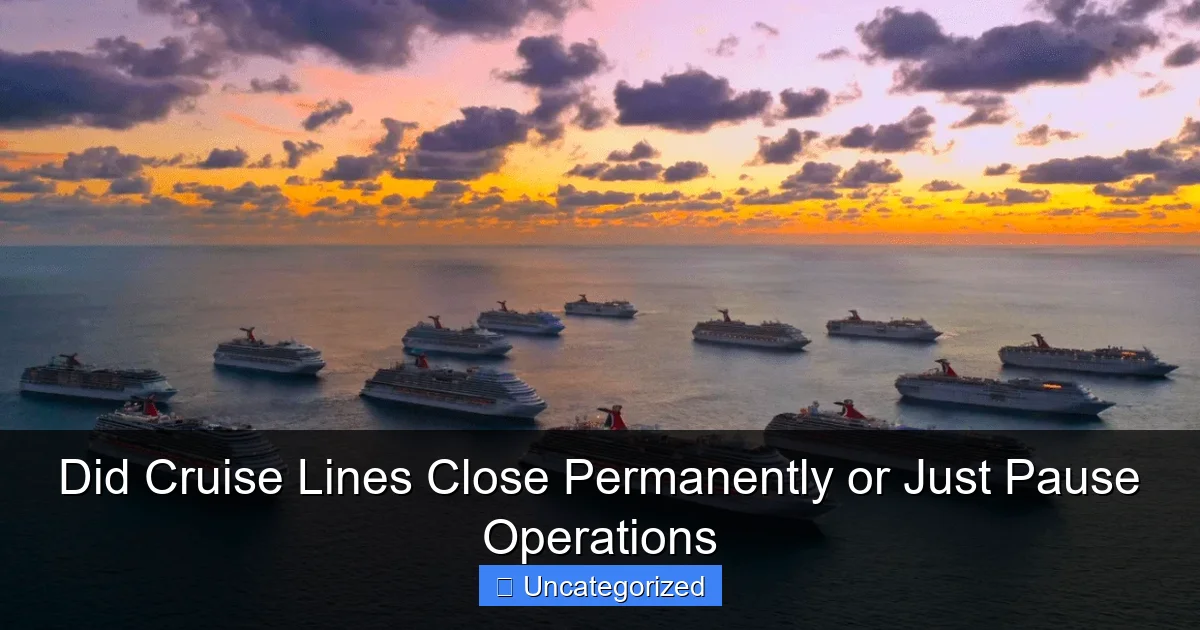
Featured image for did cruise lines close
Image source: cruiseradio.net
Most cruise lines did not close permanently but instead paused operations in response to global health and travel disruptions, maintaining their fleets and staff for future sailings. Strategic pauses allowed companies to adapt safety protocols and comply with regulations, ensuring long-term viability rather than shutting down entirely. This temporary suspension reflects resilience, not retreat, in the cruise industry.
Key Takeaways
- Most cruise lines paused operations instead of closing permanently during the pandemic.
- Health protocols are mandatory for safe resumption of sailings worldwide.
- Financial reserves helped major brands survive prolonged shutdowns.
- Smaller lines faced higher risk of permanent closure without government aid.
- Demand remains strong despite delays, signaling industry recovery.
- Flexible booking policies now standard to reassure hesitant travelers.
📑 Table of Contents
- Did Cruise Lines Close Permanently or Just Pause Operations?
- The Immediate Impact of the Pandemic on Cruise Lines
- Which Cruise Lines Closed Permanently?
- How Major Cruise Lines Adapted and Survived
- Resumption of Operations: A Gradual and Phased Return
- The Future of Cruising: Trends and Predictions
- Conclusion: A Resilient Industry, Forever Changed
Did Cruise Lines Close Permanently or Just Pause Operations?
The cruise industry, once synonymous with luxury, adventure, and global exploration, faced an unprecedented challenge in 2020. With the outbreak of the COVID-19 pandemic, cruise ships became floating headlines—not for their destinations, but for outbreaks, quarantines, and port denials. Images of massive vessels stranded at sea, unable to dock, sparked global concern and raised a pressing question: Did cruise lines close permanently, or were they just pressing pause? For travelers, investors, and industry insiders alike, the uncertainty loomed large. Would the golden era of cruising vanish overnight, or was this merely a temporary setback?
Fast forward to today, and the answer is more nuanced than a simple “yes” or “no.” While some cruise lines did cease operations—either through bankruptcy, mergers, or strategic exits—the vast majority of major operators survived by adapting, innovating, and reimagining the cruise experience. The pandemic wasn’t a death knell for the industry, but rather a catalyst for transformation. In this comprehensive guide, we’ll explore the fate of cruise lines during and after the pandemic, analyze which companies closed, which adapted, and what the future holds. Whether you’re a seasoned cruiser, a first-time traveler, or simply curious about the industry’s resilience, this article will provide clarity on whether cruise lines closed permanently or simply paused operations—and what that means for you.
The Immediate Impact of the Pandemic on Cruise Lines
The early months of 2020 marked a turning point for the cruise industry. As the World Health Organization (WHO) declared a global pandemic in March, cruise ships quickly became hotspots for COVID-19 transmission. The Diamond Princess, quarantined off the coast of Japan, reported over 700 cases—a grim preview of what was to come. By April, the U.S. Centers for Disease Control and Prevention (CDC) issued a No Sail Order, effectively halting all cruise operations in U.S. waters. Similar restrictions followed in Europe, Asia, and Australia.

Visual guide about did cruise lines close
Image source: cruiseradio.net
Global Suspension of Operations
By mid-2020, nearly every major cruise line had suspended operations:
- Carnival Corporation (including Carnival Cruise Line, Princess Cruises, Holland America Line, and Seabourn) paused all voyages in March 2020.
- Royal Caribbean Group (Royal Caribbean International, Celebrity Cruises, Silversea Cruises) followed suit, canceling all sailings through at least June.
- Norwegian Cruise Line Holdings (Norwegian, Oceania, Regent Seven Seas) halted operations globally.
- MSC Cruises and Virgin Voyages delayed inaugural voyages and suspended existing itineraries.
This wasn’t a temporary delay—it was a complete operational freeze. For the first time in modern history, cruise ships sat idle at ports, with crews stranded and ships requiring maintenance despite no passengers.
Financial and Human Cost
The financial toll was staggering. Carnival Corporation reported a net loss of $10.2 billion in 2020. Royal Caribbean’s revenue dropped by 80% compared to 2019. Norwegian Cruise Line Holdings furloughed 25% of its workforce. Beyond the numbers, thousands of crew members were repatriated or stuck at sea for months due to travel restrictions. The human cost of the pause was as significant as the economic one.
Public Perception and Reputational Damage
Beyond financials, cruise lines faced a crisis of trust. Media coverage focused on outbreaks, lack of transparency, and perceived negligence. A 2020 Pew Research survey found that only 38% of Americans viewed cruise travel as safe—down from 67% in 2019. This reputational damage forced cruise lines to invest heavily in health protocols, communication, and customer reassurance strategies.
Which Cruise Lines Closed Permanently?
While most major cruise lines survived the pandemic through restructuring and government aid, several smaller or niche operators did not. Some ceased operations permanently, while others merged or rebranded. The closures were often due to a combination of financial instability, lack of government support, and changing market dynamics.
Smaller and Niche Cruise Lines That Ceased Operations
- Pullmantur Cruceros (Spain): Once Spain’s largest cruise line, Pullmantur filed for bankruptcy in June 2020. With no government bailout and declining bookings, the company liquidated its assets, including its three ships.
- Dream Cruises (Genting Hong Kong): Part of the Genting Group, Dream Cruises ceased operations in 2022 after its parent company entered liquidation. The World Dream was auctioned, and the brand dissolved.
- CMV (Cruise & Maritime Voyages): This UK-based line, known for affordable, no-frills cruises, went bankrupt in 2020. All ships were sold or scrapped, and no revival plans emerged.
- Albatros Travel (Scandinavia): A regional operator, Albatros suspended operations in 2020 and never resumed, citing “irreversible financial damage.”
Lines That Merged or Were Absorbed
Not all closures were outright failures. Some companies survived by merging or being acquired:
- Hurtigruten Expeditions: While Hurtigruten (Norway) survived, its expedition arm was rebranded and restructured under new ownership. The MS Fram and other vessels were sold.
- Silversea’s Expansion via Royal Caribbean: Though Silversea remained operational, Royal Caribbean increased its ownership from 66% to 100% in 2021, signaling deeper integration.
- Windstar Cruises: Acquired by Xanterra Travel Collection in 2021, the line avoided closure but underwent strategic repositioning.
Why Some Lines Couldn’t Survive
Several factors contributed to permanent closures:
- Lack of Government Aid: Smaller lines in countries without cruise-specific bailouts (e.g., Spain, UK) struggled to access capital.
- High Fixed Costs: Ships require fuel, maintenance, and crew even when idle. Without revenue, costs became unsustainable.
- Niche Markets: Lines targeting older demographics or budget travelers faced lower demand during and after the pandemic.
- Insurance and Liability: Fear of lawsuits from passengers or crew made insurers hesitant to cover operations.
How Major Cruise Lines Adapted and Survived
While some lines closed, the industry’s titans adapted with remarkable agility. Carnival, Royal Caribbean, and Norwegian Cruise Line implemented a multi-pronged strategy to survive, rebuild, and eventually thrive.
Health and Safety Overhauls
Cruise lines invested billions in health protocols to regain public trust:
- Enhanced Sanitation: Electrostatic spraying, UV-C light disinfection, and hospital-grade air filtration systems (e.g., Royal Caribbean’s MedallionClass ships).
- Vaccination Mandates: By 2021, most lines required passengers and crew to be fully vaccinated. Some, like Norwegian, even offered “vaccine-only” sailings.
- Testing and Screening: Pre-boarding PCR tests, thermal scans, and rapid antigen testing became standard.
- Contactless Technology: Mobile apps for check-in, ordering, and navigation reduced physical contact.
These measures were validated by the CDC’s Conditional Sailing Order (2021), which allowed cruises to resume with strict protocols.
Financial Restructuring and Capital Raising
To stay afloat, major lines took aggressive financial steps:
- Debt Issuance: Carnival raised $6.5 billion through debt and equity offerings in 2020–2021.
- Asset Sales: Norwegian sold older ships (e.g., Norwegian Spirit) to reduce debt.
- Government Loans: Some lines accessed low-interest loans (e.g., through the U.S. CARES Act).
- Cost-Cutting: Royal Caribbean reduced its workforce by 10% and paused new ship construction.
Innovation in Itineraries and Experiences
To attract travelers, cruise lines reimagined their offerings:
- Short “Cruise to Nowhere” Voyages: Royal Caribbean launched 3–4 night sailings from Florida to build confidence.
- Expedition and River Cruises: Smaller, less crowded vessels (e.g., Seabourn Venture) gained popularity.
- Digital Integration: Carnival’s HUB app allowed passengers to book excursions, order food, and access real-time ship updates.
- Sustainability Focus: New ships (e.g., MSC World Europa) use LNG fuel and waste-reduction tech to appeal to eco-conscious travelers.
Rebuilding Consumer Trust
Marketing campaigns emphasized safety, flexibility, and value:
- “Cruise with Confidence” (Carnival): Offered refunds or future credits for cancellations due to COVID.
- “Sail Safe” (Norwegian): Highlighted health protocols with third-party audits.
- Social Proof: Partnered with influencers and medical experts to share positive experiences.
Resumption of Operations: A Gradual and Phased Return
The return to sailing wasn’t instantaneous. Cruise lines adopted a phased approach, starting with limited voyages and expanding as conditions improved.
Phase 1: Domestic and “Bubble” Cruises (2021–2022)
In the U.S., the CDC’s Conditional Sailing Order allowed cruises to resume under strict rules:
- Vaccination requirements for all passengers and crew.
- Simulated voyages with volunteer passengers to test protocols.
- Capacity limits (initially 50%, later increased).
Example: Royal Caribbean’s Freedom of the Seas resumed in June 2021 with a 7-night Caribbean cruise, 90% vaccinated passengers, and daily health checks.
Phase 2: International and Longer Voyages (2022–2023)
As vaccination rates rose and travel restrictions eased, cruise lines expanded:
- Transatlantic crossings resumed (e.g., Queen Mary 2).
- Alaska and Europe itineraries returned with enhanced safety measures.
- New Ships Launched: Virgin Voyages’ Scarlet Lady (2021), Carnival’s Mardi Gras (2021).
Phase 3: Full Capacity and Global Resumption (2023–2024)
By 2023, most lines operated at or near pre-pandemic capacity. The CDC ended its Conditional Sailing Order in July 2022, shifting oversight to cruise lines themselves. Key milestones:
- Carnival’s Excel-class ships (e.g., Carnival Celebration) launched with 6,500+ passengers.
- Norwegian’s Prima-class ships introduced “free at sea” perks to boost bookings.
- Royal Caribbean’s Icon of the Seas (2024) became the world’s largest cruise ship, signaling confidence in the future.
Data Table: Cruise Line Resumption Timeline
| Cruise Line | First Post-Pandemic Sailing | Key Protocols | 2023 Capacity vs. 2019 |
|---|---|---|---|
| Carnival Cruise Line | July 2021 (Galveston, TX) | Vaccination mandate, testing, enhanced sanitation | 95% |
| Royal Caribbean | June 2021 (Miami, FL) | “Healthy Sail Panel” protocols, contactless tech | 100% |
| Norwegian Cruise Line | August 2021 (Seattle, AK) | “Sail Safe” program, vaccine-only sailings | 90% |
| MSC Cruises | August 2020 (Italy) | “MSC Shield” protocols, pre-boarding testing | 105% |
| Princess Cruises | July 2021 (Seattle, AK) | MedallionClass tech, vaccination requirements | 92% |
The Future of Cruising: Trends and Predictions
The pandemic reshaped the cruise industry in ways that will endure long after 2024. Here’s what to expect in the coming years.
1. Health and Safety as a Permanent Priority
While vaccine mandates may fade, health protocols will remain. Expect:
- Ongoing investment in air filtration and sanitation.
- Flexible booking policies (e.g., “no-fee cancellations” for illness).
- Onboard medical facilities with telehealth capabilities.
2. Rise of Smaller, Niche Cruises
Passengers increasingly favor intimate, personalized experiences:
- Expedition Cruises: Lines like Lindblad Expeditions and Ponant are expanding.
- River Cruises: Viking, AmaWaterways, and Uniworld report record bookings.
- Adventure Cruises: Hurtigruten’s new MS Fridtjof Nansen focuses on sustainability and wildlife.
3. Sustainability and Eco-Friendly Ships
Environmental concerns are shaping ship design:
- LNG and Hydrogen Fuel: New ships (e.g., MSC World Europa) reduce emissions by 20–30%.
- Waste-to-Energy Systems: Carnival’s Mardi Gras converts waste into energy.
- Carbon Offsetting: Lines like Royal Caribbean offer voluntary carbon-neutral bookings.
4. Technology Integration
Digital tools enhance the cruise experience:
- Wearable Tech: Carnival’s OceanMedallion tracks location, purchases, and preferences.
- Virtual Reality: Royal Caribbean’s Adventures Unbound offers VR excursions.
- AI Concierge: Norwegian’s Prima-class ships use AI for personalized recommendations.
5. Shifting Demographics and Marketing
To attract younger travelers, cruise lines are:
- Partnering with influencers and TikTok creators.
- Offering “cruise + stay” packages (e.g., pre-cruise hotel stays).
- Focusing on wellness, adventure, and cultural immersion.
Conclusion: A Resilient Industry, Forever Changed
So, did cruise lines close permanently or just pause operations? The answer is both. While a few smaller operators succumbed to the pressures of the pandemic, the majority of cruise lines survived—and are now stronger than ever. The pause wasn’t a failure, but a forced pause that allowed for innovation, adaptation, and reinvention. Today’s cruise industry is more health-conscious, technologically advanced, and environmentally aware than before 2020.
For travelers, this means greater choice, improved safety, and more personalized experiences. Whether you’re drawn to luxury liners, expedition voyages, or river cruises, the options are expanding. The pandemic tested the industry’s resilience—and it passed. As cruise lines sail into the future, they carry not just passengers, but lessons in adaptability, trust, and the enduring human desire to explore.
The golden age of cruising isn’t over. It’s evolving. And for those ready to set sail, the horizon looks brighter than ever.
Frequently Asked Questions
Did cruise lines close permanently due to the pandemic?
Most major cruise lines did not close permanently but instead paused operations temporarily during global health crises. Companies like Carnival, Royal Caribbean, and Norwegian resumed sailings with enhanced safety protocols after 2020.
Why did cruise lines pause operations in recent years?
Cruise lines paused operations primarily due to health regulations, travel restrictions, and onboard COVID-19 outbreaks. These pauses allowed them to implement new sanitation and health measures before resuming voyages.
Are cruise lines still operating today?
Yes, most cruise lines have fully resumed operations with modified itineraries and health requirements. Some smaller or financially struggling lines merged or ceased, but major brands continue sailing globally.
Did cruise lines close any ships permanently during the pause?
Several cruise lines retired older or less efficient ships during the operational pause, including vessels from Carnival and Royal Caribbean. However, these retirements were part of fleet optimization, not company-wide closures.
How long were cruise lines closed before restarting?
The pause varied by region, but most major lines resumed operations within 12–18 months after halting sailings in 2020. Alaska and Mediterranean routes restarted earlier than international or transatlantic cruises.
Will cruise lines close again if another crisis occurs?
While another crisis could lead to temporary halts, permanent closures are unlikely for major lines due to their financial reserves and diversified operations. The industry has adapted with flexible cancellation policies and health safeguards to minimize future disruptions.