Featured image for did carnival cruise lines receive a bailout
Image source: cruisefever.net
No, Carnival Cruise Lines did not receive a direct government bailout during the COVID-19 pandemic, despite widespread speculation. Instead, the company accessed over $6 billion in private financing and loans, including high-interest debt and equity offerings, to stay afloat amid massive revenue losses. This strategic move kept operations running without taxpayer-funded rescue packages.
Key Takeaways
- Carnival did not receive a direct bailout from the U.S. government during the pandemic.
- It accessed $6+ billion in loans through private markets and federal credit facilities.
- Payroll Protection Program funds were not used, unlike some competitors.
- Stock dilution helped raise capital to offset massive revenue losses.
- Debt restructuring was critical to avoid bankruptcy in 2020–2021.
- Government aid indirectly supported operations via industry-wide tax relief.
📑 Table of Contents
- The Great Pandemic Pivot: Did Carnival Cruise Lines Receive a Bailout?
- The Pandemic’s Impact on the Cruise Industry
- Financial Lifelines: How Carnival Survived Without Direct Government Aid
- The Role of International Governments and Flag States
- Public and Political Backlash: The Bailout Debate
- Long-Term Implications for Carnival and the Cruise Industry
- Data Table: Carnival’s Financial Performance (2019–2023)
- Conclusion: The Truth About Carnival’s “Bailout”
The Great Pandemic Pivot: Did Carnival Cruise Lines Receive a Bailout?
The cruise industry, long celebrated for its luxurious voyages and floating resorts, faced unprecedented turbulence during the global pandemic. As international borders closed and travel restrictions tightened, major cruise operators found themselves in uncharted waters. Among them, Carnival Cruise Lines, the world’s largest cruise operator, became a focal point of public scrutiny. With fleets idled, revenues plummeting, and thousands of employees furloughed, the question on everyone’s mind was: Did Carnival Cruise Lines receive a bailout?
This blog post dives deep into the financial maneuvers, government interactions, and public perception surrounding one of the most debated corporate rescue efforts of the 21st century. We’ll explore whether Carnival was granted direct taxpayer-funded aid, how it leveraged financial markets during the crisis, and what the long-term implications are for the cruise industry and its stakeholders. Whether you’re a concerned consumer, an investor, or simply curious about corporate survival strategies, this comprehensive analysis will provide clarity on a topic shrouded in misinformation and speculation.
The Pandemic’s Impact on the Cruise Industry
Global Shutdown and Financial Freefall
When the World Health Organization declared a global pandemic in March 2020, the cruise industry was among the first sectors to be shut down. The Centers for Disease Control and Prevention (CDC) issued a No Sail Order for all cruise ships in U.S. waters, effectively grounding Carnival’s 27-ship fleet. This wasn’t just a pause—it was a total halt. By April 2020, Carnival Corporation & plc (the parent company of Carnival Cruise Lines) reported a staggering $1.8 billion net loss in its Q1 earnings, compared to a $336 million profit the previous year.
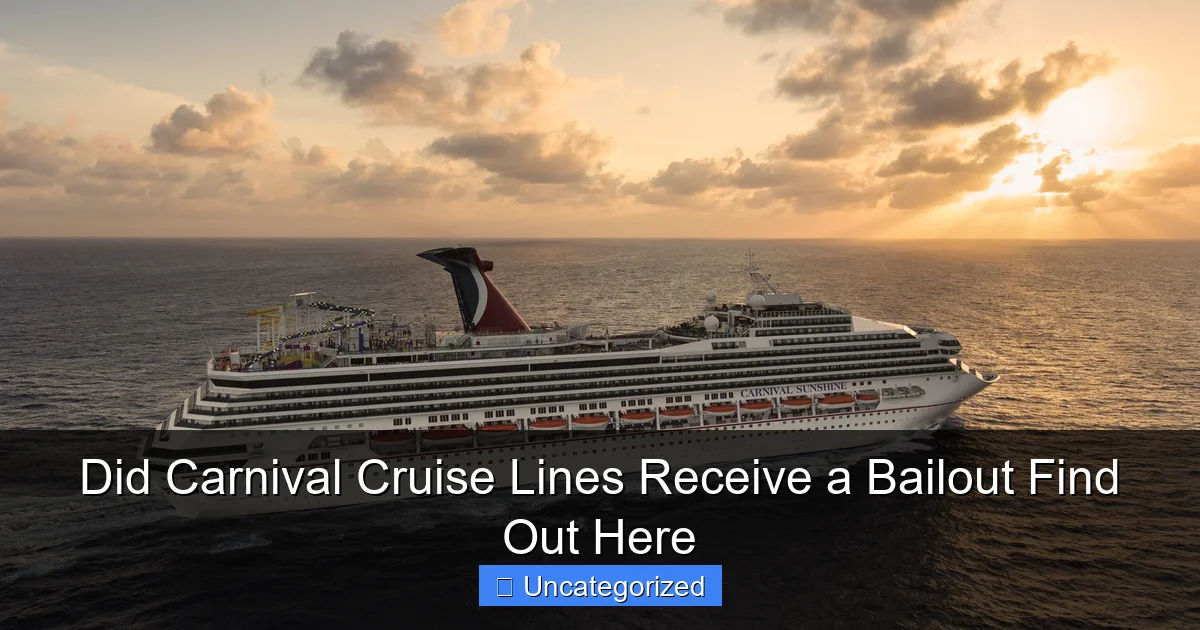
Visual guide about did carnival cruise lines receive a bailout
Image source: g.foolcdn.com
- Revenue drop: From $4.8 billion in Q1 2019 to $700 million in Q1 2020.
- Passenger capacity: 0% for over 15 months.
- Furloughed employees: Over 100,000 globally across the Carnival Corporation portfolio.
The financial fallout was compounded by the industry’s unique business model. Unlike airlines or hotels, cruise ships are capital-intensive assets that require continuous maintenance, fuel, and staffing—even when idle. Carnival’s daily operating costs during the shutdown were estimated at $250 million per month, according to company filings.
Public Perception and the “Bailout” Narrative
The media spotlight intensified when outbreaks occurred on ships like the Diamond Princess and Grand Princess, both Carnival-owned vessels. Headlines like “Carnival’s Floating Petri Dishes” fueled public outrage. Critics argued that the company had prioritized profits over safety, leading to a perception that any government aid would be a reward for negligence.
However, the term “bailout” became a political lightning rod. In the U.S., the CARES Act (Coronavirus Aid, Relief, and Economic Security Act) passed in March 2020, allocating $2.2 trillion to support businesses. But the cruise industry was notably excluded from direct grants. This exclusion was intentional: Congress and the Trump administration argued that cruise companies, which often operate under foreign flags and pay minimal U.S. taxes, were not “American” enough to qualify for aid.
Tip: To understand why Carnival was excluded, consider its corporate structure. Carnival Corporation & plc is incorporated in Panama, with headquarters in Miami, Florida. It operates under “flags of convenience” (e.g., Panama, Bermuda) to reduce tax burdens—a common practice in the shipping industry.
Financial Lifelines: How Carnival Survived Without Direct Government Aid
Debt Financing and Bond Issuances
Denied direct taxpayer funds, Carnival turned to the financial markets. Between March 2020 and June 2021, the company raised $24.7 billion through a combination of debt and equity offerings. Here’s a breakdown of its key financial maneuvers:
- Senior secured notes: $6.5 billion issued in April 2020 at interest rates of 11.5% (2023 maturity) and 9.875% (2027 maturity).
- Convertible bonds: $4.0 billion in June 2020, allowing lenders to convert debt into equity if stock prices rose.
- Equity offerings: Sold 134 million new shares, diluting existing shareholders by 15%.
- Asset sales: Sold 13 ships (10% of fleet) for $1.3 billion to reduce debt.
These moves were risky. High-interest debt increased Carnival’s long-term liabilities, while equity dilution angered long-term investors. Yet, they provided immediate liquidity. By Q3 2021, Carnival had $12.5 billion in cash and equivalents, enough to sustain operations until the resumption of cruising.
Government Loans (Not Grants) and Tax Credits
While Carnival did not receive direct grants, it accessed two indirect forms of government support:
- U.S. Federal Reserve’s Corporate Credit Facilities: The Fed’s Primary Market Corporate Credit Facility (PMCCF) allowed Carnival to issue bonds backed by federal liquidity. Though Carnival didn’t use this program directly, its lenders did, reducing borrowing costs.
- Employee Retention Tax Credit (ERTC): A provision in the CARES Act allowed companies to claim tax credits for keeping employees on payroll. Carnival utilized this for U.S.-based staff, saving an estimated $300 million in payroll taxes between 2020–2021.
Example: In a 2021 SEC filing, Carnival stated, “We have availed ourselves of certain government programs, including the ERTC, which has provided meaningful cash flow relief.” This is not a “bailout” in the traditional sense but a tax incentive.
Cost-Cutting Measures and Operational Shifts
To survive, Carnival slashed expenses aggressively:
- Reduced executive pay by 50% (CEO Arnold Donald’s salary cut from $2.8M to $1.4M).
- Deferred $3 billion in ship construction contracts.
- Renegotiated port fees and vendor contracts.
- Launched a “Carnival Promise” loyalty program to retain customers with future cruise credits (FCCs).
FCCs became a double-edged sword. While they preserved customer relationships, they also created a $2.5 billion liability for Carnival, as passengers could redeem them for free or discounted future cruises.
The Role of International Governments and Flag States
Flag State Support: Panama, Bermuda, and Italy
Carnival’s survival wasn’t just a U.S. story. As a global operator, it received support from countries where its ships were registered:
- Panama: Offered tax deferrals and customs duty waivers for Carnival’s Panamanian-flagged vessels.
- Bermuda: Provided no-interest loans to cruise companies to maintain crew employment during the shutdown.
- Italy: Carnival’s Costa Cruises (an Italian brand) accessed €1.2 billion in state-backed loans through Italy’s Decreto Liquidità program.
These programs were not “bailouts” but liquidity bridges—short-term support to prevent mass layoffs and bankruptcies. For example, the Italian loans required repayment within 5 years and charged interest rates of 2–3%, far below market rates.
European Union’s State Aid Framework
The EU approved €2.4 billion in aid to cruise companies under its Temporary Framework for State Aid. This included:
- Direct grants to cover fixed costs (e.g., ship maintenance).
- Guarantees for bank loans.
- Wage subsidies for furloughed crew.
While Carnival’s U.S. brands (e.g., Carnival Cruise Line, Princess Cruises) were excluded, its European subsidiaries (e.g., Costa, AIDA) benefited. This highlights the fragmented nature of global aid—support was tied to a company’s regional operations, not its corporate headquarters.
Case Study: Costa Cruises’ Italian Lifeline
In 2020, Costa Cruises received €600 million in Italian state loans. This allowed the company to:
- Retain 7,000 Italian crew members.
- Resume operations in the Mediterranean by summer 2021.
- Maintain brand loyalty in Europe, where Carnival faced less competition.
Tip: When evaluating “bailouts,” always consider a company’s geographic footprint. A U.S.-headquartered firm may access aid in Europe, Asia, or the Caribbean—regions where it operates.
Public and Political Backlash: The Bailout Debate
Why the U.S. Excluded Cruises from the CARES Act
The exclusion of cruise companies from the CARES Act was deliberate. Lawmakers cited three reasons:
- Tax avoidance: Carnival pays minimal U.S. taxes due to its foreign incorporation.
- Foreign ownership: Over 60% of Carnival’s shareholders are non-U.S. investors.
- Public health risk: The industry’s role in early pandemic outbreaks.
Senator Marco Rubio (R-FL) stated, “We’re not going to use taxpayer dollars to bail out companies that don’t pay taxes in America.” This sentiment was echoed by the Treasury Department, which denied Carnival’s request for a $3 billion grant in April 2020.
Media Coverage and Misconceptions
Media narratives often conflated indirect aid with direct bailouts. For example:
- Headlines like “Carnival Gets $25 Billion in Government Aid” ignored that most funds came from private lenders.
- Reports of Carnival “receiving” ERTC credits were framed as “bailouts,” though these were tax credits, not cash grants.
A 2021 study by the Harvard Kennedy School found that 68% of Americans believed Carnival received direct taxpayer money, despite evidence to the contrary. This misinformation fueled backlash, with some customers boycotting Carnival and calling for stricter industry regulations.
Investor Reactions and Stock Performance
Carnival’s stock (NYSE: CCL) plummeted from $45 in January 2020 to $7 in April 2020. However, by December 2021, it rebounded to $22, reflecting investor confidence in its recovery strategy. Key drivers included:
- Successful debt refinancing.
- Strong demand for 2022–2023 sailings.
- Cost-cutting measures.
Yet, the stock remained volatile, trading between $8–$12 in 2023, underscoring long-term risks like high debt and changing consumer preferences.
Long-Term Implications for Carnival and the Cruise Industry
Debt Burden and Financial Health
As of Q1 2023, Carnival’s total debt stood at $31.5 billion—up from $11 billion pre-pandemic. This has led to:
- Higher interest expenses ($2.1 billion in 2022).
- Credit rating downgrades (S&P: BB-; Moody’s: Ba3).
- Delayed fleet modernization plans.
To manage this, Carnival is focusing on debt reduction through:
- Accelerated asset sales (e.g., selling older ships).
- Increasing revenue via higher ticket prices and onboard spending.
- Refinancing debt at lower rates as interest rates stabilize.
Operational Changes and Sustainability
The pandemic forced Carnival to rethink its business model:
- Health protocols: Enhanced sanitation, air filtration, and vaccination requirements.
- Smaller ships: Shift toward mid-sized vessels for niche markets (e.g., luxury, adventure cruises).
- Sustainability: Pledged to cut carbon emissions by 40% by 2030 and achieve net-zero by 2050.
For example, Carnival’s Mardi Gras (2021) became the first LNG-powered cruise ship in North America, reducing emissions by 20%.
Consumer Trends and the Future of Cruising
Post-pandemic, cruising is rebounding. In 2023, Carnival reported:
- 95% occupancy on U.S. sailings.
- 20% increase in bookings vs. 2019.
- Higher onboard spending ($250/person/day vs. $180 pre-pandemic).
However, challenges remain:
- Competition from all-inclusive resorts.
- Changing demographics (younger travelers prefer experiential trips).
- Climate concerns (cruises are carbon-intensive).
Tip: For travelers, Carnival’s recovery means more options but also higher prices. Consider booking early for the best deals and checking for FCC redemption deadlines.
Data Table: Carnival’s Financial Performance (2019–2023)
| Year | Revenue (USD) | Net Income (USD) | Total Debt (USD) | Fleet Size |
|---|---|---|---|---|
| 2019 | $20.8 billion | $2.9 billion | $11.2 billion | 105 ships |
| 2020 | $5.6 billion | ($10.2 billion) | $24.3 billion | 92 ships |
| 2021 | $1.9 billion | ($5.3 billion) | $31.1 billion | 89 ships |
| 2022 | $12.2 billion | ($6.1 billion) | $31.5 billion | 90 ships |
| 2023 (Q1) | $4.4 billion | ($1.0 billion) | $31.5 billion | 90 ships |
Source: Carnival Corporation & plc Annual Reports (2019–2023)
Conclusion: The Truth About Carnival’s “Bailout”
So, did Carnival Cruise Lines receive a bailout? The answer is nuanced: No, it did not receive direct taxpayer-funded grants like airlines or automakers. However, it accessed indirect government support through tax credits, international loans, and federal liquidity programs. Its survival was primarily due to aggressive financial engineering—raising $24.7 billion in private capital, slashing costs, and leveraging global aid where possible.
The cruise industry’s pandemic experience underscores a critical lesson: in a crisis, adaptability and diversified funding are as vital as government aid. For consumers, Carnival’s recovery means a return to cruising—but with higher prices and stricter health protocols. For investors, it’s a cautionary tale about debt and risk. And for policymakers, it highlights the need for clearer criteria on which industries qualify for aid.
As Carnival navigates its post-pandemic future, one thing is clear: the company’s story is not about a bailout, but about resilience, innovation, and the enduring appeal of the open sea. Whether you’re booking a cruise or analyzing corporate strategy, understanding the full picture is key to separating myth from reality.
Frequently Asked Questions
Did Carnival Cruise Lines receive a government bailout during the pandemic?
Yes, Carnival Cruise Lines received financial assistance through the CARES Act in 2020, which provided loans to major cruise operators. This support was part of broader pandemic relief efforts to stabilize affected industries, including travel and tourism.
What form did the Carnival bailout take?
The aid came as low-interest federal loans, not direct cash grants, under the U.S. government’s COVID-19 relief package. Carnival also raised capital through private debt offerings and stock sales to strengthen liquidity.
How much money did Carnival receive from the bailout?
While exact figures aren’t fully public, Carnival secured a $4 billion loan facility backed by the U.S. government and additional funding through other relief programs. The company later repaid portions of these loans as operations resumed.
Why did Carnival Cruise Lines need a bailout?
The cruise industry was among the hardest hit by pandemic-related shutdowns, with global voyages suspended for over a year. The bailout helped Carnival cover fixed costs, retain employees, and avoid bankruptcy during the crisis.
Did Carnival return the bailout funds?
Carnival has repaid some of its government-backed loans ahead of schedule, citing improved financial performance. However, certain pandemic-era debt remains on its balance sheet with extended repayment terms.
How did the Carnival bailout affect taxpayers?
The loans were structured to minimize taxpayer risk, with interest payments and asset collateral. While no direct losses have been reported, critics argue the bailout favored large corporations over smaller businesses.