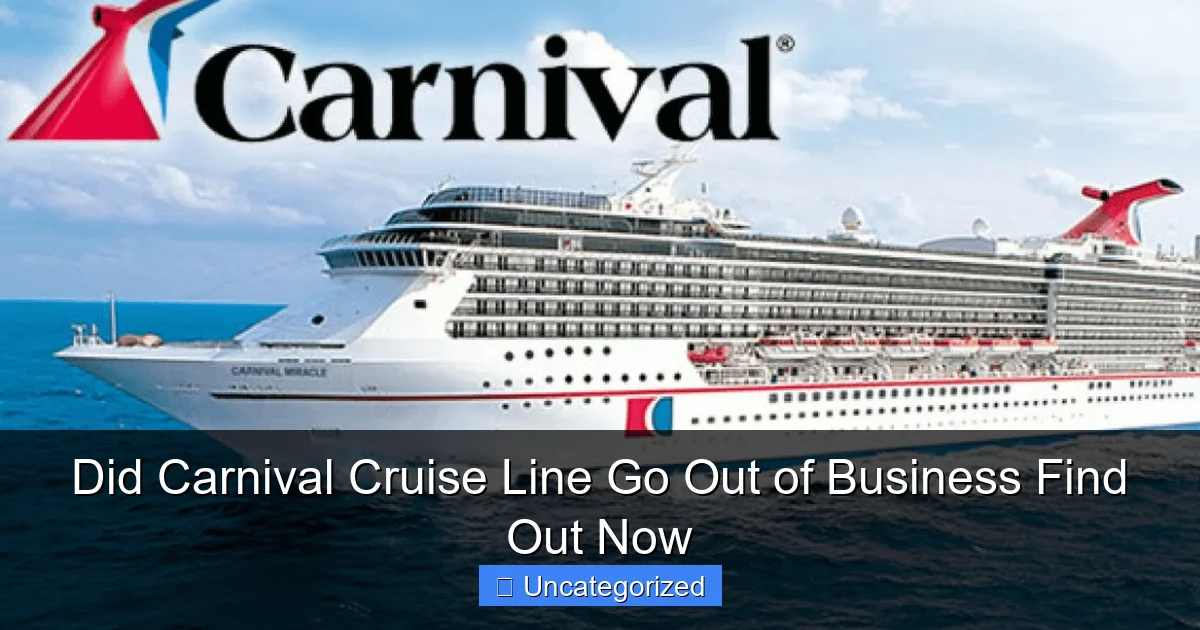
Featured image for did carnival cruise line go out of business
Image source: dominicantoday.com
Carnival Cruise Line has NOT gone out of business and continues to operate as one of the world’s leading cruise companies, despite pandemic-related challenges. The brand remains financially stable, with ongoing voyages, new ship launches, and strong booking demand proving its resilience and long-term viability.
Key Takeaways
- Carnival Cruise Line is operational: It has not gone out of business and continues sailings.
- Post-pandemic recovery: Bookings are rebounding with enhanced health protocols in place.
- Financial resilience: Aggressive cost-cutting and financing stabilized its post-2020 finances.
- New ships & itineraries: Ongoing investments signal long-term growth and confidence.
- Monitor official updates: Check Carnival.com for real-time sailing status and policy changes.
📑 Table of Contents
- Did Carnival Cruise Line Go Out of Business? The Truth Behind the Headlines
- The Pandemic’s Impact on Carnival Cruise Line: A Crisis Like No Other
- Carnival’s Recovery Strategy: How the Company Bounced Back
- Financial Health in 2023–2024: A Turnaround Story
- Operational Updates and Future Plans: What’s Next for Carnival?
- Comparing Carnival to Competitors: Where It Stands in the Market
- Conclusion: Carnival Cruise Line Is Alive, Well, and Adapting
Did Carnival Cruise Line Go Out of Business? The Truth Behind the Headlines
When the global pandemic hit in early 2020, the travel and hospitality industry faced unprecedented challenges. Among the hardest-hit sectors was the cruise industry, with major players like Carnival Cruise Line temporarily suspending operations. As news outlets reported on port closures, canceled voyages, and financial losses, a wave of speculation began to circulate: Did Carnival Cruise Line go out of business? The short answer is no—but the full story is far more complex, involving financial restructuring, strategic pivots, and a remarkable recovery effort that has positioned the company for long-term resilience.
For millions of travelers, Carnival Cruise Line is synonymous with affordable, fun-filled vacations at sea. Known for its vibrant atmosphere, family-friendly amenities, and iconic “Fun Ships,” the brand has long dominated the mass-market cruise segment. However, the pandemic’s impact on global tourism raised legitimate concerns about the sustainability of cruise operations. Social media buzz, sensational headlines, and misinformation only fueled confusion. This blog post aims to cut through the noise, offering a comprehensive, data-driven analysis of Carnival’s current status, financial health, operational recovery, and future outlook. Whether you’re a loyal cruiser, a potential first-timer, or a curious observer, this guide will answer the burning question: Did Carnival Cruise Line go out of business? Spoiler: It’s very much alive—and evolving.
The Pandemic’s Impact on Carnival Cruise Line: A Crisis Like No Other
Operations Ground to a Halt
The onset of the COVID-19 pandemic in March 2020 brought Carnival Cruise Line’s operations to a near-complete standstill. With the Centers for Disease Control and Prevention (CDC) issuing a No Sail Order for U.S.-based cruise ships, and international ports closing borders, Carnival suspended all voyages across its fleet. At its peak, over 80 ships were docked, affecting hundreds of thousands of passengers and crew members. The sudden halt in operations led to an immediate loss of revenue, with Carnival reporting a staggering $10.2 billion net loss in fiscal year 2020—its worst financial performance in company history.
Financial Strain and Liquidity Concerns
With no income from ticket sales, onboard spending, or shore excursions, Carnival faced severe liquidity challenges. To stay afloat, the company took several aggressive financial measures:
- Raised $12.6 billion through debt and equity offerings between 2020 and 2021
- Secured $4 billion in term loans and revolving credit facilities
- Issued new shares, diluting existing shareholders but bolstering capital
- Delayed new ship deliveries and sold 13 older vessels to reduce costs
These actions, while painful, were critical in preventing a total collapse. Carnival’s leadership emphasized that these were strategic survival moves, not signs of impending bankruptcy. Unlike smaller cruise operators that struggled to access capital, Carnival’s size, brand recognition, and access to global financial markets gave it a lifeline.
Misconceptions About Bankruptcy
During this period, many assumed Carnival was on the verge of filing for Chapter 11 bankruptcy. While the company did face insolvency risks, it never filed. Instead, it restructured debt, extended payment terms with suppliers, and negotiated with creditors to avoid formal bankruptcy proceedings. In a 2021 investor call, Carnival CEO Arnold Donald stated, “We are not going out of business. We are repositioning for a stronger future.” This distinction is crucial: going out of business implies permanent closure, while financial restructuring is a temporary but necessary step toward recovery.
Carnival’s Recovery Strategy: How the Company Bounced Back
Phased Return to Service
Starting in July 2021, Carnival began a cautious, phased return to operations. The strategy focused on:
- Starting with short, domestic itineraries (e.g., 3- to 5-day cruises from U.S. ports)
- Implementing enhanced health protocols, including pre-boarding testing, mask mandates, and improved air filtration
- Partnering with health authorities like the CDC and local governments to ensure compliance
- Prioritizing crew vaccination and training in pandemic response
For example, Carnival Horizon became the first U.S.-based Carnival ship to resume operations in July 2021, sailing from Miami to The Bahamas with 95% of passengers and crew vaccinated. By the end of 2022, over 90% of the fleet was back in service, with full operations restored by mid-2023.
Customer Confidence and Loyalty Programs
To rebuild trust, Carnival launched several initiatives to reassure travelers:
- Enhanced flexibility: Free cancellations and future cruise credits (FCCs) for pandemic-related disruptions
- “Carnival Guarantee”: A promise to refund or rebook passengers if health protocols prevent sailing
- “Cruise with Confidence”: A marketing campaign highlighting safety measures and crew dedication
The company also leveraged its loyalty program, “VIFP Club,” to retain repeat customers. Members received priority booking, exclusive offers, and bonus points for rebooking canceled cruises. This strategy paid off: by Q3 2023, 65% of bookings came from repeat cruisers, indicating strong brand loyalty.
Cost Optimization and Fleet Modernization
Beyond safety, Carnival focused on long-term efficiency. The company accelerated its fleet optimization plan, selling older, less efficient ships (e.g., Carnival Fantasy, Carnival Imagination) and investing in newer, LNG-powered vessels like the Mardi Gras and Carnival Celebration. These new ships offer:
- Lower fuel consumption (up to 20% savings)
- Advanced wastewater and air treatment systems
- More onboard attractions (e.g., roller coasters, VR zones)
Additionally, Carnival reduced administrative costs by streamlining operations, consolidating offices, and leveraging digital tools for crew management and customer service.
Financial Health in 2023–2024: A Turnaround Story
Earnings Reports and Revenue Growth
The numbers tell a compelling turnaround story. In fiscal year 2023, Carnival reported:
- Total revenue: $21.6 billion (up from $1.9 billion in 2020)
- Net income: $1.1 billion (first annual profit since 2019)
- Operating cash flow: $3.4 billion
By Q1 2024, the company saw a 25% year-over-year increase in bookings, with demand for 2025 sailings already outpacing 2019 levels. Analysts attribute this to:
- Pent-up demand from travelers after years of restrictions
- Increased interest in experiential vacations
- Effective marketing and competitive pricing
Debt Reduction and Credit Ratings
While Carnival’s debt remains high (~$30 billion as of 2024), the company has made progress in reducing leverage. Key actions include:
- Using 2023 profits to pay down $2.1 billion in debt
- Refinancing high-interest loans at lower rates
- Maintaining a $6.5 billion liquidity buffer for emergencies
Credit rating agencies have taken note. In 2023, Moody’s upgraded Carnival’s outlook from “Negative” to “Stable,” citing improved cash flow and demand recovery. While still rated below investment grade (“Ba3”), the trend signals growing confidence in Carnival’s financial stability.
Investor Confidence and Stock Performance
Carnival’s stock (NYSE: CCL) reflects this recovery. After plunging to $8 per share in 2020, it rebounded to over $18 by mid-2024. Institutional investors like Vanguard and BlackRock have increased their holdings, indicating long-term confidence. However, volatility persists due to macroeconomic factors (e.g., inflation, fuel prices), reminding investors that the cruise industry remains cyclical.
Operational Updates and Future Plans: What’s Next for Carnival?
New Ship Launches and Itinerary Expansion
Carnival continues to invest in innovation. Upcoming highlights include:
- Carnival Jubilee (December 2023): The third Excel-class ship, featuring a 1,500-foot roller coaster and a massive water park
- 2025 itineraries: New routes to the Mediterranean, Alaska, and private destinations like Half Moon Cay and Bahamas Paradise Island
- “Carnival Play”: A new onboard app for booking excursions, dining, and activities
The company is also expanding its “Carnival Journeys” program, offering longer, destination-focused cruises (10+ days) to attract older, affluent travelers.
Sustainability and Environmental Initiatives
As environmental concerns grow, Carnival is stepping up its green efforts. Key initiatives include:
- Transitioning to liquefied natural gas (LNG) for 70% of new ships by 2025
- Reducing carbon emissions by 40% by 2030 (vs. 2019 baseline)
- Partnering with Clean the World to recycle soap and reduce plastic waste
- Investing in shore power technology to cut emissions in ports
These efforts not only align with ESG (Environmental, Social, Governance) standards but also appeal to eco-conscious travelers.
Digital Transformation and Personalization
Carnival is leveraging AI and data analytics to enhance the customer experience. For example:
- Smart staterooms: Voice-activated controls, personalized lighting, and AI concierge services
- Dynamic pricing: Real-time fare adjustments based on demand, booking trends, and customer profiles
- “Carnival Horizon”: A loyalty tier offering perks like free Wi-Fi, drink packages, and cabin upgrades
By 2025, Carnival aims to have 90% of bookings made through its mobile app or website, reducing reliance on third-party travel agents.
Comparing Carnival to Competitors: Where It Stands in the Market
Royal Caribbean and Norwegian Cruise Line
Carnival’s main competitors—Royal Caribbean (RCL) and Norwegian Cruise Line (NCL)—faced similar pandemic challenges. However, their recovery trajectories differ:
| Metric | Carnival Cruise Line | Royal Caribbean | Norwegian Cruise Line |
|---|---|---|---|
| 2023 Revenue | $21.6B | $13.9B | $8.5B |
| Net Income (2023) | $1.1B | $1.4B | $0.8B |
| Fleet Size | 85 ships | 65 ships | 30 ships |
| Debt (2024) | $30B | $20B | $12B |
| Customer Base | Families, budget travelers | Adventure seekers, luxury | Younger adults, couples |
While Royal Caribbean has a stronger premium/luxury focus and Norwegian targets a younger demographic, Carnival maintains its edge in volume, affordability, and family appeal. Its larger fleet and diversified itineraries allow it to capture a broader market.
Market Share and Brand Loyalty
Carnival holds 40% of the global mass-market cruise segment, according to CLIA (Cruise Lines International Association). Its brand recognition and loyalty programs give it a competitive advantage. For instance, Carnival’s “VIFP Club” has over 10 million members, compared to Royal Caribbean’s “Crown & Anchor” (7 million) and Norwegian’s “Latitudes” (3 million).
Future Challenges
Despite its strengths, Carnival faces ongoing challenges:
- Geopolitical risks: Conflicts in the Red Sea and Eastern Europe disrupt itineraries
- Regulatory scrutiny: Stricter environmental and labor laws
- Competition from land-based vacations: All-inclusive resorts and Airbnb
To stay ahead, Carnival is diversifying into cruise-adjacent experiences, such as land-based resorts in the Caribbean and partnerships with airlines for bundled packages.
Conclusion: Carnival Cruise Line Is Alive, Well, and Adapting
To answer the question definitively: No, Carnival Cruise Line did not go out of business. While the pandemic brought the company to its knees, it emerged stronger through strategic financial management, operational innovation, and a relentless focus on customer trust. The $1.1 billion profit in 2023, the return of its full fleet, and the launch of new ships like the Carnival Jubilee prove that the “Fun Ship” era is far from over.
For travelers, this means Carnival remains a viable, exciting option for affordable, memorable vacations. The company’s investments in safety, sustainability, and digital technology ensure it can meet the demands of modern cruisers. For investors, Carnival’s turnaround offers a compelling case study in resilience. And for the cruise industry as a whole, Carnival’s recovery signals a broader rebound in global tourism.
As you plan your next getaway, consider this: Carnival isn’t just surviving—it’s evolving. Whether you’re drawn to its family-friendly vibe, budget-friendly pricing, or innovative onboard experiences, the brand continues to deliver. So pack your bags, grab your sunscreen, and set sail. The sea is calling, and Carnival is ready to answer. Did Carnival Cruise Line go out of business? Absolutely not. And the best is yet to come.
Frequently Asked Questions
Did Carnival Cruise Line go out of business during the pandemic?
No, Carnival Cruise Line did not go out of business during the pandemic. While operations were temporarily paused from 2020–2021, the company resumed sailings with enhanced safety protocols and remains a leading cruise operator.
Is Carnival Cruise Line financially stable in 2024?
Yes, Carnival Cruise Line is financially stable in 2024, reporting strong booking momentum and revenue growth. The company has successfully navigated post-pandemic challenges and continues to expand its fleet.
Why did people think Carnival Cruise Line went out of business?
Many assumed Carnival Cruise Line went out of business due to the global cruise industry shutdown in 2020. However, this was a temporary suspension, and the company has since rebounded with record demand.
Are Carnival cruises still operating after rumors of closure?
Absolutely. Carnival Cruise Line is actively operating across its global destinations, including the Caribbean, Alaska, and Europe. The brand remains one of the most popular choices for affordable cruising.
Did Carnival Cruise Line file for bankruptcy?
No, Carnival Cruise Line did not file for bankruptcy. While it faced financial strain during the pandemic, it secured funding and implemented cost-saving measures to stay afloat without legal restructuring.
What is the current status of Carnival Cruise Line?
Carnival Cruise Line is fully operational and thriving, with new ships like Carnival Jubilee launched in 2023. The company continues to innovate and attract millions of passengers annually.