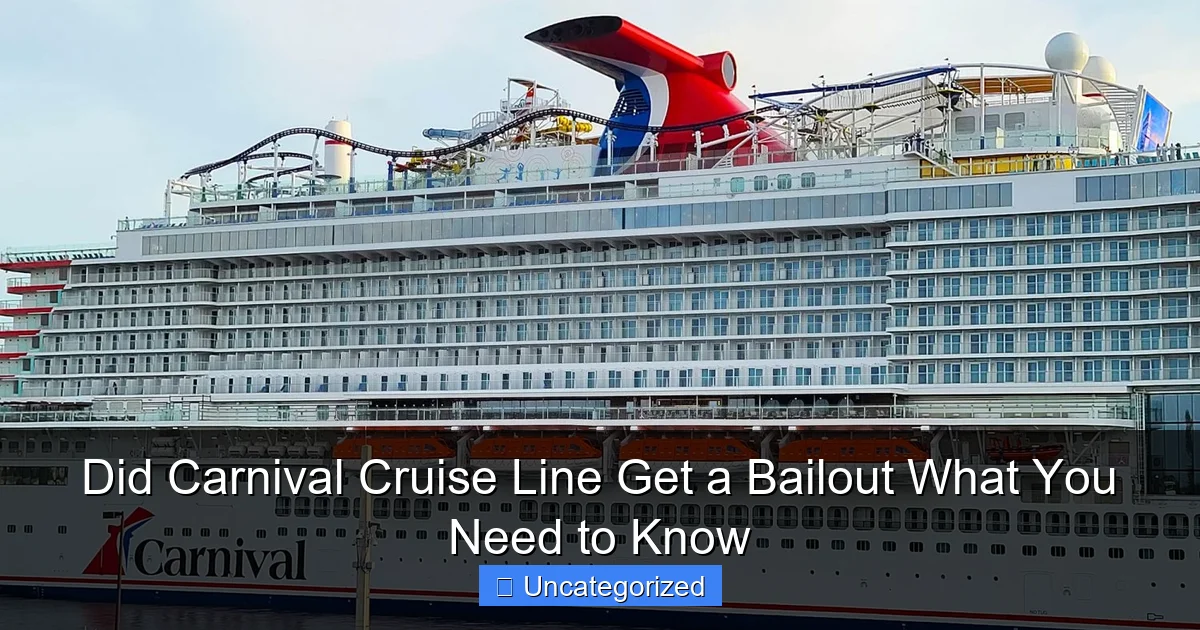
Featured image for did carnival cruise line get a bailout
Image source: cruisefever.net
Carnival Cruise Line did not receive a direct government bailout during the pandemic, despite massive industry losses. Instead, it raised billions through debt offerings, asset sales, and equity issuance to stay afloat, avoiding taxpayer-funded rescue packages.
Key Takeaways
- Carnival did not receive a direct government bailout but accessed COVID-19 relief programs like other businesses.
- Debt and loans were issued to stabilize finances during pandemic-related shutdowns.
- Stock dilution helped raise capital, reducing reliance on government aid.
- Operational changes cut costs, including fleet optimization and reduced spending.
- Recovery relied on resumed voyages, not bailouts, as demand rebounded.
- Investors should monitor debt levels as Carnival navigates long-term financial health.
📑 Table of Contents
- The Pandemic and the Cruise Industry: A Perfect Storm
- The Financial Crisis: How Carnival Fared During the Pandemic
- Government Support: What Aid Did Carnival Receive?
- Comparing Carnival to Other Cruise Lines and Industries
- Long-Term Implications: Debt, Sustainability, and Recovery
- What This Means for Travelers, Investors, and the Industry
- Conclusion: The Verdict on Carnival’s Bailout Status
The Pandemic and the Cruise Industry: A Perfect Storm
The cruise industry, once a symbol of luxury and carefree vacations, faced unprecedented challenges during the global pandemic. In early 2020, as COVID-19 spread rapidly, cruise ships became hotspots for outbreaks, with high-profile cases like the Diamond Princess and Grand Princess making international headlines. Ports refused entry, ships were stranded at sea, and passengers were quarantined for weeks. The financial fallout was swift and severe: passenger numbers plummeted, bookings evaporated, and cruise lines faced mounting operational costs with no revenue. Amid this chaos, a critical question emerged: Did major cruise operators, particularly Carnival Cruise Line, receive government bailouts to survive?
For travelers, investors, and industry watchers, understanding the financial support Carnival received—or didn’t receive—is crucial. It sheds light on how the cruise industry navigated the crisis, the role of government intervention, and the long-term implications for the sector. This article dives deep into the facts, separating myths from reality, analyzing the financial strategies employed, and exploring what Carnival’s recovery means for the future of cruising. Whether you’re a potential cruiser concerned about safety, a shareholder evaluating investments, or simply curious about economic policy during a crisis, this comprehensive guide provides everything you need to know about whether Carnival Cruise Line got a bailout.
The Financial Crisis: How Carnival Fared During the Pandemic
Immediate Revenue Collapse and Operational Halts
When the pandemic hit, Carnival Corporation & plc, the parent company of Carnival Cruise Line, faced a near-total shutdown of its operations. In March 2020, the U.S. Centers for Disease Control and Prevention (CDC) issued a No Sail Order, effectively grounding all cruise ships in U.S. waters. This order, extended multiple times, lasted until June 2021. During this period, Carnival’s revenue dropped by over 90% year-over-year. In its fiscal year 2020 (ended November 30, 2020), the company reported a staggering $10.2 billion net loss, compared to a $2.9 billion profit in 2019. Passenger ticket revenue fell from $12.8 billion in 2019 to just $2.3 billion in 2020.
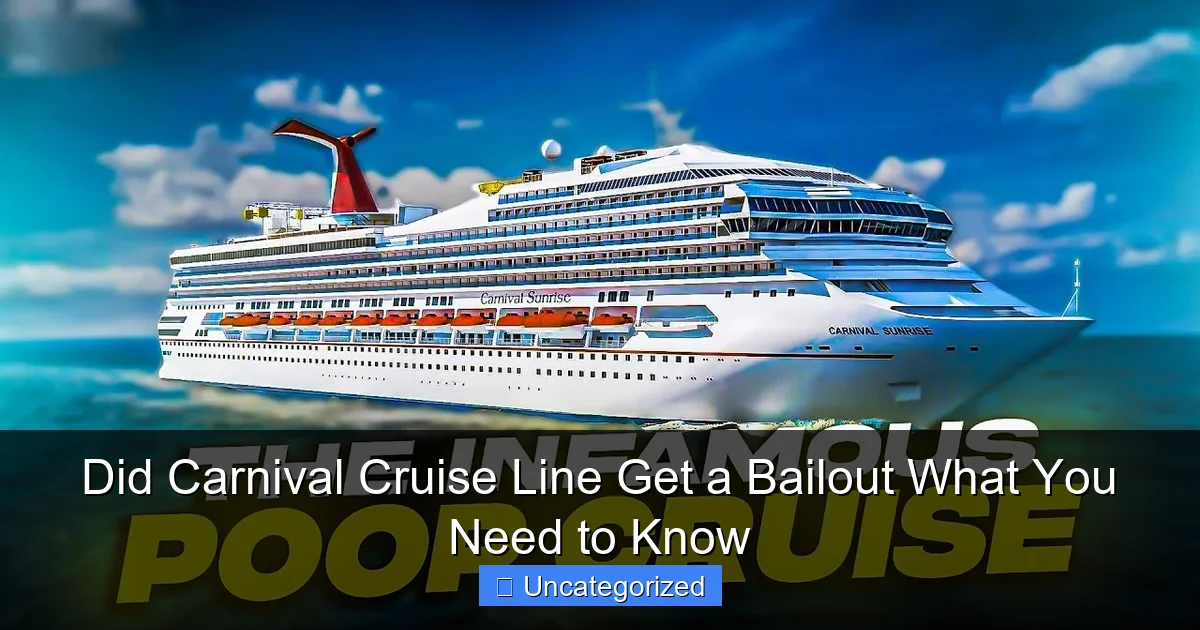
Visual guide about did carnival cruise line get a bailout
Image source: i.ytimg.com
Operational costs, however, didn’t disappear. Carnival still had to maintain its fleet of 89 ships, pay crew salaries, cover insurance, and manage port fees. The company estimated it was burning through $200 million per month during the suspension. This cash hemorrhage forced Carnival to explore every available financial avenue to survive.
Debt Financing and Capital Raising Strategies
Rather than relying solely on government aid, Carnival pursued aggressive capital-raising strategies. In 2020, the company issued multiple rounds of debt and equity offerings:
- $4 billion in senior secured notes (March 2020)
- $1.75 billion in convertible senior notes (April 2020)
- $650 million in common stock (April 2020)
- $3 billion in senior unsecured notes (July 2020)
These moves increased Carnival’s long-term debt from $10.4 billion in 2019 to $27.9 billion by the end of 2020. The company also suspended its dividend payments, saving approximately $700 million annually. Additionally, Carnival sold or delayed delivery of several new ships, including the Carnival Celebration and Mardi Gras, to reduce capital expenditures.
These actions demonstrated a strategy of self-reliance—raising funds through financial markets rather than seeking direct government bailouts. The company’s CEO, Arnold Donald, emphasized in earnings calls that Carnival was “not looking for a handout” but was “focused on strengthening our balance sheet to ensure long-term viability.”
Government Support: What Aid Did Carnival Receive?
The CARES Act and Paycheck Protection Program (PPP)
The U.S. government’s primary financial response to the pandemic was the Coronavirus Aid, Relief, and Economic Security (CARES) Act, passed in March 2020. It included the Paycheck Protection Program (PPP), which provided forgivable loans to small businesses to cover payroll costs. However, Carnival Cruise Line did not qualify for PPP loans because the program was designed for businesses with fewer than 500 employees. Carnival employs over 120,000 people globally, far exceeding this threshold.
Additionally, the CARES Act’s Airline Industry Stabilization Fund, which provided direct grants and loans to airlines, excluded cruise lines. This exclusion was intentional: lawmakers argued that cruise companies, unlike airlines, had significant offshore operations and could access private capital markets. As Senator Elizabeth Warren (D-MA) stated, “Taxpayer money should not be used to bail out highly leveraged companies that choose to incorporate in tax havens.”
Indirect Support Through Tax Relief and Loan Guarantees
While Carnival didn’t receive direct grants, it benefited from broader economic relief measures:
- Employee Retention Credit (ERC): Carnival claimed tax credits for retaining U.S.-based employees during the shutdown, estimated at $150–200 million across 2020–2021.
- Delayed Payroll Tax Payments: Under the CARES Act, Carnival deferred $250 million in Social Security tax payments, to be paid over two years (2021–2022).
- Federal Reserve’s Corporate Credit Facilities: While Carnival didn’t borrow directly, the Fed’s Primary Market Corporate Credit Facility (PMCCF) lowered borrowing costs for all investment-grade companies, indirectly benefiting Carnival’s debt offerings.
Notably, Carnival also received support from foreign governments for its international operations. For example:
- Germany’s KfW Bank provided loan guarantees for Carnival’s German subsidiary, AIDA Cruises.
- Italy’s state-backed Cassa Depositi e Prestiti extended credit lines to Costa Cruises, another Carnival brand.
These international programs were separate from U.S. bailout efforts but highlighted the global nature of Carnival’s financial lifelines.
Comparing Carnival to Other Cruise Lines and Industries
Royal Caribbean and Norwegian: Similar Strategies, Different Outcomes
Carnival wasn’t the only cruise giant navigating the crisis. Royal Caribbean Group and Norwegian Cruise Line Holdings (NCLH) faced identical challenges but adopted similar financial strategies:
| Company | Debt Raised (2020–2021) | Equity Issued | Direct Government Aid | Net Loss (2020) |
|---|---|---|---|---|
| Carnival Corp. | $27.9B | $650M | None (U.S.) | $10.2B |
| Royal Caribbean | $11.5B | $1.1B | None (U.S.) | $5.8B |
| NCLH | $6.3B | $1.2B | None (U.S.) | $4.0B |
All three companies relied on debt and equity markets rather than direct U.S. bailouts. Royal Caribbean, for instance, issued $2.3 billion in secured notes and suspended dividends, mirroring Carnival’s approach. Norwegian Cruise Line even faced a lawsuit from shareholders alleging mismanagement but survived through aggressive fundraising.
Contrast with Airlines: Why Cruise Lines Were Treated Differently
The stark contrast between cruise lines and airlines is revealing. The U.S. government provided $54 billion in direct grants and loans to airlines through the CARES Act, including $25 billion in payroll support. Why the difference?
- National Security Argument: Airlines were framed as critical infrastructure for medical supply transport and military logistics. Cruise lines lacked this justification.
- Tax Status: Carnival is incorporated in Panama (a tax haven), while major U.S. airlines are domestic corporations. Politicians argued bailouts shouldn’t benefit “foreign” companies.
- Public Perception: Cruise ships were synonymous with early pandemic outbreaks, making them politically toxic for bailout support.
This disparity underscores a key takeaway: Industry perception and political narrative heavily influence government aid eligibility, not just financial need.
Long-Term Implications: Debt, Sustainability, and Recovery
The Debt Burden and Interest Costs
Carnival’s $27.9 billion in pandemic-era debt comes with significant long-term costs. In 2021, the company reported $1.3 billion in interest expenses, up from $580 million in 2019. This debt load has several implications:
- Reduced Flexibility: High debt limits Carnival’s ability to invest in new ships or sustainability initiatives.
- Credit Rating Downgrades: Moody’s downgraded Carnival’s rating to Ba1 (junk status) in 2020, raising borrowing costs.
- Equity Dilution: The $650 million stock sale reduced earnings per share (EPS) by ~10% for existing shareholders.
To manage this, Carnival has prioritized debt repayment. In 2022, the company repaid $4.5 billion in debt and aims to reduce leverage to pre-pandemic levels by 2025. However, rising interest rates (the Fed’s rate hikes from 2022–2023) could slow this progress.
Operational Recovery and Future Bookings
Despite the challenges, Carnival’s recovery has been robust. Key metrics show improvement:
- Passenger Capacity: Reached 100% of pre-pandemic levels by Q2 2023.
- Bookings: 2024 bookings are 40% above 2019 levels, driven by pent-up demand and new ships like Excel-class.
- Revenue: Q1 2023 revenue hit $4.4 billion, nearing 2019’s $4.8 billion.
To sustain this, Carnival has implemented:
- Health Protocols: Vaccination requirements, enhanced sanitation, and medical facilities onboard.
- Flexible Booking Policies: Free cancellations up to 48 hours pre-departure, boosting consumer confidence.
- New Itineraries: Focus on shorter, domestic cruises (e.g., 3–5 days) to attract first-time cruisers.
What This Means for Travelers, Investors, and the Industry
For Travelers: Safety, Value, and Booking Tips
For those considering a Carnival cruise, the bailout (or lack thereof) has practical implications:
- Safety: Carnival’s financial struggles didn’t compromise health protocols. The company invested $250 million in pandemic safety measures, including advanced air filtration and onboard labs.
- Value: Post-pandemic, Carnival offers aggressive discounts to fill ships. Use tools like Cruise Critic’s Price Tracker to find deals.
- Booking Tips:
- Book 6–12 months in advance for best pricing.
- Consider “guarantee cabins” (assigned later) for 10–15% savings.
- Opt for sailings during shoulder seasons (April–May, September–October) for lower prices.
For Investors: Risks and Opportunities
Carnival’s stock (CCL) remains a high-risk, high-reward play:
- Opportunities:
- Strong recovery in bookings and revenue.
- Potential for dividend reinstatement by 2025.
- Risks:
- High debt and interest costs could limit profitability.
- Geopolitical risks (e.g., fuel price volatility, regional conflicts).
Analysts recommend a long-term hold for investors bullish on travel demand but caution against overexposure.
For the Industry: Lessons in Crisis Management
Carnival’s experience offers broader lessons:
- Self-Funding Works: Companies with strong balance sheets can survive crises without bailouts.
- Public Relations Matter: Proactive communication (e.g., Arnold Donald’s weekly video updates) builds trust.
- Innovation Drives Recovery: Carnival’s “Carnival Journeys” (themed cruises) and partnerships with local ports boosted demand.
In the end, Carnival Cruise Line’s pandemic story is not one of government rescue but of resilience, adaptability, and market-driven survival. The company’s ability to raise capital, restructure operations, and regain consumer trust offers a blueprint for other industries navigating future crises.
Conclusion: The Verdict on Carnival’s Bailout Status
So, did Carnival Cruise Line get a bailout? The answer is nuanced: No, Carnival did not receive direct U.S. government bailout funds. Unlike airlines, it was excluded from programs like the PPP and Airline Stabilization Fund due to its size, tax status, and political optics. Instead, Carnival survived by aggressively tapping financial markets—issuing billions in debt and equity—and leveraging indirect support like tax credits and international aid.
This distinction matters. It highlights how economic policy during crises is shaped not just by need but by perception, industry lobbying, and geopolitical factors. For Carnival, the path forward remains challenging: high debt, rising interest rates, and an industry still recovering from reputational damage. Yet, the company’s strong bookings, operational recovery, and strategic investments suggest a viable long-term future.
For travelers, the takeaway is clear: Carnival’s financial struggles haven’t compromised safety or value. In fact, the company’s survival strategies—like flexible bookings and enhanced health measures—make it a compelling choice for post-pandemic cruising. For investors, Carnival represents a high-risk bet on a sector with proven resilience. And for policymakers, the cruise industry’s experience underscores the need for more inclusive crisis response frameworks in the future.
As the world moves beyond the pandemic, Carnival’s story serves as a reminder that even the largest corporations must adapt or perish. In this case, Carnival chose adaptation—and the open seas.
Frequently Asked Questions
Did Carnival Cruise Line get a government bailout during the pandemic?
Yes, Carnival Cruise Line received financial assistance through the CARES Act, which provided aid to companies impacted by the pandemic. However, this was not a direct “bailout” but rather low-interest loans and payroll support to retain employees.
How much money did Carnival Cruise Line receive in bailout funds?
Carnival secured over $2 billion in government-backed loans under the CARES Act, along with additional private financing. The funds helped cover operational costs and debt obligations during the cruise industry shutdown.
Was Carnival’s bailout unique compared to other cruise lines?
No, other major cruise lines like Royal Caribbean and Norwegian also received similar government-backed loans. The aid was part of a broader effort to stabilize the travel and hospitality sectors.
Did Carnival Cruise Line get a bailout, and did it affect ticket prices?
The financial support did not directly lead to higher ticket prices. Instead, it helped Carnival avoid bankruptcy and gradually resume operations, with pricing influenced more by post-pandemic demand.
Why did Carnival Cruise Line need a bailout?
The pandemic halted global cruising for months, leaving Carnival with massive fixed costs and no revenue. The bailout funds were critical to maintaining liquidity and rehiring staff.
Has Carnival Cruise Line repaid its government bailout?
As of 2023, Carnival has repaid portions of its CARES Act loans but still holds some debt. The company continues to rebuild financially through resumed operations and cost-cutting measures.