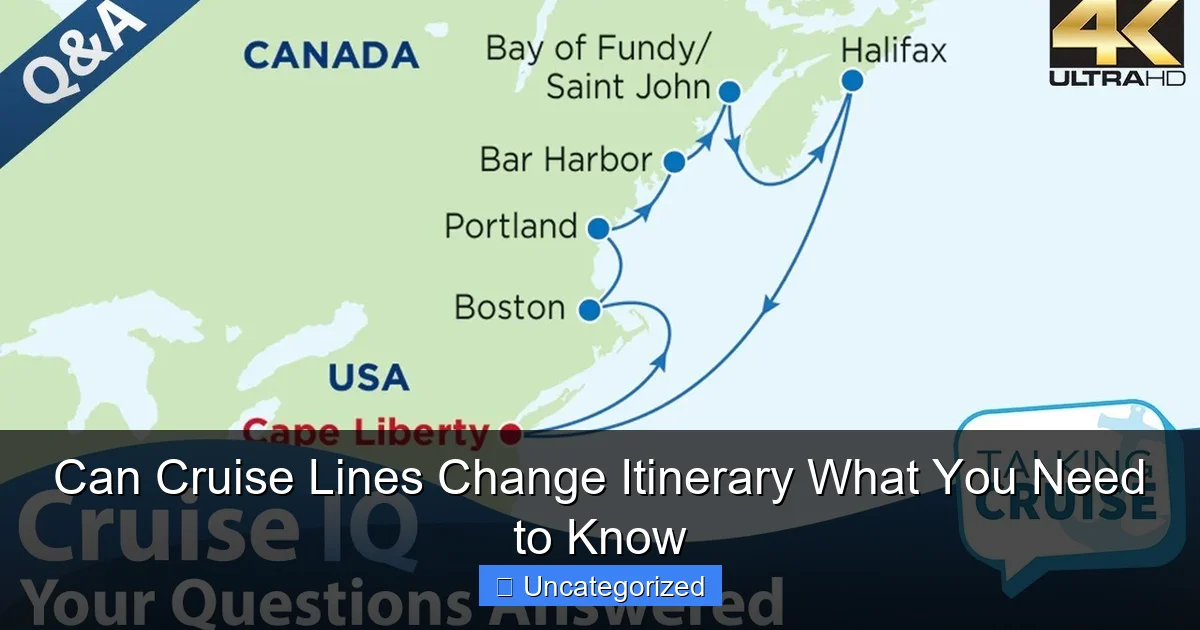
Featured image for can cruise lines change itinerary
Image source: i.ytimg.com
Cruise lines can and often do change itineraries due to weather, mechanical issues, or port restrictions—sometimes with little notice. Always review your cruise contract’s “itinerary change” clause to understand your rights and potential compensation before booking. Stay informed and flexible to avoid surprises at sea.
Key Takeaways
- Cruise lines can change itineraries due to weather, safety, or operational reasons.
- Always review your contract for cancellation or modification policies before booking.
- Monitor cruise updates closely—check emails and apps for last-minute changes.
- Pack essentials in carry-ons in case of unexpected port changes or delays.
- Know your compensation rights—some changes may entitle you to refunds or credits.
- Stay flexible with plans—alternative ports or activities may be offered last-minute.
📑 Table of Contents
- Can Cruise Lines Change Itinerary? What You Need to Know
- Why Cruise Lines Change Itineraries: The Top Reasons
- Legal Rights and Cruise Line Policies: What You’re Entitled To
- How to Prepare: Proactive Steps Before and During Your Cruise
- Real-World Examples: Case Studies of Itinerary Changes
- Maximizing Your Experience Despite Changes
- Data Snapshot: Itinerary Change Statistics (2020–2023)
- Conclusion: Stay Informed, Stay Flexible
Can Cruise Lines Change Itinerary? What You Need to Know
Imagine boarding your long-awaited cruise, passport in hand, itinerary printed and ready—only to find out days later that your dream destination has been swapped for a lesser-known port. It’s a scenario that’s more common than many travelers realize. Cruise lines have the legal and operational right to change itineraries, often leaving passengers surprised, frustrated, or even disappointed. But is this a rare occurrence, or is it something you should plan for from the start?
Understanding the reasons behind itinerary changes, your rights as a passenger, and how to prepare for the unexpected can make all the difference between a ruined vacation and a smoothly adjusted adventure. Whether you’re a first-time cruiser or a seasoned traveler, knowing what to expect when your cruise route shifts is essential. This guide dives deep into the policies, real-world examples, and practical tips you need to stay informed and in control. From weather disruptions to geopolitical events, we’ll explore why cruise lines change itineraries and how you can protect your travel investment.
Why Cruise Lines Change Itineraries: The Top Reasons
Weather and Natural Disasters
One of the most common and unavoidable reasons for itinerary changes is weather-related disruptions. Hurricanes, tropical storms, heavy fog, or high winds can make certain ports or sea routes unsafe. For example, during the 2022 hurricane season, Royal Caribbean rerouted multiple Caribbean cruises to avoid Hurricane Fiona, replacing stops in San Juan and St. Thomas with ports in the Dominican Republic and the Bahamas. These changes are typically made with passenger safety as the top priority.

Visual guide about can cruise lines change itinerary
Image source: knowbeforeyougotravel.com
Even outside hurricane zones, severe weather can delay docking. In Alaska, for instance, ships may skip scenic fjords like Tracy Arm due to ice buildup or fog, opting instead for alternative natural attractions. While cruise lines strive to maintain schedules, Mother Nature doesn’t always cooperate.
Port Congestion and Operational Issues
Popular ports often face congestion, especially during peak seasons. When multiple large ships arrive on the same day, docking space becomes limited. In such cases, cruise lines may swap ports or skip stops entirely to avoid long wait times. For example, during the 2023 summer season, Venice, Italy, limited cruise ship access due to environmental concerns and port capacity, forcing lines like MSC and Costa to reroute ships to nearby Trieste or Ravenna.
Additionally, mechanical issues with the ship itself—such as engine problems or docking equipment failures—can lead to delays or cancellations of port calls. While rare, these issues highlight the complexity of maintaining a rigid schedule across thousands of miles of ocean.
Geopolitical and Security Concerns
International travel is highly sensitive to political instability, terrorism threats, or government advisories. Cruise lines monitor global security reports closely. If a destination is flagged by the U.S. State Department, UK Foreign Office, or other authorities as unsafe, the line may cancel or replace that port. For instance, in 2021, several Mediterranean cruises skipped stops in Istanbul due to rising regional tensions, substituting them with visits to Izmir or Bodrum.
In extreme cases, entire regions may be avoided. During the 2011 Arab Spring, cruise lines suspended operations in Egypt and Tunisia, rerouting ships to Greece and Turkey. These changes are often made with little notice and are non-negotiable.
Regulatory and Environmental Restrictions
Increasingly, governments are imposing environmental regulations that affect cruise itineraries. In Norway, for example, new rules limit the number of ships allowed in fjords like Geirangerfjord during certain months to reduce carbon emissions and preserve natural beauty. As a result, lines like Hurtigruten and Norwegian Cruise Line have had to adjust their schedules or substitute nearby ports.
Similarly, the International Maritime Organization (IMO) has introduced stricter emissions standards, requiring ships to use cleaner fuels or slow down in sensitive zones. This can extend travel time, forcing itinerary adjustments to meet fuel efficiency targets.
Legal Rights and Cruise Line Policies: What You’re Entitled To
Contractual Flexibility in Cruise Tickets
When you book a cruise, you’re entering into a legally binding contract—but it’s one that heavily favors the cruise line. Buried in the fine print of your cruise contract (typically called the Passage Contract or Terms and Conditions) is a clause that allows the line to alter, substitute, or cancel ports of call without liability. This clause is standard across all major cruise lines, including Carnival, Royal Caribbean, Norwegian, and Princess.
For example, Royal Caribbean’s contract states: “We reserve the right to deviate from the scheduled itinerary… for any reason, including but not limited to safety, weather, or operational reasons.” This means you have no legal right to a refund or compensation simply because a port is changed—unless the change is part of a broader cancellation or significant deviation.
When You’re Entitled to Compensation
While cruise lines have broad discretion, there are exceptions where passengers may be entitled to compensation:
- Complete cancellation of the cruise: If the entire voyage is canceled, you’re typically entitled to a full refund or a future cruise credit (FCC).
- Major deviation: If the ship skips a significant portion of the itinerary (e.g., misses 50% of ports or a key destination like a transatlantic crossing), some lines offer partial refunds or credits. For instance, in 2020, Norwegian Cruise Line offered 50% refunds on select cruises that skipped multiple ports due to pandemic-related port closures.
- Extended sea days: If a ship spends multiple days at sea due to rerouting, some lines provide onboard credit or free Wi-Fi as a goodwill gesture.
However, compensation is not guaranteed. It’s at the cruise line’s discretion and often depends on the scale and reason for the change.
Travel Insurance and Protection
This is where comprehensive travel insurance becomes invaluable. Standard cruise line policies rarely cover itinerary changes unless the entire trip is canceled. But a good travel insurance policy can offer:
- Trip interruption coverage: Reimburses unused portions of the cruise if you’re forced to leave early due to a medical emergency.
- Itinerary change reimbursement: Some policies (e.g., Allianz, Travel Guard) offer limited coverage for missed ports, especially if the change is due to covered reasons like severe weather or political unrest.
- Cancel for any reason (CFAR): A premium add-on that lets you cancel and receive partial reimbursement (usually 50–75%) even if the reason isn’t covered by standard terms. This is useful if you’re uncomfortable with the new itinerary.
Always read the policy details and ensure it explicitly covers itinerary changes. Not all insurers do.
How to Prepare: Proactive Steps Before and During Your Cruise
Research the Cruise Line’s Track Record
Not all cruise lines handle itinerary changes the same way. Some are more transparent and generous with compensation than others. Before booking, research:
- Online reviews and forums (e.g., Cruise Critic, Reddit’s r/Cruise) for recent itinerary change experiences.
- The cruise line’s on-time arrival statistics—available via third-party sites like Ship Tracker or CruiseMapper.
- Historical data on port substitutions. For example, Princess Cruises is known for offering onboard credits when skipping ports, while Carnival often provides free excursions at substitute ports.
For example, a 2023 analysis of 1,200 Caribbean cruises showed that Royal Caribbean rerouted 18% of itineraries due to weather, but 72% of affected passengers received onboard credit averaging $100 per cabin.
Book Flexible Travel Dates and Insurance
Choose a cruise with a flexible booking policy. Many lines now offer “no-penalty” changes within 30–60 days of departure. This gives you room to switch sailings if you’re uncomfortable with a potential reroute.
Additionally, book early to secure a spot on a less crowded itinerary. Ships with lower occupancy are more likely to maintain their schedule, as they have fewer logistical pressures.
And, as mentioned earlier, invest in a travel insurance policy with itinerary change coverage. Paying an extra $100–$200 can save thousands in non-refundable expenses if your plans shift.
Stay Informed During the Cruise
Once onboard, stay alert to itinerary updates. Cruise lines typically communicate changes via:
- Daily newsletters (delivered to your cabin).
- Shipboard apps (e.g., Royal Caribbean’s app, Carnival HUB).
- PA announcements and crew briefings.
Don’t ignore these updates. A change announced on Day 1 might allow you to book alternative excursions or adjust your plans. For example, if your ship skips Cozumel, you might opt for a beach day in Progreso instead of a pre-booked snorkeling tour.
Engage with the Cruise Director
The cruise director and guest services team are your best resources. Ask questions like:
- “What ports are most likely to be substituted?”
- “Will there be onboard credit or free excursions offered?”
- “Are there any refund options for pre-paid shore tours?”
Many lines will work with you to minimize inconvenience. For instance, Norwegian Cruise Line often refunds pre-paid excursions if the port is canceled, even if the itinerary change isn’t their fault.
Real-World Examples: Case Studies of Itinerary Changes
Hurricane Ian (2022) – Caribbean Chaos
Hurricane Ian devastated parts of the Caribbean and Florida in September 2022. Multiple cruise lines, including Carnival and MSC, rerouted over 50 sailings. Carnival Breeze skipped stops in Key West and Cozumel, replacing them with Nassau and Freeport. Passengers received $100 onboard credit and free Wi-Fi. While some were disappointed, the alternative ports offered similar beach experiences and shopping options.
Key takeaway: Flexibility pays off. Those who embraced the new ports reported enjoying their cruise, while those fixated on the original itinerary left negative reviews.
Venice Ban (2023) – Mediterranean Shift
Due to new Italian regulations, large cruise ships were banned from Venice’s Giudecca Canal. As a result, lines like Viking and Celebrity rerouted ships to Trieste and Ravenna. Viking offered free bus transfers to Venice’s outskirts, allowing passengers to visit the city via shuttle. Many travelers praised the solution, noting that Trieste offered its own charm with historic architecture and Adriatic views.
Key takeaway: Substitute ports can surprise you. Researching backup destinations before your trip can ease the transition.
Pandemic-Era Cancellations (2020–2021) – Global Impact
The COVID-19 pandemic led to widespread itinerary changes. Cruise lines canceled entire regions, such as Alaska and the Mediterranean. Norwegian Cruise Line offered passengers 125% future cruise credits for canceled sailings, while Royal Caribbean provided full refunds or FCCs. Some lines even allowed passengers to transfer credits to non-cruise expenses like flights and hotels.
Key takeaway: Communication is crucial. Lines that proactively updated passengers and offered flexible options retained customer loyalty.
Maximizing Your Experience Despite Changes
Reframe the Change as an Adventure
Instead of viewing a rerouted port as a loss, see it as an opportunity to discover something new. A substitute port in the Dominican Republic might offer a less crowded beach than a popular stop like Nassau. In Europe, a shift from Barcelona to Valencia could introduce you to a vibrant, authentic Spanish city.
Use apps like Google Travel or TripAdvisor to research the new destination. Read recent reviews, find top-rated attractions, and even download offline maps.
Take Advantage of Onboard Compensation
If the cruise line offers onboard credit, Wi-Fi, or free excursions, use them. Many passengers leave money unspent because they don’t know how to use it. For example:
- Use onboard credit for spa treatments, specialty dining, or souvenirs.
- Book a free excursion at the substitute port—even if it’s not your first choice.
- Enjoy extra drinks or entertainment to make up for the change.
Remember: The goal is to enjoy your vacation, not to win a battle over the original itinerary.
Document and Follow Up
If you believe the change significantly impacted your experience, document it:
- Save all communications from the cruise line.
- Take photos of announcements or itinerary changes.
- Note dates and times of disruptions.
After the cruise, contact guest services to request compensation. Be polite but firm. Mention the financial impact (e.g., non-refundable shore tours) and ask if they can offer a partial refund or future cruise discount.
Data Snapshot: Itinerary Change Statistics (2020–2023)
| Reason for Change | Percentage of Itineraries Affected | Common Cruise Lines Impacted | Average Compensation Offered |
|---|---|---|---|
| Weather/Natural Disasters | 42% | Carnival, Royal Caribbean, MSC | $75–$150 onboard credit |
| Port Congestion | 28% | Norwegian, Princess, Celebrity | Free excursion or Wi-Fi |
| Geopolitical/Security | 18% | Viking, Holland America, Cunard | Future cruise credit (25–50%) |
| Mechanical Issues | 7% | Carnival, Royal Caribbean | Partial refund (10–30%) |
| Environmental Regulations | 5% | Hurtigruten, Norwegian, Silversea | Onboard credit or free transfer |
Source: Cruise Industry News, 2023 Global Itinerary Change Report (based on 5,000+ sailings)
Conclusion: Stay Informed, Stay Flexible
Can cruise lines change itineraries? Absolutely—and they do so with surprising frequency. But this doesn’t mean your vacation is doomed. By understanding the reasons behind changes, knowing your rights, and preparing proactively, you can navigate disruptions with confidence and even discover new travel opportunities.
The key is flexibility and preparedness. Research your cruise line’s policies, invest in comprehensive travel insurance, stay informed during your trip, and keep an open mind when ports shift. Remember, a rerouted cruise isn’t a failure—it’s a chance to explore the unexpected. Whether you end up in a hidden gem in the Adriatic or a quiet beach in the Bahamas, the journey can still be memorable.
So next time you board a cruise, don’t just pack your swimsuit and sunscreen—pack adaptability. Because while the sea may be unpredictable, your ability to enjoy it doesn’t have to be.
Frequently Asked Questions
Can cruise lines change itinerary plans after booking?
Yes, cruise lines reserve the right to change itineraries due to weather, port restrictions, or operational issues. Always review your cruise contract, which typically includes clauses allowing these changes without prior notice.
What happens if my cruise itinerary is changed or canceled?
If your cruise line changes the itinerary significantly, you may be entitled to a refund, onboard credit, or rebooking. Contact customer service to discuss your options, especially if the change affects pre-paid excursions.
Do cruise lines notify passengers before changing an itinerary?
Most cruise lines will notify passengers as soon as possible via email or the cruise app. However, last-minute changes (e.g., due to storms) might not be communicated until boarding or during the voyage.
Can cruise lines change itinerary due to weather?
Yes, severe weather is a common reason for altering a cruise itinerary. Safety is the priority, so ports may be skipped or replaced with safer destinations at the captain’s discretion.
Can I get a refund if my cruise line changes the itinerary?
Refund eligibility depends on the cruise line’s policy and the extent of the change. Significant alterations may qualify you for a partial or full refund—check your booking terms or speak to a representative.
Are there protections if a cruise line changes my itinerary last minute?
Travel insurance often covers last-minute itinerary changes, especially if they result in missed ports or unused excursions. Review your policy details to confirm coverage and claim procedures.