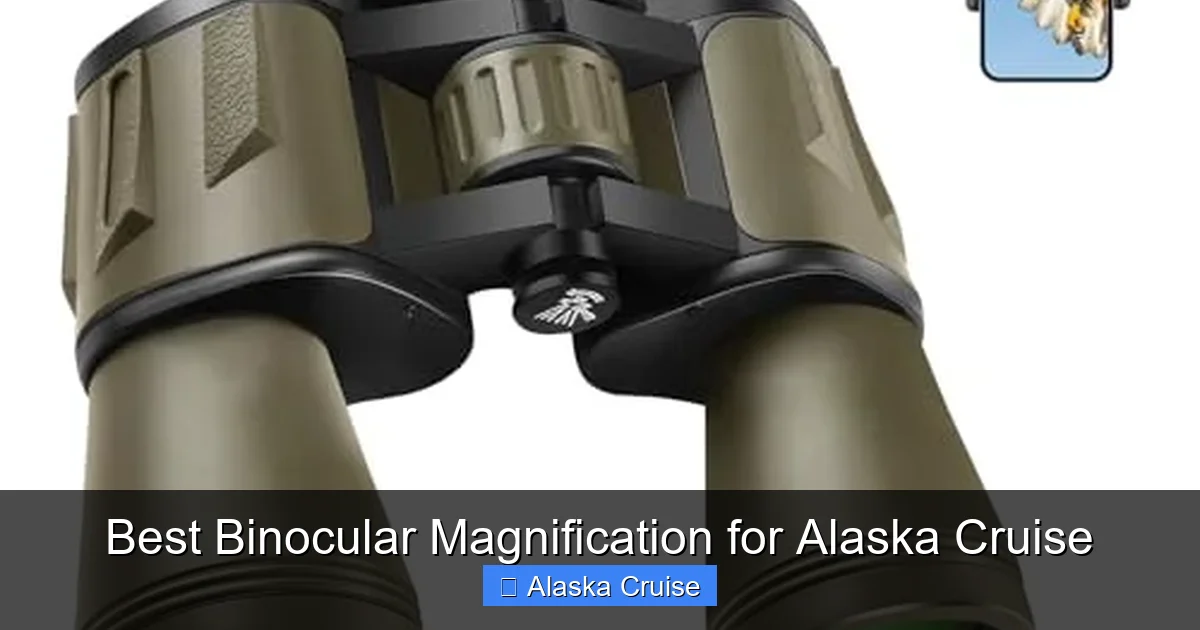
Choosing the right binocular magnification for an Alaska cruise can make or break your wildlife viewing experience. With vast landscapes, unpredictable weather, and distant marine life, you need optics that balance power, stability, and portability. This guide breaks down everything you need to know to pick the perfect pair for spotting humpback whales, sea lions, glaciers, and bald eagles in crisp detail.
Key Takeaways
- 8×42 is the ideal magnification for most Alaska cruises: Offers a bright, stable image with a wide field of view—perfect for scanning coastlines and spotting wildlife.
- Avoid high magnification (10x and above) unless using a tripod: Handheld high-power binoculars cause shaky images, especially on a moving ship.
- Waterproof and fog-proof construction is essential: Alaska’s damp, cold climate demands durable, sealed optics to prevent internal fogging.
- Consider weight and size for comfort: You’ll be using them for hours—lightweight models reduce neck strain during long excursions.
- Look for fully multi-coated lenses: Enhances light transmission for brighter views in low-light conditions like dawn or overcast skies.
- Close focus distance matters for shore excursions: Some binoculars allow you to focus on objects as close as 6 feet—great for examining tide pools or bird nests.
- Try before you buy if possible: Comfort, grip, and eye relief vary—test models to ensure they fit your face and vision needs.
📑 Table of Contents
- Why Binoculars Are a Must-Have for Your Alaska Cruise
- Understanding Binocular Magnification: What the Numbers Mean
- Key Features to Look for Beyond Magnification
- Top Binocular Recommendations for Alaska Cruises
- Tips for Using Binoculars on an Alaska Cruise
- Common Mistakes to Avoid
- Conclusion: Make Every Moment Count
Why Binoculars Are a Must-Have for Your Alaska Cruise
An Alaska cruise isn’t just a vacation—it’s a front-row seat to one of nature’s greatest shows. From towering glaciers calving into icy waters to pods of orcas slicing through the sea, the sights are nothing short of breathtaking. But here’s the catch: much of the action happens far from the ship’s deck. That’s where a good pair of binoculars becomes your most valuable travel companion.
Imagine standing on the upper deck, binoculars in hand, as a humpback whale breaches just 200 yards away. Without magnification, it’s just a splash. With the right optics, you see the spray, the curve of its back, even the barnacles clinging to its skin. Or picture a bald eagle perched high on a spruce tree across a fjord—its white head barely visible to the naked eye. With binoculars, you’re close enough to admire its piercing gaze.
But not all binoculars are created equal. The wrong pair can leave you frustrated with blurry images, shaky views, or fogged-up lenses. That’s why choosing the best binocular magnification for Alaska cruise adventures is about more than just numbers—it’s about matching your optics to the environment, your needs, and the realities of life at sea.
Understanding Binocular Magnification: What the Numbers Mean

Visual guide about Best Binocular Magnification for Alaska Cruise
Image source: voyagerinfo.com
Binoculars are labeled with two numbers, like 8×42 or 10×50. The first number is the magnification—how many times closer the object appears. The second is the objective lens diameter in millimeters, which affects how much light the binoculars can gather.
So, what does “8×42” really mean? It means objects appear 8 times closer than they do to the naked eye, and the front lenses are 42mm wide. This combination strikes a sweet spot for Alaska cruising: enough power to see details, but not so much that the image becomes unstable when you’re on a moving ship.
Higher magnification, like 10x or 12x, might seem appealing—after all, more power means better views, right? Not always. On a rocking boat, high magnification amplifies every tiny movement of your hands, making the image jump and blur. It’s like trying to take a photo with a long zoom lens while riding a rollercoaster. You’ll spend more time steadying the view than actually enjoying it.
That’s why most experts—including seasoned cruise guides and wildlife photographers—recommend sticking to 7x to 10x magnification for Alaska. Within that range, 8x is often the gold standard. It provides a bright, wide field of view, excellent stability, and enough detail to identify species from a distance.
Why 8×42 Is the Sweet Spot for Alaska
The 8×42 configuration is widely regarded as the best binocular magnification for Alaska cruise travelers. Here’s why:
First, the 8x magnification is powerful enough to bring distant wildlife into clear focus—whether it’s a sea otter floating on its back or a glacier cracking off icebergs miles away. Yet it’s not so strong that it magnifies every little hand tremor.
Second, the 42mm objective lenses gather ample light, which is crucial in Alaska’s often overcast or low-light conditions. Early morning whale watches or late evening fjord explorations benefit from brighter, clearer images. The larger lenses also help maintain image quality in dim light, so you don’t miss a thing.
Third, 8×42 binoculars typically offer a wide field of view—around 350 to 400 feet at 1,000 yards. This means you can scan large areas quickly, which is essential when trying to locate a breaching whale or a distant bear on a hillside. A wider view also makes it easier to track moving animals without losing them from sight.
Finally, most 8×42 models are designed with portability in mind. They’re compact enough to carry around your neck all day, yet robust enough to handle the elements. Many come with rubber armor for shock resistance and a comfortable grip—perfect for chilly, damp conditions.
When to Consider 7x or 10x Magnification
While 8×42 is the go-to, there are situations where 7x or 10x might be better.
7x binoculars, like 7×35 or 7×42, offer an even wider field of view and greater image stability. They’re excellent for fast-moving scenes—like a pod of dolphins racing alongside the ship—or for passengers who wear glasses, as they often have longer eye relief. If you prioritize comfort and ease of use over extreme detail, 7x could be your best bet.
On the other hand, 10x magnification can be useful if you’re planning to spend a lot of time on shore excursions with a tripod. For example, if you’re visiting a wildlife sanctuary and setting up for a long observation session, 10×50 binoculars can reveal finer details—like the pattern on a puffin’s beak or the texture of a glacier’s surface. Just remember: without a tripod, 10x binoculars are nearly impossible to hold steady on a moving ship.
Key Features to Look for Beyond Magnification
Magnification is important, but it’s only one piece of the puzzle. To get the most out of your Alaska cruise, you’ll want binoculars that are built for the environment and your lifestyle.
Waterproof and Fog-Proof Construction
Alaska is famously wet and cold. Rain, sea spray, and sudden temperature drops are part of the experience. That’s why your binoculars must be fully waterproof and fog-proof.
Look for models labeled “nitrogen-purged” or “O-ring sealed.” These terms mean the internal optics are protected from moisture and condensation. Nitrogen purging prevents fogging by replacing the air inside with dry nitrogen gas. This is especially important when moving between cold outdoor air and warm indoor spaces—like stepping inside the ship after a chilly deck session.
Without this protection, your lenses can fog up from the inside, ruining your view and potentially damaging the optics over time.
Lens Coatings Matter
Not all glass is created equal. Lens coatings dramatically affect image brightness, color accuracy, and clarity.
Fully multi-coated lenses are the gold standard. These coatings reduce glare, enhance contrast, and maximize light transmission—critical for Alaska’s often gray skies and long twilight hours. You’ll notice the difference when viewing a dark bear against a snowy backdrop or a whale’s shadow beneath the water.
Cheaper binoculars may have single or partial coatings, which can result in dimmer, washed-out images. Don’t skimp here—your wildlife sightings deserve the best possible view.
Eye Relief and Comfort
If you wear glasses, eye relief is a critical factor. Eye relief is the distance between your eye and the eyepiece where you can see the full field of view. Longer eye relief (15mm or more) allows you to keep your glasses on while using the binoculars comfortably.
Even if you don’t wear glasses, comfort matters. Look for rubber eyecups that can be folded down or twisted up to suit your preference. A comfortable fit means you can use your binoculars for hours without fatigue.
Close Focus Distance
Most binoculars are designed for distant viewing, but Alaska offers plenty of up-close encounters too. During shore excursions, you might find yourself examining tide pools, bird nests, or intricate ice formations just a few feet away.
Binoculars with a close focus distance of 6 to 8 feet allow you to zoom in on these details without switching to a monocular or camera. It’s a small feature that can make a big difference in your overall experience.
Weight and Portability
You’ll be carrying your binoculars around your neck for hours—sometimes all day. A heavy pair can strain your neck and shoulders, especially on windy decks or during long hikes.
Look for models under 2.5 pounds. Many high-quality 8×42 binoculars weigh between 1.5 and 2 pounds, making them easy to carry without sacrificing performance. Compact roof prism designs are especially popular for their balance of size and power.
Top Binocular Recommendations for Alaska Cruises
With so many options on the market, it can be hard to know where to start. Here are a few top-rated models that consistently earn praise from travelers and experts alike.
Nikon Monarch M7 8×42
A favorite among nature enthusiasts, the Nikon Monarch M7 offers exceptional clarity, a wide field of view, and rugged construction. Fully multi-coated lenses deliver bright, true-to-life colors, while the ergonomic design ensures a comfortable grip. Weighing just 1.6 pounds, it’s lightweight enough for all-day use. The close focus of 6.6 feet makes it versatile for both distant whales and nearby wildlife.
Vortex Optics Diamondback HD 8×42
Known for their lifetime warranty and excellent value, Vortex binoculars are a smart choice for cruisers. The Diamondback HD features high-density glass and fully multi-coated lenses for superior image quality. It’s waterproof, fog-proof, and built to withstand drops and bumps. At 1.8 pounds, it’s slightly heavier than the Nikon but still very manageable.
Zeiss Terra ED 8×42
For those willing to invest in premium optics, the Zeiss Terra ED delivers outstanding performance. Extra-low dispersion (ED) glass reduces chromatic aberration, resulting in sharper, more vibrant images. The compact design and lightweight build (1.7 pounds) make it ideal for travel. While pricier, it’s a long-term investment for serious wildlife watchers.
Carson VP Series 8×42
If you’re on a budget, the Carson VP Series offers impressive quality at an affordable price. Fully multi-coated lenses, waterproof housing, and a lightweight design make it a solid choice for casual cruisers. It may not match the clarity of higher-end models, but it’s more than capable of delivering great views of Alaska’s wonders.
Tips for Using Binoculars on an Alaska Cruise
Even the best binoculars won’t help if you’re not using them correctly. Here are some practical tips to maximize your viewing experience.
Stabilize Your View
On a moving ship, keeping your binoculars steady is half the battle. Lean against the railing, rest your elbows on a surface, or use a monopod for extra support. Some travelers even use a scarf or bandana as a makeshift sling to reduce hand fatigue.
Scan Slowly and Systematically
Don’t rush. Move your binoculars in slow, sweeping motions across the horizon. Start from one side and work your way across, pausing to focus on anything that catches your eye. This method helps you cover more area and reduces the chance of missing something.
Use the Ship’s Rail as a Rest
The ship’s railing is your best friend. Rest your forearms on it to steady your hands. If the rail is too high, try crouching slightly or using a jacket as a cushion. Every little bit of support helps.
Keep Them Dry and Clean
Sea spray and rain are inevitable. Use a lens cloth to wipe down your binoculars after each use. Store them in a protective case or pouch when not in use. Avoid touching the lenses with your fingers—oils from your skin can degrade image quality.
Share the View
Binoculars are a great way to connect with fellow passengers. Offer to let others take a look when you spot something amazing. It’s a simple gesture that can spark conversations and create shared memories.
Common Mistakes to Avoid
Even experienced travelers make mistakes when choosing or using binoculars. Here are a few to watch out for.
Choosing High Magnification for Handheld Use
As mentioned earlier, 10x and 12x binoculars are nearly impossible to hold steady on a moving ship. Unless you’re using a tripod, stick to 8x or lower.
Ignoring Weather Resistance
Buying cheap, non-waterproof binoculars is a recipe for disaster. Moisture can ruin the optics and shorten the lifespan of your investment. Always choose waterproof and fog-proof models.
Overlooking Comfort and Fit
A pair that doesn’t fit your face or feels awkward in your hands will spend more time in your bag than in use. Try them on before buying—adjust the eyecups, test the focus wheel, and make sure they feel balanced.
Forgetting a Strap or Case
Dropping your binoculars overboard is a real risk. Always use a neck strap or harness, and keep them in a protective case when not in use. Some models come with a harness that distributes weight more evenly—worth considering for long days.
Conclusion: Make Every Moment Count
An Alaska cruise is a once-in-a-lifetime adventure, and the right binoculars can elevate it from memorable to unforgettable. The best binocular magnification for Alaska cruise travelers isn’t about chasing the highest number—it’s about finding a balance of power, clarity, and comfort that suits your needs.
For most people, that means an 8×42 model with waterproof construction, fully multi-coated lenses, and a lightweight design. These optics deliver bright, stable views of whales, glaciers, and wildlife, even in challenging conditions. Whether you’re scanning the horizon from the deck or exploring a quiet cove on a Zodiac, your binoculars will be your window to the wild.
Invest in a quality pair, learn how to use them effectively, and you’ll return home with stories—and images—that no photograph could ever capture. After all, some moments are meant to be seen up close.
Frequently Asked Questions
What magnification is best for whale watching on an Alaska cruise?
The best magnification for whale watching is 8x. It provides enough power to see details like spouts and flukes without magnifying hand movements, which is crucial on a moving ship. 8×42 binoculars are ideal for balancing clarity, brightness, and stability.
Can I use 10x binoculars on a cruise ship?
You can, but they’re difficult to use handheld due to image shake. 10x binoculars are better suited for use with a tripod, such as during shore excursions. For general deck use, 8x is more practical and user-friendly.
Do I need waterproof binoculars for Alaska?
Yes. Alaska’s climate is wet and unpredictable. Waterproof, fog-proof binoculars with nitrogen purging protect against moisture, sea spray, and temperature changes, ensuring clear views and long-term durability.
Are compact binoculars good for Alaska cruises?
Compact binoculars (like 8×25) are lightweight and portable but may lack brightness and field of view. For Alaska’s vast landscapes and low-light conditions, full-size 8×42 models offer better performance and comfort.
Should I wear glasses while using binoculars?
If you wear glasses, choose binoculars with long eye relief (15mm or more) and adjustable eyecups. This allows you to see the full field of view without removing your glasses, improving comfort and clarity.
How do I clean my binoculars after an Alaska cruise?
Use a microfiber lens cloth to gently wipe the lenses. Avoid touching them with your fingers. Store them in a dry, protective case. For stubborn smudges, use a lens cleaning solution designed for optics—never household cleaners.