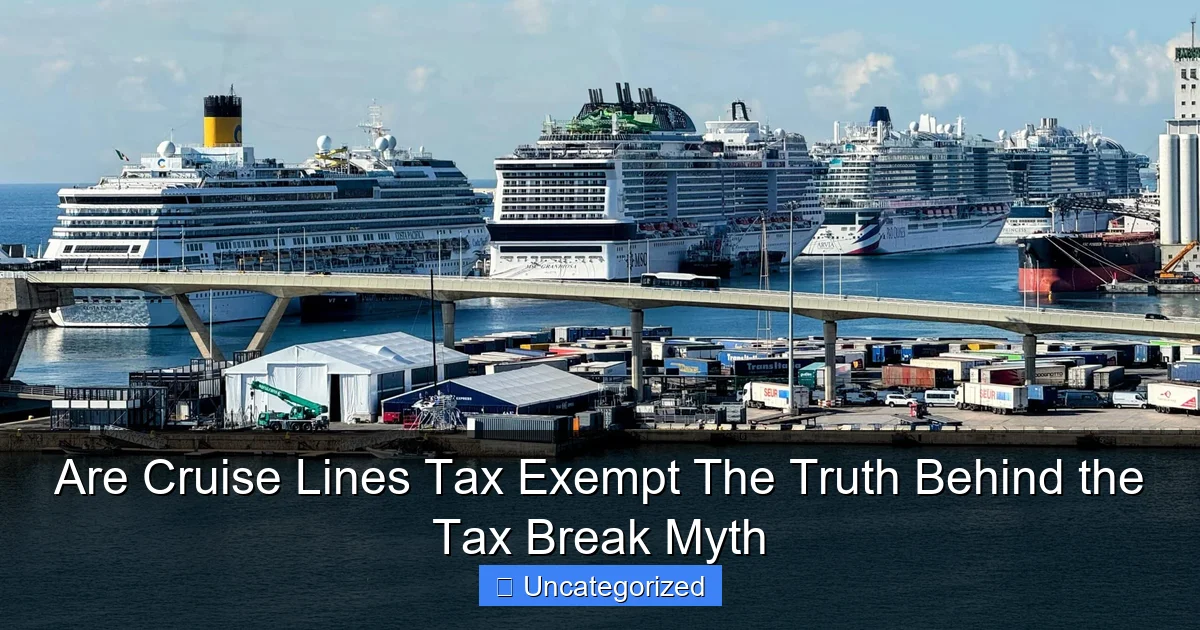
Featured image for are cruise lines tax exempt
Image source: cruiseradio.net
Cruise lines are not fully tax-exempt, despite common misconceptions fueled by offshore registrations and complex corporate structures. While they benefit from strategic tax loopholes and foreign flagging—often registering ships in low-tax countries like Panama or Liberia—they still pay U.S. taxes on domestic operations and passenger revenue, debunking the myth of complete exemption. This nuanced reality highlights legal tax avoidance, not evasion, reshaping how travelers and investors view the industry’s financial footprint.
Key Takeaways
- Cruise lines pay taxes: They are not fully tax-exempt despite common myths.
- Port fees are mandatory: These costs are passed to passengers, not waived via tax breaks.
- Corporate taxes apply: Cruise companies file returns in home countries like the U.S. or Norway.
- Flagging loopholes exist: Some use foreign flags to reduce tax burdens legally.
- Local taxes vary: Taxes depend on itinerary, not just the cruise line’s registration.
📑 Table of Contents
- The Allure and the Illusion: Unpacking Cruise Line Taxes
- How Cruise Lines Minimize Taxes: The Legal Framework
- What Taxes Do Cruise Lines Actually Pay?
- International Regulations and the Role of the IMO
- Real-World Examples: How Major Cruise Lines Handle Taxes
- What This Means for Travelers, Ports, and the Environment
- Data Table: Cruise Line Tax Payments (2022-2023)
- Conclusion: The Myth, the Reality, and the Way Forward
The Allure and the Illusion: Unpacking Cruise Line Taxes
Picture this: a sun-drenched deck, the gentle sway of the ocean, and the promise of adventure in far-off ports. Cruising has long been marketed as a luxurious escape, a floating resort where every need is catered to. But beneath the glittering surface of this idyllic vacation experience lies a more complex reality—one that involves international law, corporate strategy, and a persistent myth: are cruise lines tax exempt? The idea that these massive, profit-driven corporations sail tax-free has fueled public skepticism and even outrage. After all, how can an industry that generates billions in revenue avoid the same tax obligations that everyday businesses and citizens face?
The truth, as it often is, is far more nuanced than the myth suggests. While cruise lines do enjoy certain tax advantages, they are not universally or completely tax-exempt. The perception of tax-free operations stems from a combination of legal structures, international regulations, and jurisdictional loopholes that allow cruise companies to minimize their tax burden—but not eliminate it entirely. This blog post dives deep into the mechanics behind cruise line taxation, separating fact from fiction, and exploring how these corporations navigate a global tax landscape that’s as complex as the oceans they traverse. Whether you’re a curious traveler, a policy advocate, or a business professional, understanding the reality behind cruise line taxation is key to making informed decisions and holding powerful industries accountable.
How Cruise Lines Minimize Taxes: The Legal Framework
Flag of Convenience: The Foundation of Tax Strategy
One of the most powerful tools cruise lines use to reduce their tax liability is the flag of convenience (FOC) system. This practice involves registering a ship under the laws of a foreign country—typically one with minimal regulation and low or zero corporate taxes. Countries like Panama, Liberia, the Bahamas, and Bermuda are among the most popular registries for cruise ships. These nations offer streamlined registration processes, low fees, and, crucially, no corporate income tax on international earnings.
Visual guide about are cruise lines tax exempt
Image source: i.insider.com
For example, Carnival Corporation—the world’s largest cruise operator—registers many of its ships under the Panamanian flag. This means that income generated from cruises outside Panamanian waters isn’t subject to Panama’s corporate tax (which is zero for foreign-sourced income). It’s not that Carnival is “hiding” from taxes; it’s that it’s legally structuring its operations to fall under jurisdictions with favorable tax laws. This isn’t unique to cruise lines—shipping companies, oil tankers, and even airlines use similar strategies. But the scale and visibility of the cruise industry make it a lightning rod for scrutiny.
Corporate Structuring and Holding Companies
Beyond ship registration, cruise lines use sophisticated corporate structures to further reduce tax exposure. Many parent companies are incorporated in tax-friendly jurisdictions. For instance:
- Carnival Corporation is incorporated in Panama and has a dual-listed structure with Carnival plc in the UK, allowing it to leverage international tax treaties.
- Royal Caribbean Group is incorporated in Liberia and operates through subsidiaries in Bermuda, the US, and elsewhere.
- Norwegian Cruise Line Holdings is incorporated in Bermuda, a jurisdiction known for its zero corporate tax rate.
These structures allow companies to centralize ownership, management, and financial reporting in low-tax jurisdictions while operating globally. Profits from ticket sales, onboard spending, and excursions are often funneled through holding companies in these countries, where they are taxed at minimal or zero rates. This is legal under international tax law, though it raises ethical questions about tax fairness and corporate responsibility.
Double Taxation Treaties and Tax Havens
Another layer of complexity comes from double taxation treaties (DTTs) between countries. These agreements prevent the same income from being taxed twice—once in the country where it’s earned and again where the company is based. Cruise lines use these treaties to route profits through intermediate jurisdictions that have favorable tax agreements with both the operating and home countries.
For example, a cruise line operating a ship registered in the Bahamas (which has no corporate tax) might sell tickets through a US-based subsidiary. The US subsidiary collects revenue and then transfers profits to the Bahamian parent via intercompany transactions. If the US and Bahamas have a DTT (or if the US doesn’t tax foreign-sourced income), the profits may never be taxed at a high rate. This is known as profit shifting, a common but controversial practice in global corporate taxation.
What Taxes Do Cruise Lines Actually Pay?
Corporate Income Tax: The Big Myth
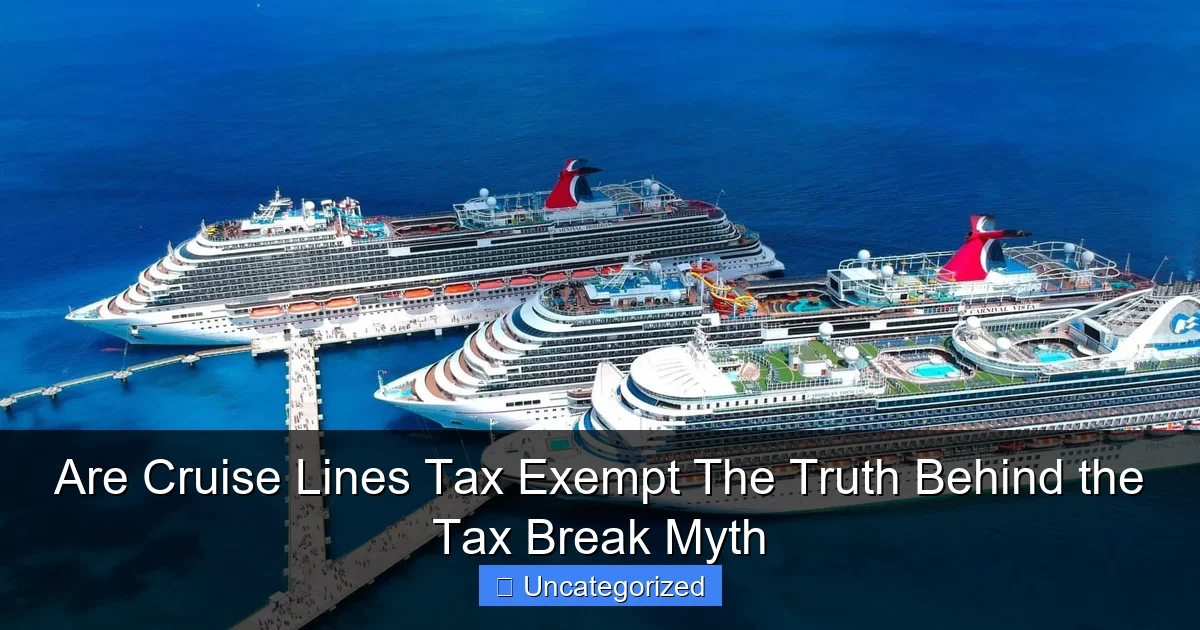
The myth that cruise lines pay no taxes is just that—a myth. While they minimize corporate income tax through legal structures, they do pay taxes in various forms. The key is understanding which taxes apply and where.
Visual guide about are cruise lines tax exempt
Image source: cruiseradio.net
Corporate income tax is the most misunderstood. In the US, for example, cruise lines are subject to the Shipping Tax Act of 1970, which allows foreign-registered ships to operate in US waters without paying US corporate income tax on international voyages. However, they do pay income tax on domestic US operations—such as shore excursions, onboard services, and advertising—if those activities are deemed to have a US nexus. For instance, a cruise that departs from Miami, sells tickets through a US website, and employs US-based sales staff may owe US tax on a portion of its profits.
Payroll, Sales, and Property Taxes
While corporate income tax is minimized, cruise lines are not exempt from other taxes:
- Payroll taxes: Crew members, even if employed by a foreign-registered company, may be subject to payroll taxes in the country where they are paid. US-based crew members on ships registered in Panama still pay US Social Security and Medicare taxes if they’re US citizens or residents.
- Sales and use taxes: Onboard purchases (e.g., drinks, souvenirs, spa services) are often subject to local sales taxes when the ship is in port. In the US, states like Florida and Alaska collect sales tax on goods sold during port calls.
- Property taxes: Cruise terminals, warehouses, and offices on land are taxable real estate. Carnival, for example, owns and operates the Port of Miami terminal, which is subject to Florida property taxes.
Environmental and Regulatory Fees
Modern cruise lines also face growing pressure to pay for their environmental impact. While not traditional taxes, these fees function similarly:
- Port fees and docking charges: Every time a cruise ship docks, it pays fees to the port authority—these are often based on ship size, duration of stay, and passenger count.
- Emissions and carbon taxes: In the EU, cruise ships are subject to the EU Emissions Trading System (ETS) starting in 2024, requiring them to buy carbon allowances for emissions during voyages to or from EU ports.
- Waste disposal fees: Ports like Venice and Barcelona charge cruise lines for waste management, sewage, and water treatment services.
These fees, while not “taxes” in the traditional sense, represent a growing financial burden that reflects society’s demand for environmental accountability.
International Regulations and the Role of the IMO
The International Maritime Organization (IMO) and Tax Neutrality
The International Maritime Organization (IMO) plays a central role in shaping the tax landscape for cruise lines. Established in 1948 under the United Nations, the IMO sets global standards for maritime safety, environmental protection, and legal frameworks. One of its key principles is tax neutrality—ensuring that ships aren’t unfairly taxed by multiple countries for the same activity.
This principle supports the use of flag states for tax jurisdiction. According to IMO guidelines, a ship’s tax obligations are primarily determined by its flag state, not the countries it visits. This prevents port states from imposing income taxes on foreign-registered vessels. For example, a Norwegian-flagged ship cruising the Caribbean can’t be taxed by Jamaica or the Dominican Republic on income earned during the voyage—only by Norway.
Challenges and Criticisms of the Current System
While the IMO’s framework promotes consistency, it has been widely criticized for enabling tax avoidance. Advocacy groups like Tax Justice Network and Oxfam argue that the flag of convenience system allows companies to exploit regulatory gaps and avoid contributing to the economies they profit from.
For instance, a cruise ship may:
- Register in Liberia (a country with no corporate tax).
- Depart from Miami (US).
- Visit ports in Mexico, the Caribbean, and Canada.
- Generate revenue from passengers from dozens of countries.
Yet, the only jurisdiction with a clear claim to tax the income is Liberia—which collects nothing. The countries that host ports, provide emergency services, and benefit (or suffer) from the economic and environmental impact of cruise tourism get no direct tax revenue from the core business activity.
Recent Reforms and the Push for Fairer Taxation
In response to these concerns, there’s a growing movement to reform international maritime taxation. The OECD’s Base Erosion and Profit Shifting (BEPS) project has included shipping in its scope, urging countries to close loopholes and ensure that economic activity is taxed where value is created.
Some countries are taking unilateral action:
- Norway requires ships operating in its waters to pay a tonnage tax, even if registered abroad.
- Australia has proposed a “cruise tax” on foreign-flagged ships, though it faces legal challenges.
- The European Union is expanding its ETS to include maritime emissions, effectively creating a carbon tax on cruise lines.
These efforts signal a shift toward greater accountability, though global consensus remains elusive.
Real-World Examples: How Major Cruise Lines Handle Taxes
Carnival Corporation: The Panama Playbook
Carnival Corporation, with over 90 ships and $20 billion in annual revenue, is a case study in tax optimization. Incorporated in Panama, Carnival registers most of its ships under the Panamanian flag. This allows it to avoid corporate income tax on international voyages.
However, Carnival does pay taxes in key markets:
- US-based subsidiaries pay federal and state taxes on domestic operations.
- UK-based Carnival plc pays UK corporation tax.
- Port fees and sales taxes are collected in every country it visits.
According to Carnival’s 2022 annual report, the company paid $1.1 billion in taxes and fees worldwide—mostly in the form of payroll, sales, and port charges, not corporate income tax.
Royal Caribbean: The Liberian Advantage
Royal Caribbean Group, incorporated in Liberia, uses a similar model. Its parent company pays no corporate tax, but its US subsidiary, Royal Caribbean International, pays taxes on US-source income. In 2023, Royal Caribbean paid $850 million in taxes, including $320 million in payroll taxes and $210 million in port and regulatory fees.
One innovative strategy: Royal Caribbean has invested in private island destinations (e.g., CocoCay in the Bahamas). These islands are owned by the company and generate revenue from shore excursions, food, and entertainment. Because the islands are in the Bahamas, income from these activities is taxed at low rates—or not at all—further reducing the company’s global tax burden.
Norwegian Cruise Line: Bermuda’s Zero-Rate Haven
Norwegian Cruise Line Holdings, based in Bermuda, operates under a zero corporate tax regime. However, like its peers, it pays substantial indirect taxes. In 2022, the company reported $600 million in tax and fee payments, including $250 million in US payroll taxes and $180 million in port fees.
A unique challenge: Norwegian has faced lawsuits in the US over whether its corporate structure constitutes tax evasion. While courts have ruled that the structure is legal, the controversy highlights the tension between tax minimization and public perception.
What This Means for Travelers, Ports, and the Environment
For Travelers: Should You Care?
As a traveler, the tax status of cruise lines may seem irrelevant—but it’s not. When cruise companies minimize taxes, they can afford to offer lower ticket prices, more onboard amenities, and aggressive marketing. This benefits consumers in the short term.
However, there are downsides:
- Overcrowding: Low taxes allow more ships, leading to overtourism in fragile ecosystems (e.g., Venice, Santorini).
- Environmental cost: Tax savings may delay investment in cleaner technologies.
- Local economic impact: Ports may receive fees, but the bulk of revenue goes to the cruise line, not local businesses.
Tip: If you’re concerned about tax fairness, consider supporting cruise lines that are transparent about their tax practices or that invest in sustainable tourism. Look for companies that publish annual tax reports or participate in carbon offset programs.
For Port Communities: The Double-Edged Sword
For port cities, cruise tourism brings jobs and revenue—but not always in the way they expect. While cruise lines pay docking fees and sales taxes, they often bring their own food, supplies, and even staff. Local businesses may see a surge in foot traffic, but they don’t benefit from the core revenue stream: ticket sales.
Some ports are fighting back:
- Barcelona has capped the number of cruise ships allowed per day.
- Venice banned large cruise ships from its historic center in 2021.
- Key West, Florida passed a referendum to limit cruise ship size and frequency.
These actions reflect a growing demand for fairer revenue sharing and environmental protection.
Environmental Implications: Who Pays for Pollution?
Cruise ships are major polluters—emitting sulfur dioxide, nitrogen oxides, and carbon dioxide. While new regulations like the IMO’s 2020 sulfur cap and the EU’s ETS are pushing for cleaner operations, the cost of compliance is high.
When cruise lines save on taxes, they may have more capital to invest in green technologies—but they may also lack the incentive to do so. The absence of a global carbon tax on maritime transport means that the environmental cost is largely externalized—borne by the planet and local communities, not the cruise companies.
Data Table: Cruise Line Tax Payments (2022-2023)
| Cruise Line | Parent Country | Corporate Income Tax Rate | Total Tax & Fees Paid (USD) | Breakdown |
|---|---|---|---|---|
| Carnival Corporation | Panama | 0% (on int’l income) | $1.1 billion | Payroll: $480M, Port Fees: $350M, Sales Tax: $150M, Other: $120M |
| Royal Caribbean Group | Liberia | 0% | $850 million | Payroll: $320M, Port Fees: $210M, Sales Tax: $180M, Other: $140M |
| Norwegian Cruise Line | Bermuda | 0% | $600 million | Payroll: $250M, Port Fees: $180M, Sales Tax: $100M, Other: $70M |
| MSC Cruises | Switzerland | 12-15% (Swiss rates) | $720 million | Corporate Tax: $200M, Payroll: $280M, Port Fees: $150M, Other: $90M |
Conclusion: The Myth, the Reality, and the Way Forward
So, are cruise lines tax exempt? The answer is a resounding no—but they are certainly tax-optimized. Through a combination of international law, corporate structuring, and jurisdictional strategy, cruise lines have legally minimized their corporate income tax burden. However, they do pay substantial indirect taxes: payroll, sales, port fees, and environmental charges. The myth of total tax exemption persists because the public sees the absence of corporate income tax as a loophole—and in many ways, it is.
The cruise industry’s tax practices reflect a broader issue in global capitalism: the tension between legal tax minimization and ethical responsibility. While cruise lines aren’t breaking the law, they’re operating in a system that allows them to profit from global tourism while contributing minimally to the economies and environments they depend on.
The path forward requires international cooperation. Reforms like a global maritime carbon tax, fairer revenue-sharing models for port communities, and stricter enforcement of anti-profit-shifting rules can help level the playing field. As travelers, we can also play a role—by supporting companies that prioritize transparency and sustainability, and by advocating for policies that ensure the cruise industry pays its fair share.
The ocean is a shared resource. It’s time the tax system reflected that truth.
Frequently Asked Questions
Are cruise lines tax exempt under international law?
Cruise lines are not universally tax exempt, but they often benefit from tax advantages due to international maritime laws. Many register ships under “flags of convenience” (like Panama or Liberia), which offer lower tax rates and regulatory benefits.
Why do cruise lines seem to pay little in taxes?
Cruise lines leverage legal tax structures, including foreign incorporation, offshore subsidiaries, and operating in international waters, to minimize taxable income. These strategies reduce their effective tax rate but don’t make them fully tax exempt.
Do cruise lines pay U.S. taxes if they sail from American ports?
Even when departing from U.S. ports, cruise lines may avoid federal income taxes if they operate foreign-flagged ships. However, they still pay local taxes (e.g., port fees, sales taxes) in the cities they visit.
Are cruise lines tax exempt on passenger ticket sales?
No, cruise lines collect and remit sales taxes on tickets sold within U.S. jurisdictions. However, portions of the fare tied to international voyages may be excluded from state/local taxes under federal maritime rules.
How do cruise lines use tax havens to their advantage?
By incorporating in tax haven countries, cruise lines defer or reduce corporate income taxes on global profits. This common practice is legal but often fuels the myth of blanket tax exemption.
Does the tax-exempt status apply to cruise line employees?
No, crew members pay income taxes based on their country of residence or citizenship. While cruise lines may withhold taxes, their employees aren’t covered by any cruise line tax exemption policies.