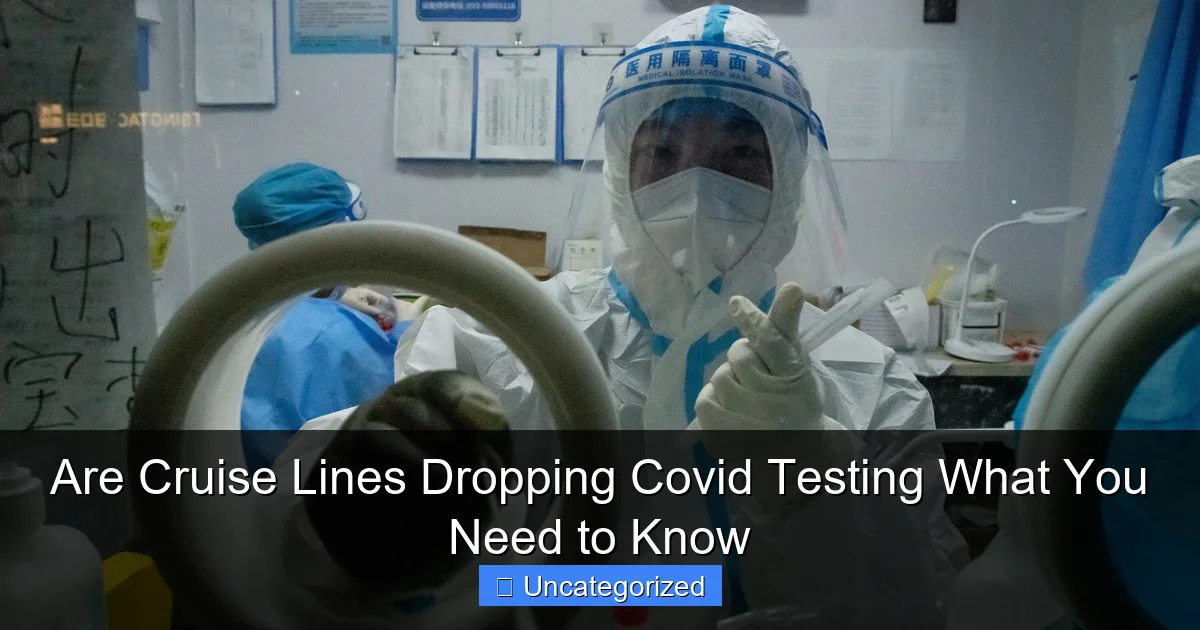
Featured image for are cruise lines dropping covid testing
Image source: static01.nyt.com
Many major cruise lines are dropping pre-departure Covid testing requirements as of 2023, aligning with relaxed global health guidelines and increasing passenger demand. This shift makes cruising more accessible, though some destinations and sailings may still require tests—always check your cruise line’s latest policy before booking.
Key Takeaways
- Many cruise lines now skip pre-trip testing. Check each line’s current policy before booking.
- Vaccination rules still apply on most voyages. Carry proof of vaccination to avoid entry issues.
- Onboard outbreaks may trigger sudden testing mandates. Pack rapid tests for unexpected requirements.
- Shore excursions can enforce independent testing rules. Research destination-specific health protocols early.
- Unvaccinated travelers face stricter testing requirements. Expect frequent tests if not fully vaccinated.
📑 Table of Contents
- The Cruise Comeback: Are Cruise Lines Dropping Covid Testing?
- Why Cruise Lines Initially Required Covid Testing
- Current Status: Which Cruise Lines Are Dropping Covid Testing?
- Factors Influencing Cruise Lines’ Testing Policies
- What This Means for Passengers: Practical Tips and Considerations
- Regional Variations and Future Outlook
- Conclusion: Navigating the New Era of Cruise Travel
- Current Cruise Line Testing Policies (2024)
The Cruise Comeback: Are Cruise Lines Dropping Covid Testing?
For over two years, the cruise industry navigated uncharted waters, grappling with pandemic-related restrictions, health mandates, and shifting traveler expectations. One of the most significant changes during this time was the introduction of mandatory Covid testing for all passengers and crew before boarding, during voyages, and upon disembarkation. These protocols, once seen as temporary measures, became the new normal—until now. As global health conditions improve and governments lift public health restrictions, travelers are asking: Are cruise lines dropping Covid testing?
The answer is nuanced. While some cruise lines have relaxed or eliminated pre-departure testing, others continue to require it—especially for specific itineraries, high-risk destinations, or unvaccinated passengers. The landscape is evolving rapidly, influenced by international regulations, regional outbreaks, and individual company policies. For anyone planning a cruise in 2024 or beyond, understanding these changes is critical to avoid last-minute surprises, denied boarding, or unexpected costs. This comprehensive guide explores the current state of Covid testing on cruise ships, what’s changed, what remains, and what you need to know before setting sail.
Why Cruise Lines Initially Required Covid Testing
When the pandemic halted global cruise operations in 2020, the industry faced existential threats. Ships became hotspots for outbreaks due to confined spaces, shared ventilation systems, and high passenger turnover. To restart safely, cruise lines collaborated with health authorities like the CDC, WHO, and local governments to implement strict health protocols. Among the most visible and impactful of these measures was mandatory Covid testing.

Visual guide about are cruise lines dropping covid testing
Image source: a57.foxnews.com
The Role of Testing in Early Reopening Phases
In 2021 and early 2022, most major cruise lines—including Carnival, Royal Caribbean, Norwegian, and Princess—required all adult passengers to be fully vaccinated and to provide a negative PCR or antigen test taken within 2–3 days of embarkation. These requirements were often more stringent than land-based travel rules. The goal was twofold: prevent outbreaks onboard and rebuild consumer confidence.
- Pre-departure testing helped screen out infected individuals before they boarded.
- Onboard surveillance testing was used for crew members to catch asymptomatic cases early.
- Post-cruise testing was required in some destinations (e.g., Caribbean islands) for re-entry.
For example, Royal Caribbean’s “Cruise with Confidence” program in 2021 mandated PCR testing for all passengers, with rapid antigen tests available on board for symptomatic individuals. The CDC’s Conditional Sailing Order also required cruise lines to follow strict testing and quarantine protocols to operate in U.S. waters.
Public Health vs. Passenger Experience
While testing was essential for safety, it came with trade-offs. Passengers faced logistical hurdles: finding approved testing centers, paying for tests (often $100+ per person), and managing timing. Some missed their sailings due to delayed test results. Cruise lines invested heavily in on-site testing facilities at terminals to streamline the process. Carnival, for instance, partnered with local labs in Miami, Seattle, and Galveston to offer rapid PCR tests for $98 per person.
Despite the challenges, these measures were largely effective. According to the Cruise Lines International Association (CLIA), only 0.01% of passengers tested positive for Covid during the first 18 months of resumption (2021–2022). This success helped justify the continuation of testing—but also set the stage for its eventual relaxation.
Current Status: Which Cruise Lines Are Dropping Covid Testing?
As of 2024, the cruise industry is in a transitional phase. Many lines have dropped or modified their pre-departure testing requirements, but policies vary widely by brand, region, and itinerary. Here’s a breakdown of the current landscape.
Major Cruise Lines That No Longer Require Pre-Departure Testing
- Carnival Cruise Line: As of May 2023, Carnival eliminated pre-departure testing for vaccinated passengers on most U.S.-based cruises. However, unvaccinated passengers (e.g., children under 5) must still provide a negative test within 2 days of embarkation.
- Royal Caribbean International: Dropped pre-departure testing for vaccinated guests on sailings from the U.S., Canada, and the Caribbean in April 2023. Unvaccinated passengers must test negative within 3 days of boarding.
- Norwegian Cruise Line (NCL): Removed testing for vaccinated guests in March 2023. Unvaccinated travelers must test within 2 days and provide proof of travel insurance covering medical evacuation.
- MSC Cruises: No pre-departure testing for vaccinated guests on most sailings. Unvaccinated passengers must test within 2 days and carry travel insurance.
These changes apply primarily to short-haul cruises (3–7 days) in the Caribbean, Alaska, and the Mediterranean. Longer voyages or those visiting high-risk regions may still have testing mandates.
Cruise Lines with Conditional or Regional Testing Rules
Some lines maintain testing requirements based on destination or itinerary length:
- Princess Cruises: No pre-departure testing for vaccinated passengers on U.S. cruises, but testing required for transatlantic or world cruises due to port entry rules.
- Holland America Line: Testing waived for vaccinated guests on most sailings, but required for unvaccinated passengers and for cruises to Australia, New Zealand, and certain South American countries.
- Celebrity Cruises: Follows Royal Caribbean’s policy (no testing for vaccinated guests), but enforces testing for unvaccinated passengers on cruises longer than 10 nights.
For example, a 14-night Celebrity cruise from Barcelona to Istanbul in 2024 requires all unvaccinated passengers to test negative within 3 days of boarding, even if vaccinated guests are exempt.
Exceptions for Unvaccinated and High-Risk Travelers
While testing is being dropped for vaccinated guests, unvaccinated travelers still face hurdles. Most lines require:
- A negative test within 1–3 days of embarkation.
- Proof of travel insurance with Covid coverage (e.g., $100,000+ medical evacuation).
- Possible quarantine or isolation if symptoms develop onboard.
Some lines, like Disney Cruise Line, have reinstated vaccination requirements for all guests over 5, effectively eliminating the unvaccinated category. This means even if testing is dropped, unvaccinated travelers may not be allowed to sail.
Factors Influencing Cruise Lines’ Testing Policies
Why are cruise lines dropping testing now? The shift isn’t arbitrary—it’s driven by a mix of health, economic, and regulatory factors.
Global Health Improvements and Vaccination Rates
By mid-2023, over 70% of the global population had received at least one Covid vaccine dose, according to the WHO. Severe illness and hospitalization rates dropped significantly, reducing the risk of outbreaks onboard. Cruise lines now view Covid as a manageable risk rather than an existential threat.
Additionally, most cruise passengers are vaccinated. CLIA reports that 95% of cruisers in 2023 were fully vaccinated, minimizing the need for universal testing.
Changes in International Travel Regulations
Many countries have lifted entry requirements. For example:
- The U.S. ended its pre-arrival testing rule for international air travelers in June 2022.
- The EU removed Covid testing and vaccination requirements for entry in 2023.
- Caribbean nations like Jamaica and the Bahamas no longer require tests for cruise passengers.
With fewer port-of-call restrictions, cruise lines can relax their own policies without risking itinerary disruptions.
Economic Pressures and Competitive Advantage
Covid testing added significant costs:
- $100–$200 per passenger for PCR tests.
- Staff and logistics for on-site testing at terminals.
- Refunds for passengers who test positive and miss their cruise.
By dropping testing, cruise lines reduce operational costs and make cruising more accessible. It also levels the playing field with land-based vacations, which rarely require testing.
For example, Royal Caribbean reported a 15% increase in booking volume after eliminating pre-departure testing in 2023, suggesting travelers prefer hassle-free experiences.
Passenger Feedback and Experience
Surveys show that testing was the #1 complaint among cruisers in 2022. A CLIA study found that 68% of travelers cited “no need to test” as a key factor in choosing a cruise line. To attract families, seniors, and budget-conscious travelers, lines are prioritizing convenience over caution.
What This Means for Passengers: Practical Tips and Considerations
The relaxation of testing rules doesn’t mean Covid is gone—it means the approach has shifted. Passengers must now take more responsibility for their health. Here’s how to navigate the new normal.
Check the Fine Print Before Booking
Never assume a cruise is “test-free.” Policies can change with little notice. Always:
- Review the cruise line’s health and safety guidelines on their website.
- Confirm testing rules for your specific itinerary (e.g., a 5-day Bahamas cruise vs. a 12-day Alaska voyage).
- Contact customer service if unsure—don’t rely on third-party booking sites.
Example: A family booking a 7-day Carnival cruise to Cozumel in 2024 can skip testing if all adults are vaccinated. But if one child is unvaccinated, they’ll need a negative test within 2 days of boarding.
Prepare for Onboard Testing (If Needed)
Even if pre-departure testing is waived, cruise lines may require tests in certain situations:
- If you develop Covid symptoms (fever, cough, loss of taste/smell).
- If a close contact (e.g., roommate) tests positive.
- If visiting a destination with active outbreaks (e.g., South Africa, India).
Onboard testing is typically free but may require quarantine. For example, Norwegian Cruise Line offers rapid antigen tests for symptomatic guests. If positive, you’ll be isolated and may need to disembark early at the next port.
Travel Insurance Is More Important Than Ever
Without mandatory testing, the risk of onboard outbreaks increases. Travel insurance can cover:
- Medical expenses if you get sick.
- Trip interruption (e.g., if you’re quarantined mid-cruise).
- Repatriation or medical evacuation.
Choose a policy that specifically covers Covid-related incidents. Companies like Allianz, Travel Guard, and Seven Corners offer “cancel for any reason” (CFAR) add-ons for extra flexibility.
Stay Informed During the Cruise
Monitor your health and follow onboard protocols:
- Wash hands frequently and use sanitizer stations.
- Wear masks in crowded areas if you’re high-risk (e.g., over 65, immunocompromised).
- Report symptoms immediately to the medical center.
Royal Caribbean, for instance, has upgraded its medical centers with PCR testing capabilities and isolation cabins.
Regional Variations and Future Outlook
Covid testing policies aren’t uniform across the globe. Where you sail matters as much as which line you choose.
North America (U.S. & Canada)
Most major lines have dropped pre-departure testing for vaccinated passengers on short cruises. However, unvaccinated travelers still face testing and insurance requirements. Alaska cruises are fully open, with no testing needed for vaccinated guests.
Europe and Mediterranean
Testing is largely waived, but some countries (e.g., Greece, Italy) may require tests for unvaccinated visitors. Long-haul cruises (e.g., 10+ nights) often have stricter rules. MSC Cruises, for example, requires testing for unvaccinated passengers on 14-night Mediterranean voyages.
Asia, Australia, and New Zealand
More cautious. Australia requires all cruise passengers to be vaccinated, and unvaccinated travelers must test within 24 hours of boarding. Japan reopened to cruising in 2023 but still requires testing for unvaccinated visitors.
Future Trends: Will Testing Return?
Experts predict that testing will remain optional or situational for the foreseeable future. However, cruise lines are preparing for:
- Surge protocols: Rapid testing kits on board for outbreaks.
- Regional flexibility: Adjusting policies based on destination health data.
- Digital health apps: Apps like Royal Caribbean’s “Cruise Planner” may integrate real-time health alerts.
A 2023 CLIA report suggests that 80% of cruise lines will maintain “on-demand” testing capabilities, even if not required upfront.
Conclusion: Navigating the New Era of Cruise Travel
The era of mandatory pre-departure Covid testing on cruise ships is fading, but it’s not gone entirely. While most vaccinated passengers on short, regional cruises can now skip testing, unvaccinated travelers, long-haul voyages, and high-risk destinations still require caution. The cruise industry’s shift reflects a broader transition from emergency response to risk management.
For travelers, the message is clear: Stay informed, stay prepared, and stay flexible. Always verify testing requirements for your specific cruise, invest in travel insurance, and monitor your health before and during the voyage. The days of universal testing may be over, but personal responsibility is more important than ever.
As the industry continues to adapt, one thing is certain: cruising is back—and it’s more accessible, enjoyable, and resilient than ever. Whether you’re planning a Caribbean getaway or a transatlantic adventure, the open sea awaits. Just pack your swimsuit, your vaccine card, and a sense of adventure.
Current Cruise Line Testing Policies (2024)
| Cruise Line | Pre-Departure Testing (Vaccinated) | Pre-Departure Testing (Unvaccinated) | Onboard Testing | Notes |
|---|---|---|---|---|
| Carnival | No (most U.S. cruises) | Yes (within 2 days) | Yes (symptomatic) | Unvaccinated must have travel insurance |
| Royal Caribbean | No (U.S./Caribbean) | Yes (within 3 days) | Yes (PCR available) | Testing for cruises >10 nights if unvaccinated |
| Norwegian | No | Yes (within 2 days) | Yes (rapid antigen) | Insurance required for unvaccinated |
| MSC | No (most sailings) | Yes (within 2 days) | Yes (symptomatic) | Testing for long-haul cruises |
| Princess | No (U.S. cruises) | Yes (within 2 days) | Yes (PCR) | Testing required for transatlantic voyages |
| Disney | Yes (all guests over 5 must be vaccinated) | N/A (no unvaccinated allowed) | Yes (symptomatic) | Strict vaccination policy |
Frequently Asked Questions
Are cruise lines dropping Covid testing requirements in 2024?
Many major cruise lines have dropped pre-departure Covid testing for vaccinated passengers, but policies vary by destination and ship. Always check your specific cruise line’s rules before booking.
Do I still need a Covid test to go on a cruise?
Most cruise lines no longer require Covid testing for vaccinated travelers, though unvaccinated passengers may still face testing rules. Exceptions exist for high-risk itineraries or countries with local mandates.
Which cruise lines have completely dropped Covid testing?
Carnival, Royal Caribbean, and Norwegian Cruise Line have eliminated routine pre-cruise testing for vaccinated guests. However, “cruise lines dropping Covid testing” policies may still apply to certain voyages, like repositioning cruises.
Can I cruise without a Covid test if I’m unvaccinated?
Unvaccinated travelers often still need to show negative test results, though some lines have relaxed this. A few cruise lines allow unvaccinated kids to sail without testing if accompanied by vaccinated adults.
Why are cruise lines removing Covid testing rules?
Cruise lines are aligning with global travel trends as pandemic restrictions ease. Reduced case numbers and high onboard vaccination rates make testing less critical for health safety.
Do I need to pack a Covid test for my cruise?
While pre-cruise testing is rarely required, bringing rapid tests is wise for emergencies or unexpected illness. Some cruise lines may offer onboard testing for symptomatic passengers at a cost.