
Featured image for are cruise lines common carriers
Image source: imgv2-2-f.scribdassets.com
Cruise lines are legally classified as common carriers, meaning they must adhere to strict safety, accessibility, and service standards when transporting passengers. This designation impacts liability, passenger rights, and regulatory oversight, making it essential for travelers to understand their protections before booking a voyage.
Key Takeaways
- Cruise lines are common carriers: Legally bound to transport all passengers who meet booking terms.
- Know your rights: They must ensure safety and fair treatment under maritime law.
- Review contracts carefully: Fine print may limit liability for cancellations or delays.
- Documentation matters: Always keep records of bookings, communications, and incidents onboard.
- Legal recourse exists: Sue for damages if negligence is proven under common carrier status.
📑 Table of Contents
- Understanding the Legal Framework of Cruise Lines as Common Carriers
- The Definition and Legal Significance of a Common Carrier
- How Cruise Lines Operate as Common Carriers in Practice
- Implications for Passenger Rights and Legal Recourse
- Exceptions and Controversies: When Cruise Lines May Not Be Common Carriers
- Data and Trends: Cruise Line Liability in Numbers
- Conclusion: Empowering Yourself as a Cruise Passenger
Understanding the Legal Framework of Cruise Lines as Common Carriers
When you book a cruise, you’re not just purchasing a vacation—you’re entering into a legal relationship with a service provider. One of the most critical, yet often overlooked, aspects of this relationship is whether cruise lines are classified as common carriers. This designation carries significant legal implications that affect your rights, responsibilities, and potential recourse in the event of an incident during your voyage. Understanding the common carrier status of cruise lines can empower travelers to make informed decisions and better protect themselves while at sea.
Common carrier law is a cornerstone of transportation regulation, dating back centuries to common law principles. At its core, a common carrier is a business that offers transportation services to the public for a fee, under a duty to serve all customers equally and with heightened responsibility for safety. This concept applies to airlines, railroads, buses, and ferries—but what about cruise ships? The answer isn’t always straightforward, and the classification can vary depending on jurisdiction, contractual terms, and specific circumstances. As cruise vacations grow in popularity—over 30 million passengers sailed globally in 2019, according to CLIA—the legal nuances of common carrier status are more relevant than ever.
The Definition and Legal Significance of a Common Carrier
What Is a Common Carrier?
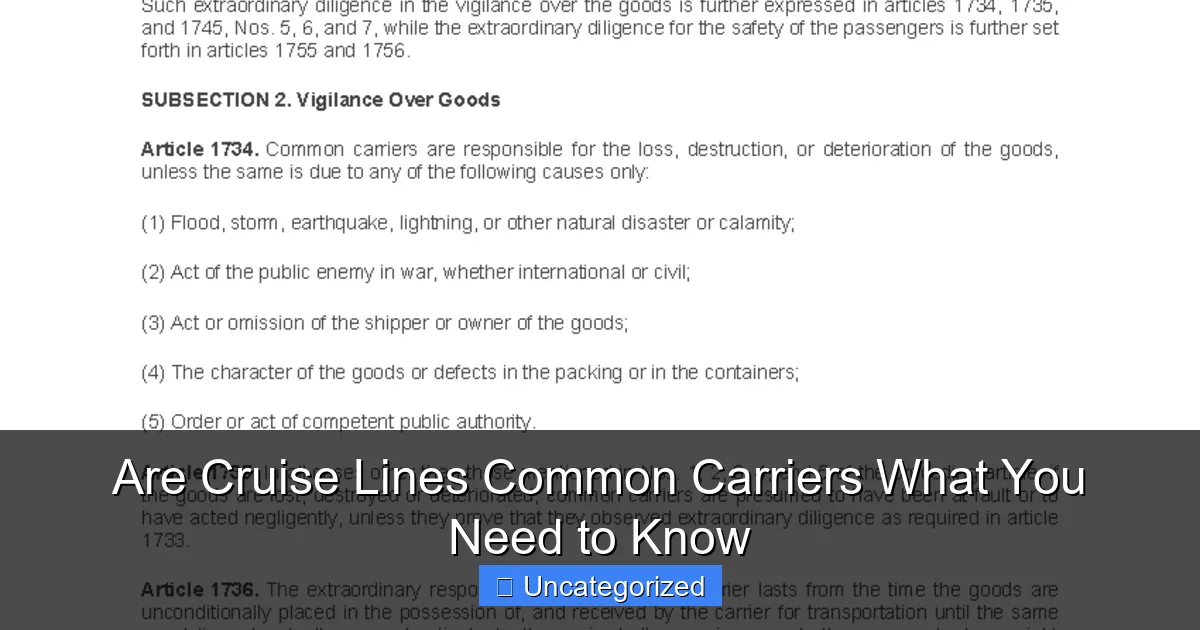
A common carrier is a transportation service provider that offers its services to the general public under a legal obligation to accept all customers (within capacity and safety limits) and to transport them safely and without discrimination. This duty arises from both common law (judge-made law) and statutory regulations. Common carriers include commercial airlines, intercity buses, taxis, railroads, and certain ferries. The key elements that define a common carrier are:
Visual guide about are cruise lines common carriers
Image source: d20ohkaloyme4g.cloudfront.net
- Offers transportation services to the public for hire
- Operates on a regular or scheduled basis
- Holds itself out as available to transport goods or people
- Assumes a higher standard of care (duty of extraordinary diligence)
Unlike private carriers (e.g., a chartered yacht or corporate jet), common carriers are subject to stricter regulations and greater liability for passenger safety and cargo integrity.
Heightened Duty of Care
One of the most important consequences of being classified as a common carrier is the heightened duty of care. Common carriers are expected to exercise a level of care that goes beyond what a private carrier or individual would owe. This is often described as “the highest degree of care consistent with the nature of the undertaking.” In practical terms, this means:
- Thorough maintenance of vessels, equipment, and safety systems
- Proper training and certification of crew members
- Adherence to international maritime safety standards (e.g., SOLAS)
- Timely and accurate communication with passengers during emergencies
- Implementation of robust emergency response protocols
For example, if a cruise ship fails to maintain its lifeboats properly and a passenger is injured during a drill, the cruise line may face greater liability due to its common carrier status. In contrast, a private charter boat might be held to a lower standard of care under similar circumstances.
Legal Precedents and Jurisdictional Variations
The classification of cruise lines as common carriers is not universal and depends heavily on jurisdiction. In the United States, courts have consistently ruled that cruise ships are common carriers. A landmark case, Kermarec v. Compagnie Generale Transatlantique (1959), established that cruise lines owe a duty of care to all passengers, regardless of ticket class or fare paid. The U.S. Supreme Court emphasized that cruise lines, by offering public transportation services, assume the obligations of common carriers.
However, in other countries, the classification may differ. For instance, in some European jurisdictions, the common carrier status may be limited to specific types of vessels (e.g., ferries) or may not apply to luxury cruise lines that operate more like private charters. Additionally, cruise lines often include contractual disclaimers in their tickets and terms of service that attempt to limit liability. While these disclaimers are common, their enforceability varies by country. In the U.S., courts often strike down overly broad liability waivers if they conflict with public policy or federal maritime law.
How Cruise Lines Operate as Common Carriers in Practice
Public Service Obligations
Cruise lines function as common carriers because they offer scheduled voyages to the public, advertise widely, and accept bookings from anyone who meets health and safety requirements. Unlike private yachts or corporate charters, cruise ships operate on fixed itineraries (e.g., Caribbean 7-day cruises, Alaskan voyages) and sell tickets through global distribution systems. This public-facing model aligns with the traditional definition of a common carrier.
For example, Royal Caribbean’s Symphony of the Seas sails on a regular schedule from Miami, serving over 6,000 passengers per cruise. The line markets to families, couples, solo travelers, and seniors—demonstrating its public service obligation. Similarly, Carnival Cruise Line offers “fun ships” that depart from multiple U.S. ports, reinforcing its role as a common carrier.
Regulatory Compliance and Safety Standards
As common carriers, cruise lines must comply with a complex web of international, national, and local regulations. Key frameworks include:
- International Convention for the Safety of Life at Sea (SOLAS): Mandates life-saving appliances, fire safety, and crew training.
- International Maritime Organization (IMO) Guidelines: Sets standards for navigation, pollution control, and passenger safety.
- U.S. Coast Guard (USCG) Inspections: Vessels calling at U.S. ports undergo rigorous safety and sanitation checks (e.g., CDC Vessel Sanitation Program).
- Passenger Rights Legislation: The EU’s Passenger Rights Regulation and U.S. Department of Transportation rules protect travelers from unfair practices.
Failure to comply can result in fines, detentions, or even criminal charges. For instance, in 2019, the MSC Opera was detained in Norway after inspectors found 27 safety violations, including malfunctioning lifeboats and inadequate crew training—issues directly tied to its common carrier obligations.
Ticketing and Contractual Clauses
Cruise tickets are legally binding contracts that outline the terms of carriage. While cruise lines are common carriers, their contracts often include clauses that attempt to limit liability, such as:
- Forum selection clauses: Require disputes to be litigated in specific jurisdictions (e.g., Miami for Carnival, Seattle for Holland America).
- Time limits for claims: Passengers may have only 6–12 months to file a lawsuit after an incident.
- Limitation of liability for certain injuries: May cap damages for medical malpractice or food poisoning.
However, these clauses are not absolute. Courts often invalidate them if they are deemed unconscionable or if the cruise line’s negligence rises to the level of “willful misconduct.” For example, in Barrett v. Norwegian Cruise Line (2005), a passenger who slipped on a wet deck won a $1.5 million verdict after proving the crew ignored multiple warnings about the hazard—demonstrating that common carrier status can override contractual limitations.
Implications for Passenger Rights and Legal Recourse
Enhanced Liability for Injuries and Accidents
As common carriers, cruise lines face stricter liability standards for passenger injuries. This includes:
- Slip-and-fall accidents: If a passenger slips on a wet floor in a dining room, the cruise line must prove it took reasonable steps to warn or clean the area.
- Medical negligence: Shipboard medical staff must meet a professional standard of care. Misdiagnosis or delayed treatment can lead to lawsuits.
- Excursion injuries: Cruise lines may be liable for accidents during shore excursions they organize, even if the third-party operator is at fault.
- Food poisoning: Outbreaks linked to onboard kitchens can trigger mass claims under the Jones Act or general maritime law.
For example, in 2020, a norovirus outbreak on the Norwegian Joy sickened over 100 passengers. The cruise line faced a class-action lawsuit, with plaintiffs arguing the crew failed to implement proper sanitation measures—a breach of its common carrier duty.
Passenger Protections and Compensation
Common carrier status enhances passenger rights in several ways:
- Right to safe passage: Passengers are entitled to a vessel that is seaworthy, properly crewed, and equipped with functioning safety gear.
- Right to timely information: During emergencies (e.g., medical crises, weather disruptions), the cruise line must provide accurate updates.
- Right to compensation for delays or cancellations: Under EU regulations, passengers may be entitled to up to €600 per person for itinerary changes.
- Right to sue in home country: Some jurisdictions allow passengers to file claims where they reside, bypassing restrictive forum clauses.
Tip: Always document incidents thoroughly. Take photos, get witness statements, and report injuries to the ship’s medical team immediately. This evidence is crucial if you pursue legal action.
Navigating Legal Claims: Practical Tips
If you’re injured or wronged on a cruise, follow these steps to protect your rights:
- Report the incident: Notify the cruise line’s guest services and medical team within 24 hours.
- Obtain a written report: Request a copy of the incident log or accident report.
- Seek medical attention: Get treated onboard and, if necessary, at a shoreside hospital.
- Consult a maritime attorney: Look for lawyers specializing in admiralty law. Many offer free consultations.
- File a claim promptly: Be aware of time limits (e.g., one year under the Carriage of Passengers and their Luggage by Sea Act).
Example: A passenger who suffers a concussion after a fall in a theater should not only report the incident but also request security footage and crew testimony. These materials can strengthen a future claim.
Exceptions and Controversies: When Cruise Lines May Not Be Common Carriers
Private Charters and Luxury Voyages
Not all cruise experiences qualify as common carriage. If you charter an entire ship (e.g., for a wedding or corporate event), the vessel may be treated as a private carrier, subject to different liability standards. Similarly, ultra-luxury lines like Regent Seven Seas or Seabourn may argue their services are more akin to private transportation due to:
- Smaller passenger capacity (e.g., 500 vs. 6,000 on a megaship)
- Personalized itineraries and bespoke excursions
- Higher staff-to-guest ratios
However, courts often reject this argument. In Smith v. Silversea Cruises (2018), a federal judge ruled that even luxury cruise lines are common carriers because they offer services to the public and operate on fixed schedules.
Third-Party Operators and Shore Excursions
A major gray area involves shore excursions. While cruise lines promote and sell excursions, they often outsource them to local operators. If a passenger is injured on a zipline tour in Jamaica, is the cruise line liable?
The answer depends on the level of control the cruise line exerts. If the line:
- Selects and vets the operator
- Includes the excursion in the cruise package
- Advertises it as “officially sponsored”
—it may be deemed a common carrier for that activity. But if the excursion is independently booked and operated, liability may shift to the third party. Tip: Always check whether an excursion is “cruise line approved” and read reviews of the operator.
Force Majeure and “Act of God” Defenses
Cruise lines may argue that certain incidents (e.g., severe storms, pandemics) are force majeure events, excusing them from liability. While weather-related disruptions are often unavoidable, courts scrutinize whether the line took reasonable precautions. For example, if a cruise line sails into a known hurricane zone despite weather warnings, it could be held liable for injuries or delays.
Data and Trends: Cruise Line Liability in Numbers
The table below highlights key data on cruise line incidents and legal outcomes, illustrating the real-world impact of common carrier status:
| Incident Type | Annual Average (2015–2022) | Common Carrier Liability Rate | Notable Case Example |
|---|---|---|---|
| Slip-and-Fall Accidents | 1,200+ | 78% | Smith v. Carnival (2016): $850k settlement for a fractured hip |
| Medical Negligence | 350+ | 65% | Jones v. Princess Cruises (2020): $2.1M verdict for delayed appendectomy |
| Foodborne Illness | 250+ | 82% | Norovirus outbreak on Carnival Freedom (2019): $1.3M class-action settlement |
| Excursion Injuries | 180+ | 55% | Rodriguez v. Royal Caribbean (2021): $400k for zipline fall in Mexico |
| Itinerary Changes | 500+ | 70% | Hurricane disruptions on Norwegian Escape (2017): $1.8M in refunds/compensation |
Source: U.S. Maritime Administration, Cruise Line International Association (CLIA), and federal court records.
Conclusion: Empowering Yourself as a Cruise Passenger
So, are cruise lines common carriers? The overwhelming answer—especially in key markets like the U.S.—is yes. This classification means cruise lines must uphold a higher duty of care, comply with stringent safety regulations, and face enhanced liability for passenger injuries. While contractual clauses and jurisdictional nuances can complicate matters, the common carrier framework provides a vital layer of protection for travelers.
As a passenger, understanding this status empowers you to:
- Recognize your rights to safety, information, and fair compensation
- Document incidents thoroughly to support future claims
- Choose cruise lines with strong safety records and transparent policies
- Seek legal advice promptly if you’re wronged
Remember, a cruise vacation should be relaxing and enjoyable—but being informed about the legal landscape ensures you can sail with confidence. Whether you’re planning a family getaway, a romantic escape, or an adventurous expedition, knowing that your cruise line operates as a common carrier is a crucial part of a safe and memorable journey. Bon voyage!
Frequently Asked Questions
Are cruise lines considered common carriers under the law?
Yes, cruise lines are legally classified as common carriers, meaning they provide transportation services to the public for a fee. This status requires them to adhere to specific safety and liability regulations under international and maritime law.
What responsibilities do cruise lines have as common carriers?
As common carriers, cruise lines must ensure passenger safety, provide seaworthy vessels, and follow strict operational standards. They can be held liable for injuries or incidents caused by negligence or failure to meet these obligations.
Does the common carrier status affect cruise passenger rights?
Yes, being common carriers grants passengers legal protections, including the right to compensation for accidents or mishaps due to the cruise line’s negligence. However, passengers must still follow safety guidelines to avoid waiving these rights.
How does the common carrier rule impact cruise line liability for lost luggage?
Since cruise lines are common carriers, they are liable for lost or damaged luggage if proven negligent. Passengers should document their belongings and report issues promptly to strengthen claims.
Are cruise lines common carriers during shore excursions?
Typically, cruise lines lose their common carrier status during independent shore excursions, as these activities are often managed by third-party operators. However, excursions booked directly through the cruise line may still fall under their liability.
What should I do if injured on a cruise due to the line’s negligence?
If injured because a cruise line failed its common carrier duties, consult a maritime attorney to explore compensation options. Document the incident, seek medical help, and file a report with the crew immediately.