Featured image for are cruise lines a good investment
Image source: i.ytimg.com
Cruise lines can be a strong investment in 2024 and beyond, driven by record post-pandemic demand and rising consumer interest in experiential travel. With major players like Carnival, Royal Caribbean, and Norwegian reporting robust booking volumes and improved pricing power, the industry shows clear signs of sustained recovery and long-term growth potential. However, investors should weigh geopolitical risks, fuel costs, and high capital expenditures before committing.
Key Takeaways
- Cruise lines offer high growth potential post-pandemic as demand rebounds and travel normalizes.
- Evaluate debt levels carefully—many carriers face heavy leverage from pandemic-era borrowing.
- Premium and luxury brands outperform with resilient pricing and loyal customer bases.
- Geopolitical risks impact routes—monitor conflicts affecting Mediterranean and Caribbean demand.
- Sustainability investments are critical to comply with regulations and attract eco-conscious travelers.
- Seasonal volatility affects returns—time investments around booking cycles and peak seasons.
📑 Table of Contents
- The Allure and Reality of Cruise Line Investments in 2024
- 1. Post-Pandemic Recovery: Where the Industry Stands in 2024
- 2. Competitive Landscape: The Big Three and Beyond
- 3. Financial Health: Debt, Liquidity, and Capital Allocation
- 4. Regulatory and Environmental Pressures
- 5. Consumer Trends and Market Risks
- 6. Investment Outlook: Bull and Bear Cases for 2024–2030
The Allure and Reality of Cruise Line Investments in 2024
For decades, cruise lines have captivated travelers with promises of luxury, adventure, and escape from the mundane. From tropical island getaways to transatlantic voyages, the cruise industry has long been a symbol of leisure and indulgence. Yet beyond the glittering onboard amenities and picturesque ports of call, a pressing question emerges for investors: Are cruise lines a good investment in 2024 and beyond? The answer is far from straightforward, as the industry navigates a complex landscape shaped by post-pandemic recovery, evolving consumer preferences, and macroeconomic volatility.
The cruise sector, which saw revenues plummet by over 80% during the COVID-19 crisis, has demonstrated remarkable resilience. In 2023, major players like Carnival Corporation, Royal Caribbean Group, and Norwegian Cruise Line Holdings reported record booking volumes, with some ships operating at 120% capacity due to pent-up demand. However, this resurgence is accompanied by rising operational costs, labor shortages, and environmental scrutiny. As we enter 2024, investors must weigh short-term recovery against long-term sustainability, regulatory risks, and shifting market dynamics. This comprehensive analysis explores the financial, operational, and strategic factors that determine whether cruise lines represent a sound investment opportunity in the current climate.
1. Post-Pandemic Recovery: Where the Industry Stands in 2024
The cruise industry’s recovery from the pandemic has been both swift and uneven. After a near-total shutdown in 2020–2021, the sector has rebounded with surprising vigor, but challenges persist beneath the surface.
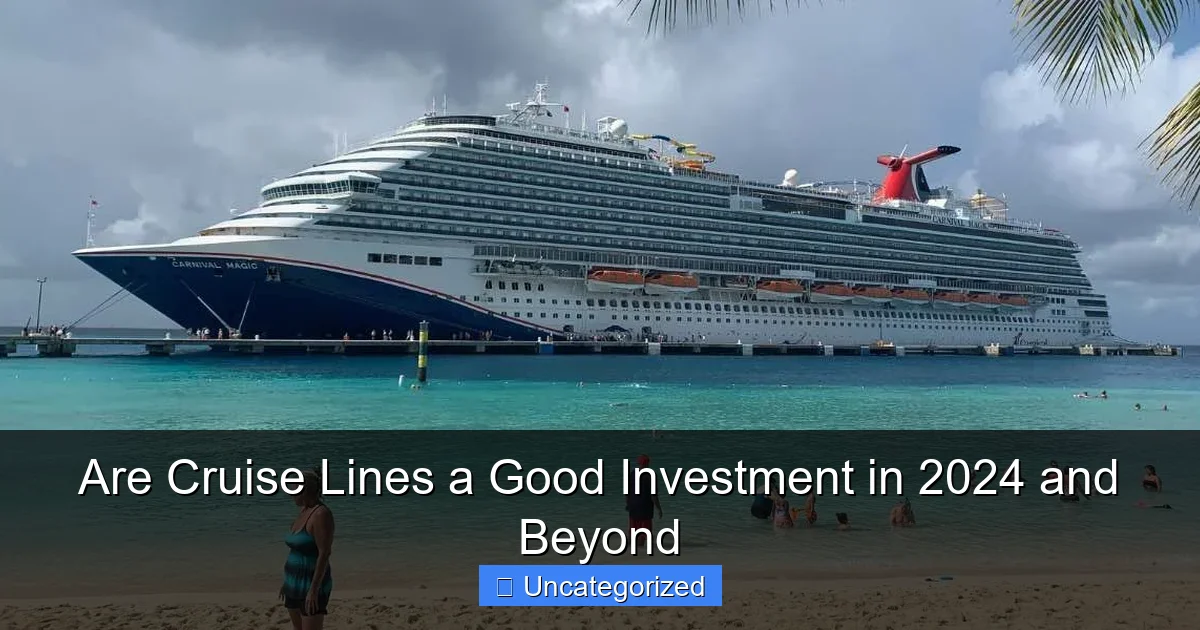
Visual guide about are cruise lines a good investment
Image source: usbusinessnews.com
Financial Performance: Revenue Growth vs. Profitability
2023 marked a turning point for cruise line financials. According to CLIA (Cruise Lines International Association), global cruise passenger volume reached 31.5 million, surpassing pre-pandemic 2019 levels. Carnival Corporation reported Q3 2023 revenues of $6.9 billion, a 60% year-over-year increase. However, profitability remains elusive: Carnival’s net loss for the quarter was $250 million, while Royal Caribbean achieved its first quarterly profit since 2019 ($367 million).
- Key driver: Premium pricing strategies (average ticket prices up 30–50% from 2019).
- Challenge: Elevated fuel costs (Brent crude averaging $82/barrel in 2023).
- Example: Norwegian Cruise Line’s “Premium All-Inclusive” packages now account for 45% of onboard revenue.
Booking Trends: Demand Signals and Capacity Constraints
Forward bookings for 2024 are 30% ahead of 2023, with Royal Caribbean reporting “the highest booking week in company history” in January 2024. However, supply limitations create bottlenecks:
- Shipyards face 18–24-month backlogs for new vessel deliveries.
- 2024 fleet capacity still 5% below 2019 levels due to pandemic-era ship retirements.
- Investor tip: Monitor “net yield” metrics (revenue per passenger per day) rather than headline revenue.
Labor and Operational Hurdles
The industry struggles with staffing shortages, particularly for specialized roles:
- 15–20% wage inflation for maritime crews since 2021.
- Royal Caribbean’s “Crew Connect” program increased retention by 25% through housing and training incentives.
- Operational risk: 12% of scheduled 2023 sailings faced delays due to crew shortages.
2. Competitive Landscape: The Big Three and Beyond
The cruise industry remains an oligopoly dominated by three corporate groups controlling 70% of the market. Understanding their strategies is critical for investment analysis.
Market Share and Fleet Composition
| Company | 2024 Fleet Size | Market Share | Key Brands |
|---|---|---|---|
| Carnival Corporation | 90 ships | 35% | Carnival, Princess, Holland America |
| Royal Caribbean Group | 64 ships | 25% | Royal Caribbean, Celebrity, Silversea |
| Norwegian Cruise Line Holdings | 32 ships | 10% | Norwegian, Oceania, Regent |
Smaller players (MSC, Virgin Voyages, Disney) collectively hold 30%, with MSC aggressively expanding via newbuilds.
Differentiation Strategies
Royal Caribbean’s “Experience Economy” focuses on onboard attractions:
- Icon of the Seas (launching 2024): $2 billion investment with 20+ dining venues and a waterpark.
- Partnerships with DreamWorks and Starbucks drive premium pricing.
Carnival’s “Mass Market” approach emphasizes affordability:
- 30% of cabins priced under $1,000/week (2024 average).
- Cost-cutting: $1.2 billion in operational efficiencies since 2021.
Norwegian’s “Luxury Niche” targets high-net-worth travelers:
- Oceania Cruises’ “Connoisseur Collection” offers 120+ shore excursions.
- Regent Seven Seas maintains all-inclusive pricing (average $1,500/day).
Emerging Competitors and Threats
New entrants like Virgin Voyages (adults-only) and Ritz-Carlton Yacht Collection (ultra-luxury) are carving niches. Meanwhile, river cruises (AmaWaterways, Viking) grew 40% YoY in 2023, pressuring ocean cruise pricing in Europe.
3. Financial Health: Debt, Liquidity, and Capital Allocation
The pandemic left cruise lines with unprecedented debt burdens. Assessing their financial resilience is paramount for investors.
Debt Crisis and Restructuring
As of Q1 2024:
- Carnival: $29 billion net debt (down from $32B in 2022).
- Royal Caribbean: $19 billion debt with 6.2x leverage ratio.
- Norwegian: $13 billion debt, 5.8x leverage.
Restructuring efforts:
- Carnival sold 13 ships (2020–2023) for $2.1 billion.
- Royal Caribbean converted $1.1 billion debt to equity.
- All three secured $15 billion in new credit lines through 2026.
Cash Flow and Dividend Risk
Free cash flow remains negative for most:
- Carnival: -$1.8 billion in 2023 (vs. -$6.1B in 2022).
- Royal Caribbean: -$400 million in 2023.
Investor alert: Dividends remain suspended since 2020. Royal Caribbean’s CFO stated “dividend reinstatement unlikely before 2025.”
Capital Expenditure and Newbuilds
2024–2027 newbuild commitments:
- Royal Caribbean: 8 ships ($14 billion).
- Carnival: 6 ships ($9 billion).
- Norwegian: 4 ships ($6 billion).
Key risk: 70% of newbuilds use LNG (liquefied natural gas), which faces price volatility.
4. Regulatory and Environmental Pressures
Environmental regulations now pose existential threats to cruise profitability.
Emissions Standards and Fuel Costs
Upcoming regulations:
- IMO 2025: 40% reduction in carbon intensity vs. 2008.
- EU ETS (2024): Cruise ships must pay $90/ton for CO2 emissions in EU waters.
Compliance costs:
- LNG conversions: $150–200 million per ship.
- Royal Caribbean’s 2023 “Clean Ports” initiative cost $300 million.
Sustainability Initiatives
Leading efforts:
- Carnival’s “Shoreside Power” program: 60% of ships now connect to clean port power.
- Norwegian’s “Green Cruising” certification (15 ships as of 2024).
- Investor tip: Monitor ESG ratings (Carnival: BBB, Royal Caribbean: A-).
Port Restrictions and Local Opposition
Popular destinations are limiting cruise traffic:
- Barcelona: 2024 cap of 140 ships/year (down from 270 in 2019).
- Venice: Complete ban on ships over 25,000 tons.
- Impact: 12% of Mediterranean itineraries altered in 2024.
5. Consumer Trends and Market Risks
Demographic shifts and travel preferences are reshaping demand dynamics.
Demographic Shifts
Generational breakdown of 2023 cruisers:
- Baby Boomers: 35% (down from 45% in 2019).
- Gen X: 30% (stable).
- Millennials: 25% (up from 15% in 2019).
- Gen Z: 10% (emerging segment).
Millennial preferences:
- 60% prioritize “authentic local experiences” over onboard amenities.
- Royal Caribbean’s “Adventure Ocean” excursions grew 40% in 2023.
Geopolitical and Economic Risks
Threats to stability:
- Red Sea diversions: 20% of 2024 itineraries rerouted, increasing fuel costs by $150 million.
- Recession risk: 10% drop in discretionary spending could reduce bookings by 15–20%.
- Insurance costs: 50% increase for war-risk coverage since 2022.
Technology Disruption
Innovations impacting operations:
- AI-powered dynamic pricing: Carnival’s “Price Optimization Engine” boosted yields by 8%.
- Biometric boarding: Reduced embarkation time by 30% (MSC, 2023).
- VR previews: Norwegian’s “Virtual Cruises” increased bookings by 12%.
6. Investment Outlook: Bull and Bear Cases for 2024–2030
Weighing the evidence reveals a bifurcated future for cruise line investments.
The Bull Case: Growth Opportunities
Positive indicators:
- Market expansion: 10% CAGR projected through 2030 (CLIA).
- New markets: Asia-Pacific demand growing at 15% annually.
- Asset value: Cruise ships now selling at 20% premiums to pre-pandemic levels.
Best-positioned players:
- Royal Caribbean (strongest balance sheet, premium pricing power).
- Norwegian (luxury focus, lower debt).
The Bear Case: Structural Challenges
Risks to watch:
- Debt servicing: 2025–2027 debt maturities total $28 billion across the big three.
- Regulatory costs: IMO 2030 rules may require $50 billion in fleet retrofits.
- Climate activism: 40% of European travelers now avoid cruise vacations (2023 survey).
Vulnerable stocks:
- Carnival (highest leverage, mass-market exposure).
- Smaller lines (lack economies of scale).
Investor Strategy: How to Approach Cruise Stocks
Actionable advice:
- Short-term (2024–2025): Favor Royal Caribbean (RCL) and Norwegian (NCLH) for recovery momentum.
- Long-term (2026+): Monitor Carnival’s (CCL) debt reduction progress.
- Diversification: Consider cruise-focused ETFs (e.g., CRUZ) to mitigate single-stock risk.
- Key metrics: Track net yield growth, debt/EBITDA ratios, and booking lead times.
Final tip: Avoid cruise bonds due to subordinated debt structures. Equity offers better recovery potential in restructuring scenarios.
In conclusion, the question “Are cruise lines a good investment?” demands nuanced analysis. While the industry’s post-pandemic rebound is impressive, the path forward is paved with both opportunity and risk. Investors with high risk tolerance may capitalize on Royal Caribbean’s premium positioning and Norwegian’s luxury niche, particularly as consumer demand diversifies. However, Carnival’s debt load and the sector’s environmental liabilities warrant caution. The 2024–2030 period will likely see consolidation, with financially robust players acquiring weaker competitors. For those willing to navigate volatility, cruise stocks could deliver outsized returns—but only with careful attention to regulatory shifts, consumer trends, and balance sheet resilience. As with any cyclical industry, timing and selectivity are everything.
Frequently Asked Questions
Are cruise lines a good investment in 2024 due to post-pandemic recovery?
Yes, many cruise lines are seeing strong demand and revenue growth as travel rebounds, making them potentially lucrative investments in 2024. However, lingering operational costs and economic uncertainty require careful evaluation of individual companies.
What are the biggest risks when investing in cruise line stocks?
Cruise lines face high debt loads, fuel price volatility, and sensitivity to economic downturns, which can impact profitability. Investors should also consider geopolitical risks and changing consumer preferences around sustainability.
How does the cruise industry’s growth potential compare to other travel sectors?
Cruise lines offer unique growth potential with rising global middle-class demand and new ship innovations, but they compete with airlines and hotels for discretionary spending. Long-term trends favor experiential travel, a plus for cruise lines as a good investment.
Do cruise line investments pay dividends?
Most major cruise companies suspended dividends during the pandemic and have been slow to reinstate them, prioritizing debt reduction. This makes cruise line stocks less appealing for income-focused investors in the near term.
How do environmental regulations impact cruise lines as an investment?
Stricter emissions rules and sustainability mandates increase operational costs for cruise lines, affecting short-term margins. However, companies investing in eco-friendly technologies may gain a competitive edge and long-term investor appeal.
Should I invest in individual cruise stocks or a travel-sector ETF?
Individual cruise stocks offer higher risk/reward, while travel-sector ETFs (e.g., CRUZ) provide diversification across airlines, hotels, and cruise lines. ETFs are often a smarter choice for investors seeking exposure to cruise lines without single-company risk.